Seeing a lot of discussion about trade-offs related to vibe-coding.
Seeing a lot of discussion about trade-offs related to vibe-coding.
Silicon sampling is the practice of using LLMs to run surveys without talking to any people at all.
Innovations in scamming: Folks are predicting that AI will supercharge scams alongside any technical and administrative innovation. Here’s one example of an unethical use of AI, where an internet-based GLP-1 hub used AI to generate fake product images and before and after photos of smiling patients.
Enh: Describing the development of agentic AI as a natural evolutionary transition naturalizes specific design choices made by specific people at Google et al. It makes it harder, not easier, to find out why this path? Who decided? What was not built?
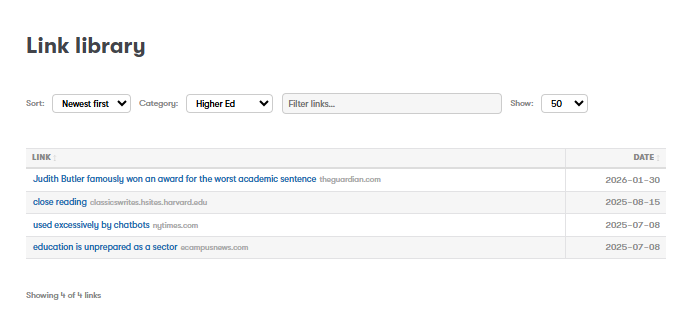
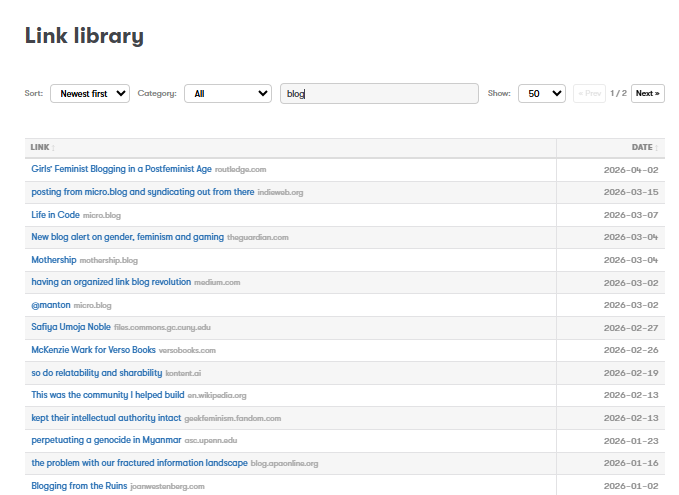
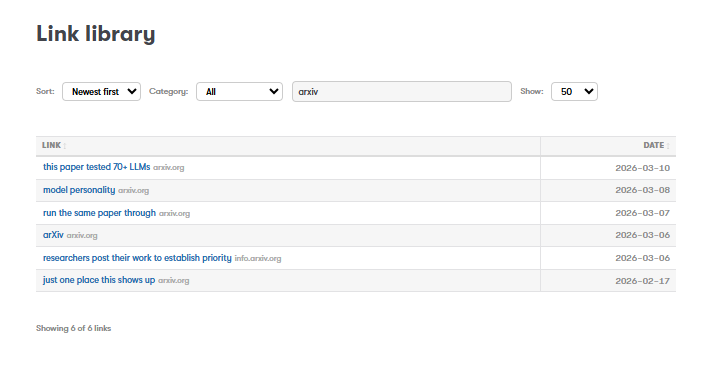
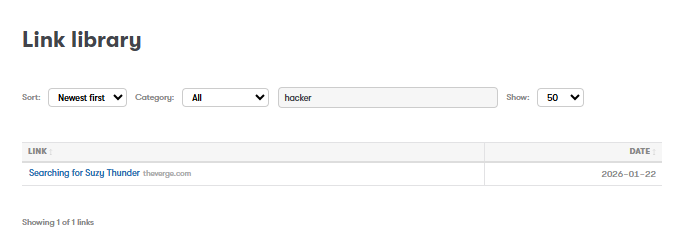
Testing a new feature I created using a mix of open source code and Claude, hoping I didn’t break my own site. I pulled together a dynamic link library using a Hugo partial and some shortcode that automatically catalogs all of my outbound links into sortable lists.
“Last mile” issues around AI in Harvard Business Review. Digital technologies work best in optimal environments, while most real world environments are nonoptimal and arguably non-optimizable.
An observation on feminist writing and Jezebel: Throughout history, a lot of time and energy has been spent mediating how and whether certain kinds of people talk to one another. The feminist blogosphere, for all its faults, was the first time lateral, public, unmediated conversation happened among women at scale. Many kinds of women were there that had no space at other tables. And it was very messy, and very revealing, because it was the first time that happened at scale for all to see.
Some thoughts:
Dip into the Diffusion Bias Explorer to explore how the text-to-image models like Stable Diffusion v1.4, Stable Diffusion v.2 and DALLE-2 represent different professions and adjectives.
What Midjourney (AI) thinks university leaders look like. Of course, the technology reflects old ideas about expertise and leadership, but AI adds the ability to reproduce these biases times infinity.
Another AI writing tell that annoys me is the preoccupation with describing what “exists,” and what is “structural” or “architectural” to an ephemeral idea. LLMs seem tuned to describing physical presence and connections even where they aren’t appropriate and don’t make sense.
A couple of weeks ago I had an interesting convo with Jessica Grose on Threads about the rise of the “Luddite teen” trend. I largely suspect neo-Luddism is a class-related trend and will not be durable. In short, I remain unconvinced that the concern of white collar professionals and parents about the attention economy can be universalized to everyone in the actual economy. This weekend, the NYT reports that the “one laptop per child” goal we’ve been living with in public education may be on the way out, like I hinted in that thread. As the anti-AI backlash develops in real time, it will implicate other tech trends like so.
I’ve been dismayed to find out how much schoolwork happens in Google Classroom in 2026, especially since the COVID shutdown accelerated the shift. My kiddo has received a good deal of math instruction through digital modules, and I’ve learned that if I want her experience to be different, I need to be prepared to pay out of pocket for a private tutor (a scenario taken for granted by much of the commentariat). At the same time, I learned that our local school district is struggling to keep up with the costs of all the hardware and software it committed to over the years, ostensibly for educational continuity, equity and access. Do we need the tech or not? Who decides what it means and how it’s applied? Chicken, egg.
I think it would be foolish to throw up our hands and say the kids need paper and pencil and nothing else, and yet that’s where the discourse is going. I have low confidence that our current landscape will produce a sane and reasonable solution to this tangle – even Haidt is selling you a product here. Until then, we need to consider what it means to offload the costs, accountability, and responsibility for this technology onto school districts, parents, and children, many of whom do not have the time, resources, or know-how to curate an ideal tech experience on nights and weekends.
This post is mostly an excuse to talk about my latest playlist: Digital Animal. This one consists of about 200 songs across genres, all reflecting on our human relationship to science and technology, futurism, digital culture and the internet.
When I’m chewing over a big idea, I like to compile resources in and around that idea to help support my thinking. Embracing my angst about artificial intelligence, I started compiling songs that reach back to the early 20th century, tapping into prior generations’ anxieties about telephones, television and early networking technology, adding more contemporary concerns as I went. The playlist runs from David Bowie and Blue Öyster Cult and Kraftwerk to Zapp and Radiohead, then forward into modern takes on social media, cell phones, and the internet from Missy Elliott, Gillian Welch and Charli XCX.
I like a playlist because it’s convenient, and because songs are one place where meaning and feeling are created simultaneously, and because it’s easy to spot salient patterns across disparate sources. Scholars in interdisciplinary studies have long argued that you cannot fully understand a thing without understanding what it feels like to live with it, and that cultural analysis may get you there faster than surveys will anyway. Meanwhile most writing about technology separates feelings from form and function. Art and music compress all three, and have the potential to surface ideas that professional and institutional language can’t. Art and culture frequently peg an issue down before emerging best practices are formalized in business and academia.
For anyone working in technology communications, that lag between culture and practice has practical consequences. The language we use to describe technical systems shapes what people can think and do about those systems. An institutional frame — efficiency, access, innovation, value — consistently misses important dynamics that people living inside those systems are experiencing as users and as people. Art keeps the human subject inside the frame, functioning as both anecdote and data.
Plus, it’s fun and we should collectively think about art as much as possible. So, treat every song like a portal.
What does it mean to be both digital and animal? Some observations:
Is fretting about our relationship to tech and industry part of the human condition? Or is there something specific to tech that accelerates these anxieties and impulses?
A few favs:
In which the author summarizes artificial intelligence functions that might be reasonably regulated.
A write up on sycophancy in popular chatbots.
The belief that LLMs are intelligent is based on the idea that language and intelligence are equivalent. From November, this article from The Verge argues that idea is a misnomer, instead arguing that we should think of language as a cultural tool we evolved to share our thoughts with one another.
On AI and the value of “taste” in Silicon Valley. As a pretentious hipster reformed, I welcome the return of bad taste as a social dealbreaker. Except for when bad taste is good.
More discussion on how “last mile” problems suggest that stories about massive AI disruption of jobs are hyperbole.
This writer suggests that LLMs used to be pretty cool and creative — read: exceedingly weird — and that corporate tinkering to prepare the tech for a broader market took away some of the magic.
The “stochastic parrot” argument against LLMs has some rhetorical limits.
Author Margaret Atwood plays with Claude and reports back on her experience.
Interesting read: NYT is using a custom LLM tool to track trends within the “manosphere,” as reported by the Nieman Journalism Lab.
A friend of the blog told me a story about a Substacker who uses AI to summarize books and then publishes AI-generated content about those summaries, never reading the books herself, and yet has a ton of followers. I’d guess at least some of those are purchased, betting that a high follower count will beget more followers by suggesting clout and credibility she didn’t earn as a reader talking to fellow readers. And followers aren’t subscribers, but that’s the business bet.
People are lookie-loos, they get curious when something is doing numbers and creating activity, so inflating follower counts is a real and persistent strategy. None of this is new. But best practices still hold regardless of which technologies you layer on top. Marketing erodes trust when it prioritizes short-term gains over honesty and reliability.
It’s strange to live in a time when you can’t reliably distinguish someone who has engaged with ideas from someone who automated the appearance of engaging with them.
Anecdotally hearing about LLMs being weaponized in divorce and custody, including inundating the other party with slop to drive up the opponent’s legal fees. Worse, the sycophancy is tuned to and confirms the aggrieved party’s grievances, regardless of their real-world relevance in court.
Brooke Warner grapples with the implications around authorship and ownership in relation to AI writing, and how it’s showing up in the small publishing business.
A good essay on writing and communication in this time. Ultimately the pickle of AI writing is that meaning is something best made through collaboration.
Forgive me, but I’d like to propose we call this a “sloppelganger.”
Doing numbers on Twitter/X this week: this paper tested 70+ LLMs on open-ended prompts and found they all produce strikingly similar outputs. Worse, the systems used to improve models actively penalize diversity, reinforcing the convergence.
Through a new quiz, NYT asks readers to rate passages of writing against AI. Despite thinking I could spot the AI writing, my results were 50/50.
Come look over my shoulder while I explore how and whether LLMs are good writing tools: Here’s a wee version of the LLM comparison exercise I did with my team. We’ll make it a two-fer so you can see how the “good writing” skill works in practice, though we’ll see how that actually goes.
One of the more useful things you can do with an LLM is hold up a few ideas side by side and apply lenses to them. I know this history pretty well, so I asked a series of LLMs, why is Wisconsin’s cultural identity and cohesion stronger than Indiana’s, from a historical and business perspective?
Here are the answers in one doc, for comparison.
Each LLM will give us more or less the same story, different flavor. Within the industry, the differences across the models reflect “model personality.” Asking “why” instead of “whether” will probably drive the answer to favor Wisconsin. Using multiple lenses (two states, historical + business, identity + cohesion) forces the LLM to cross-reference across more of its training data, which tends to produce a more comprehensive answer.
For all the chatter about consciousness and whatever, remember that an LLM is an infinite series of if/then/elses applied to human language and semantics, so being able to talk about language and communication, getting meta with the tool and how you think through language, helps a lot when using one. This is maybe the one thing I like about experimenting so hard with the tools. I’m thinking about the technical side of writing and enjoying it quite a lot.
Functionally: all of them acknowledge hard historical truths within the subject matter and don’t shy away from critical perspectives, which is good. Both Gemini and Copilot include in-line links, which lets you judge the output’s authority in the moment as a reader. I liked Copilot’s more than I expected here. Claude’s answers are more lyrical and do provide more context, and yet do not encourage checking against outside sources by providing links within the output. And you can see that even with the good writing skill calling out hard bans on certain structure, Claude plows right through them.
Model personality: Claude favors sociological answers to Copilot’s economic answers. Claude is also highly intellectual and narrative by comparison, and that narrative style can mask nuance by sinking relative context within the storytelling. Gemini simplifies, boosts and cheerleads where the others don’t, and really goes hard on Wisconsin’s reputation as a drinking and Packers state when there are stronger structural arguments in play. Copilot is tricky because it looks authoritative like a briefing, which also makes it easily “extractible” for the user, but every citation requires authentication unless this is one of those “good enough” tasks.
As a writer, something I find annoying across the whole spread is the semantic reveal. LLMs are semantic machines, and it is persistently revealed in ways that are weird to the human ear. All of them go out of their way to describe things as “structural,” “connective” as in “connective tissue,” “load-bearing” and “legible.”
Finally, I included a second tab where I asked Claude for analysis across the four outputs, where it suggests that my framing of the question is altogether kind of problematic. It shows how a strong prompt is sometimes also a bad approach.
There are a lot of possible takeaways here, but I’d rather set aside the question of which tool is “good” or “bad” or “better” and think more about the patterns across the tools and their implications.
One of the tricky things about consumer AI tools like Claude and Gemini is that the experience varies widely depending on the person using it, and it’s not always clear why. I have spent a lot of time learning the tools so I can advise on them in my work, and this variance of experience has become a frustrating part of the deal.
I manage a team of writers and creatives at work, and we are expected to be familiar with the tools, despite complex and sometimes hostile feelings about the political and environmental implications of this sector. That’s quite a pickle, organizationally, managerially. Borrowing from Haraway, I thought, okay, what if we take these tools seriously as a team of writers and creatives and put our professional standards up against them?
Among other exercises, I did a couple of comparisons on my team that help create discussion around the “plausibility” question. People dismiss LLM outputs as being merely plausible answers, rather than accurate or factual ones. And that’s correct; they are, and that’s the design. In many cases, plausibility is fine. Take Wikipedia, for example, which we understand to be a pretty good source, a plausible source, unless you’re writing a formal paper requiring original sources.
I digress. Ultimately, we needed to understand together that LLMs are not a WYSIWYG tool and talk through the implications.
I asked everyone to run the same paper through their LLM of choice, prompting it for a plain language summary. We then copied and pasted it into a shared doc, and compared and contrasted for discussion. Upon discussion, we had several takeaways, including that they were all similar in spirit but sometimes varying wildly in style and approach.
Knowing that algorithms are responsive and not static, we did it again later in the day and copied and pasted our outputs into the shared doc. We compared and contrasted the difference between AM and PM. Again, it was similar in spirit but varied in style and approach. Some changed dramatically. One team member whose morning summary had been jokey and conversational received a much more staid and serious version in the afternoon.
At the time, I asked Claude to explain the variance: “Even with the same prompt and source material, LLMs don’t produce identical outputs each time. This is by design — there’s a degree of randomness (called “temperature”) in how the model selects words, which means each run produces a slightly different path through the text.”
Anyway, this got our gears turning on how (and whether) to approach LLMs as a team and as individuals and led to good group discussion. (It’s important to create space for criticism and critical approaches here.) It also gave us more confidence as a team responding to this new layer of complexity in our work, and helping our professional contacts and peers think about how to approach the tools and when and whether to use them. There will be tasks where AI-based tools are “good enough,” and tasks where they are not.
The swirl of mystery and speculation around this sector has people up in arms, and it’s useful to have approaches that give people firsthand experience and to see how the experience works for others. The god trick of the singular interface turns out to be a bear for navigating it in the workplace, where our work is foundational, prosocial and specific.