A note on Ezra Klein: I’ve been looking across the NYT’s breathless reporting on the AI industry and seeing very few women represented across the commentary. Klein’s tech coverage tends to center a fairly narrow circuit of sources: founders, researchers, and policy thinkers who are overwhelmingly male and concentrated in a few institutions, and generally assert the inevitability of disruptive AI as a matter of course. Meanwhile, Anthropic and others are anticipating that career ladders where women are concentrated will be impacted, some claiming professional women’s jobs will dry up or disappear entirely.
I looked over his podcast guests for the last year and noticed that among his tech-focused guests, almost all white, almost all men, almost none of them are women. A rough count of eight podcasts (nine if you stretch) with accompanying commentary only produced two women, both economists. Klein’s brand is the guy who does the reading, the big ideas guy. So it’s worth asking what he’s reading and whose ideas he considers big. While he probably wouldn’t disagree with Gebru or Crawford or Noble on the substance, his current body of commentary is pulled toward the perspectives of people who have the most to gain from the technology’s expansion and the least exposure to its costs.
Some notes on arXiv: arXiv is a preprint server hosted and maintained by Cornell University, where researchers post their work to establish priority and get it in front of other researchers quickly. This kind of server is common in emerging fields, to help build a body of shared knowledge among researchers, and fast.
With all the speculation around AI futures, arXiv papers are suddenly hot content on Twitter/X, paired with aggressive forecasting and commentary. This is causing a lot of ruckus among the ranks. arXiv papers are a-okay to reference as sources of current AI research, but I’d flag a couple of things: they’re technical documents written for other researchers, not press releases or news coverage, so the claims in them are often much narrower and more specific than how they get interpreted and reported.
She draws on Acemoglu and Restrepo’s concept of “so-so” technologies and traces a pattern from MOOCs to DOGE, where each iteration promises transformation but delivers incremental improvements at best and labor displacement at worst. The real danger, she argues, is that AI’s most compelling use case in the current political environment is threatening, demoralizing workers and justifying cuts, not revolutionizing how work gets done.
Cottom has been one of the writers I keep returning to because she is not dismissing the technology or retreating into reactionary nostalgia. She looks past the product announcements to the political economy underneath them. Who benefits from the hype cycle? What happens to the institutional infrastructure (education, research, public expertise) that AI claims to augment and simultaneously threatens to starve? She’s also very active on Instagram (and promoting a new documentary) and tracing the news around AI and higher ed in real time.
A smart take on nonconsensual deepfakes, considering them not just as a social issue but as a cybersecurity issue, as they’re often connected to broader financial and social harassment campaigns.
LLMs have a default house writing style with identifiable patterns: sentence fragments for emphasis, “not X, but Y” constructions, lots of hard contrast, atmospheric openings, heavy use of em dashes, and heavy use of marketing language. This reflects the semantic construction of an LLM. Custom instructions can override these defaults. A custom skill is a set of instructions within your account that modify how the model generates text. When you paste instructions into your profile settings, Claude reads them at the start of every conversation and adjusts its output accordingly.
I began using Claude daily for light writing tasks about six months ago, and over that time I started cataloging the patterns I was consistently editing out, including the terrible “not X, but Y” construction that showed up in nearly every response, and persistent em dashes used as all-purpose connectors when other punctuation is more appropriate.
I went through several iterations of bullying Claude into submission, narrowing the scope each time, before arriving at this version, which focuses specifically on writing mechanics and hard prohibitions.
You’ll need a paid Claude plan (Pro, Max, Team, or Enterprise). Free-tier accounts don’t have access to custom skills.
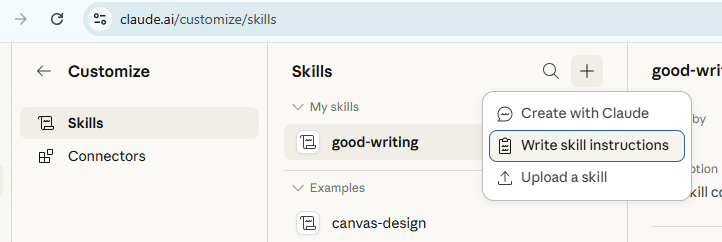
• Within the app, navigate to Customize > Skills and Create new skills
• Select add a new skill and Write skill instructions
• Copy and paste the copy from this file into the skill, making note of the name and description boxes. Feel free to tinker.
• Save your changes.
Note: The instructions in the linked file are Claude’s work, not mine. They came out of months of conversation, where Claude would analyze my style notes, and the file evolved from there. They read a little strangely because of that process. If I’d written them from scratch, they’d sound different. But looking at the file you can see what Claude responds to and how it works.
Claude will apply these instructions to every new conversation going forward. Existing conversations won’t pick up the change, so start a fresh chat to test it. If and when Claude struggles to apply the skill, call it out specifically in the prompt, such as, “Revise this for length using the good writing skill.”
The skill specifies constraints in a few categories and the instructions are plain text. As you go, you can also ask Claude to analyze previous conversations for suggested additions to the skill, which Claude will produce and implement within the chat. Each rule operates independently, so removing one doesn’t affect the others.
Claude processes custom instructions at the start of every conversation, before it generates any output. The instructions function as constraints on the model’s default behavior. The model doesn’t always follow every instruction perfectly and the results vary by task. You will still need to edit.
This new report from Anthropic is depressing at best, as it tries to measure which employment sectors carry the most exposure around AI expansion into the economy. In short, the tech is likely to impact two groups the hardest: educated professional women, and young workers for whom the career ladder will never materialize. In a right-side-up world, this would change the political dynamics of any policy response considerably. In this one, I don’t know.
Anthropic’s positioning here is curious, very god tricky. They are claiming the mantle of responsibility and transparency while predicting an inevitable end nobody wants, that they’re also selling as a service.
I still think much of the forecasting is oversold – the tech performs well in optimized environments, and last mile issues are a perennial concern in any engineering venture because the practical world is non-optimal. Time will tell, and there are big incentives in play. But the hunger and animus around the forecast feel bad.
I have pretty strong feelings against the use of AI around military operations, based on my hands-on experience with the tools. When the tech’s creators say the tech isn’t ripe for warfare, that’s strong feedback. And I agree, with the risks and implications around trust, marketing and hallucinations, it’s not even really ripe for the consumer marketplace, much less drone warfare. Whether or not artificial intelligence tech should be used for war is, of course, at the root of Haraway’s thesis, which we like to noodle with around these parts.
You might call this a taste test: Obsessed with the story about the McDonald’s CEO and how his LinkedIn-style videos selling the McD’s franchise have escaped containment, leading to one of the funnier CEO/product marketing dynamics in recent history. Burger King’s CEO swooped in, holding widely-marketed listening sessions with customers and to demonstrate his love for the Whopper in contrast with the deeply weird McD’s videos. Must read: Internet long-hauler Katie Notopoulos on how direct-to-public marketing works when the public is more familiar with the product than the org’s leaders.
My teenager thinks fast food is cool and subversive (cue the sound of one hundred moms groaning) and she and her friends regularly talk shop. They are Taco Bell fans and think burger stops are kind of gauche. Not gauche: Baja Blast.
Apparently one thing LLMs excel at is deanonymization at scale. The original promise of pseudonymity online was social and normative, over and above any question of technical depth: decent people don’t try to unmask you, because why. What strikes me today is how what used to be unacceptably antisocial behavior online is now both automated and unremarkable.
Over the last couple of weeks, I asked a couple of chatbots what could be known about me from this pseudonymous site, where I am more intentional about what I choose to reveal and conceal. It pulled the obvious but also drew conclusions based on a few geographic points I’d made in context that were both revealing and correct. I also noticed that it only drew from the top two pages of information - anything beyond page two of posts wasn’t part of the compute. Archives are for humans?
People assume that there is some computer magic on the backend where the LLMs connect all your account logins behind the scenes, but no, in fact it does all this through inference, by linking your digital trail, your friends, your breadcrumbs of likes and hearts and follows, and obvs your posts, into a picture of who you are, practically and demographically.
The Guardian has a long-running series where readers answer one another’s questions, which gives a pretty good point-in-time survey of how people of a certain demographic are feeling on a given subject. This week’s question is on AI futures: “what would happen to the world if computer said yes?”
It’s an old idea, and one I’ve been drawing from while I tinker with Claude, which is purportedly the best in the game. The “god trick” is baked right into the AI interface: one input, one output, an authoritative-seeming answer, offered without named perspectives behind it, trained on text produced overwhelmingly by a narrow demographic who has historically had access to both literacy and publishing, by programmers and new media drawing from the same well. Smushed together, it gives the impression that consensus exists where there are in fact many, many loose ends.
I increasingly find it annoying that even “good” AI outputs seem fixed on phrases like “key,” “core,” “exist,” “actually,” “never,” and possibly the worst sentence structure of all time, “it’s not X, it’s Y” — and I’ve begun to recognize how LLMs work like autocorrect for and idea, drawing from ranked search sources first before fanning out to more obscure sources, trying to determine and assert what’s important to me, a user known by demographics and data. It feels like a big linguistics machine, which is pretty cool in some regards, but also aggressive. The math doesn’t always work to connect me to what I want to find because I am situated in my individual context in ways LLMs are not able to understand, with my memory, in my body, with my unique experiences, which shape and translate meaning for me as I interact with the world (and the web).
And so for you, in your body and memory and experience. An LLM can approximate the outputs of an experience without having access to the experience itself. Sometimes this is useful, sometimes it’s reckless.
An open letter from employees of Google and OpenAI in support of Anthropic, against the DoD: notdivided.org
I’ve been spending more time in tech spaces online and getting good information from folks like @manton, creator of Micro.blog. Like this reflection on how to think about AI now that vibe coding works. Something I’m thinking about: there’s an emerging tension between those who see value in being able to immediately prototype an idea and the people downstream who have to manage the outputs/code over time. The ability to proof every idea sounds like a superpower until you’re the one driving and maintaining the results.
Some additional discussion of LLM models, including open weight and “staggered openness,” where orgs “release previous versions of proprietary models once a successor is launched, providing limited insight into the architecture while restricting access to the most current innovations.”
“Open source,” “open weight,” and “proprietary” describe different relationships between LLM model producers and users, governing what you see, modify and control. Comparing them isn’t necessarily about “best,” but whether you’re optimizing for transparency, compliance or performance. Massive investment in proprietary models means the best-resourced research teams, the largest training runs, and the most sophisticated safety work tend to happen behind closed doors.
The last time I went truly viral was in April of 2020 in the height of the COVID shutdown. I posted a tweet and walked away from my phone. By the time I checked back, my notifications were out of control.
The next morning, I got a message from an old friend familiar with my handle. “I think I saw your account on Good Morning America?” Hilariously, there I was, and I couldn’t even claim responsibility for the meme.
I’ve spent most of my time on the internet as a pseudonymous account, using my first name only, or using a handful of handles (incl feministe, fauxrealtho, flotisserie, paired with punny names like “Petty White” and “Frieda People,” a convention from the Tumblr years). Even as a visible personality online, I was only known by my first name and URL and/or handle. In recent years I de- and reactivated some of my socials, so some of these breadcrumbs no longer exist, but I’ll do my best.
Pseudonymity allows writers to explore complex ideas in digital spaces while protecting their identity, location, and other identifying factors, while also maintaining a throughline of identity and storytelling.
There are a lot of trade offs in using a pseudonym, especially around how to claim credit for your work. But people use them because they give you the privacy to be honest, real, weird, authentic, and to escape the creep of modern social media presence into high stakes spaces like the workplace. This dynamic was kind of the impetus behind the era of “weird Twitter,” where people using pseudonymous social handles routinely threw out funny, absurdist one-liners to impress their friends and followers, while taking a turn at the social media slot machine. Not every post or joke lands in a way that converts to numbers, but some do, and it’s fun to try.
I’ve written a little previously about how the English program I was a part of used fiber arts to illustrate the fundamentals of technical writing, but one of their other methods of teaching the internet was through board games. Games, like the internet, and much like writing, provide rules and structure for communication and engagement, but everything that happens inside the container of game board and game play is a mystery until it emerges through human interaction. So goes the internet (and to some extent, so goes AI). Games and gaming were used as a method to think through what it means to create rules of play, then let a community rip through the model – and many of the thinking and skills involved around game design apply in social digital spaces, from chat rooms and Teams channels to the open seas of the WWW. The longer you’ve been playing the slot machine, the more you get a feel for the kind of thing that will get seen and read, and who among your readership will take your content to the next level.
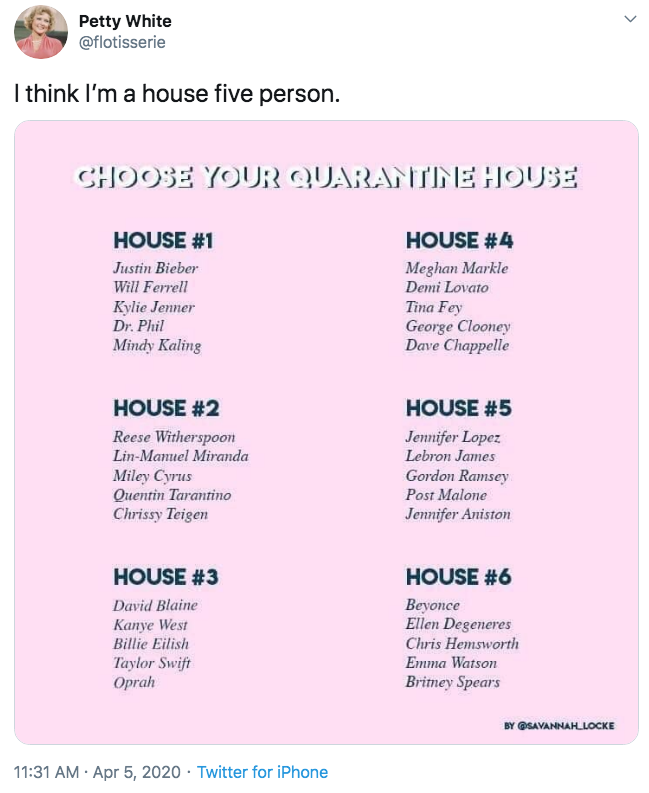
The meme was a list of six hypothetical celebrity households: pick one to quarantine in.
It had been circulating on Facebook, started by a Christian influencer named Savannah Locke. I encountered it deep in a Real Housewives fan group, and felt the pull of a good parlor game. In April 2020, everyone I knew was sitting at home, fretting about the COVID-19 pandemic looming over all of us, so I shared it with minimal ceremony, a couple of buddies with a slightly larger following hit retweet, and within two days the tweet was being cited by The Cut, Time, the Washington Post, ABC News, and others. Know Your Meme documented it for posterity. Several outlets named me as the originator, but trust, I was only trying to delight my friends with low grade Facebook content. I couldn’t find the original meme at the time – Locke appears to have had a name change that scrambled my search. But hey, as these things go, nobody earned a dime or promoted anything weird, so no harm, no foul. Business Insider managed to credit it correctly, so a special kudos to their editor.
The core game mechanism behind the meme is forced choice: constraints generate opinions and opinions generate activity. Each “house” also represents a personality type. House 3 is chaos, House 6 is aspirational, House 5 is the one where someone is definitely cooking and someone is definitely yelling about it. The choices are arbitrary, which invites curiosity about who grouped what and why. In short, this meme offered a light conversation starter at the right time, with low stakes, high personal reveal, and endlessly discussable combinations. It also drew from existing memes and games that are popular online, like “where you sitting” in the proverbial lunch room. This one became news because of the timing and gamability, not because I was particularly clever, but hey.
What does it feel like to go so viral? It’s hilarious, strangely affirming, and also a little crazy-making. It opens the door to a whole lot of wild people and ideas on the internet, not all of them flattering or welcome. Virality is sometimes paired with incredible harassment and requires “more condolences than congratulations.” But as far as this particular experience went – hilarious, whoops, and wow. It just felt like a Lebron James, Post Malone and Jennifer Aniston hang would be a good time.
Making the rounds on social today: New study suggests that while 70% of financial firms use AI today, 80% report no impact on employment or productivity.
Haraway (obvs) suggests we stick with the trouble, that sometimes our very presence in the room is what’s required to trouble existing narratives, and that it’s important that share what we learn back to our people at home, whatever that means in our context.
For me: I spend a lot of time at work translating technical ideas and projects in an institutional voice, but on nights and weekends, I’m explaining the ins and outs of the internet to my working class friends and family. Increasingly, I’m asked to explain LLMs and AI and how it relates to their needs around business, the news, entertainment, and as a legal aid.
The “cyborg’s mark” is a metaphor for writing, our duty to translate, and the inevitability of translation through experience. Perhaps staying with the trouble allows us to articulate our experiences in and around the science in ways that both advance our interests and that keep our communities safer. For those of us who straddle multiple worlds, translation is a responsibility.
Widespread AI adoption reopens some basic questions in business: who your audience is, what work can reasonably be automated, what absolutely requires human oversight, and how the service and information environment actually holds together when we shuffle these circumstances around. All this, with many social and environmental risks and a side of existential doom.
I suspect the predictions of economic and social doom are overblown by a lot – in life as in business, generalisms are easy and specifics are hard. Last mile issues remain a reality of nearly any technical or software implementation, and differentiation is in many ways the art of business. There are serious incentives to promising a smooth, profitable near-future, especially around emerging markets, so I feel pretty comfortable forecasting that the era we currently live in is valuation masquerading as value. Instead, I think we should worry more about how the tech changes our relationship to information and to each other.
The dominant conversation is about whether LLMs can write well, but I suspect that’s the wrong frame. Human storytelling will probably always be more interesting than generated storytelling, because humans love quirks and novelty that can’t be produced artificially.
The more consequential change is that AI-generated text doesn’t just sit on the web waiting to be read, and instead feeds back into the system that produced it. It becomes training data, source material, and eventually, architecture. Remember: When an LLM generates text, it’s producing word sequences based on statistical patterns. The output is one plausible version to your prompt, not a definitive one — but it gets indexed, linked, and cited like any other writing. Nothing about its surface tells you it doesn’t carry the same authority.
Researchers call what follows “model collapse,” a feedback loop where models trained on AI-generated content lose touch with the range of human-produced data. The rare and specific details disappear first, then the middle narrows. Eventually what’s left is smooth, confident, increasingly generic text that sounds authoritative whether it’s accurate or not, which becomes the training data for the next round.
I’m thinking about it in terms of the shift from SEO to GEO. SEO preserved a connection between writing and human judgment. Someone wrote content, search engines indexed it, readers got a list of links and decided which to trust by comparing to their own experience and knowledge. This system was gameable through various sleights of hand, but it assumed a reader with agency. The creator’s job was to be easy to find and worth finding. Streaming video complicated this process but still worked with the same basic ideas. Meanwhile, GEO operates on a different premise. The goal isn’t to get found by a person, but to be found by an algorithm assembling a response the user may or may not independently verify.
Consider what happens to the same piece of writing in each system. In the SEO world, your article gets indexed, shows up in search results, someone clicks through, reads it, evaluates whether you or your institution is credible on the topic, maybe skeets it or sends it to a colleague. A human encountered your work, weighed it and decided it was useful, the algo responds and indexes accordingly.
In the old way, the reader moved through the web. AI yanks that experience into a single response from a single interface. We don’t fully understand how AI systems decide what to cite, which makes this power shift feel especially risky. Worse, different people will get different responses from LLMs, even using the same prompts and source materials. We don’t know why.
Fewer entry points to the web means fewer opportunities for diverse or unexpected sources to gain traction, which means the training data gets narrower, which means the outputs get more generic, which means the architecture narrows further, which means fewer perspectives represented in the output. For the reader, it accelerates context collapse in much the same way. Fewer inputs means fewer opportunities to stress test your ideas against new information.
So, what to do?
If generative AI grows as predicted, SEO and GEO will coexist for awhile, and working developers and communicators will need to understand both and how they layer. Strong SEO foundations give you a great head start in AI visibility too, so the fundamentals of good writing and web taxonomy still matter a lot.
But the production of knowledge, the keeping of data, and how it’s all indexed are subjects that are about to become very important, and very political. So I suspect that any fields that touch those topics will also become very important, and very political, very soon.