This post and the accompanying graphs have been a trending topic on social all weekend, particularly on Twitter/X, which is negatively implicated in the findings. In short, social media looks weirder than ever.
This post and the accompanying graphs have been a trending topic on social all weekend, particularly on Twitter/X, which is negatively implicated in the findings. In short, social media looks weirder than ever.
Silicon sampling is the practice of using LLMs to run surveys without talking to any people at all.
Innovations in scamming: Folks are predicting that AI will supercharge scams alongside any technical and administrative innovation. Here’s one example of an unethical use of AI, where an internet-based GLP-1 hub used AI to generate fake product images and before and after photos of smiling patients.
Enh: Describing the development of agentic AI as a natural evolutionary transition naturalizes specific design choices made by specific people at Google et al. It makes it harder, not easier, to find out why this path? Who decided? What was not built?
I heard a good talk on “slow brain” activities this week and have been thinking about that alongside indie web practices. I’m not alone: how to leave your feed and go exploring again.
A collection of articles that answer the question, “Why have a personal website?”
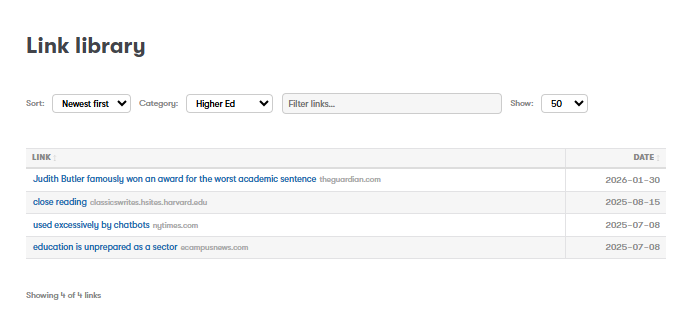
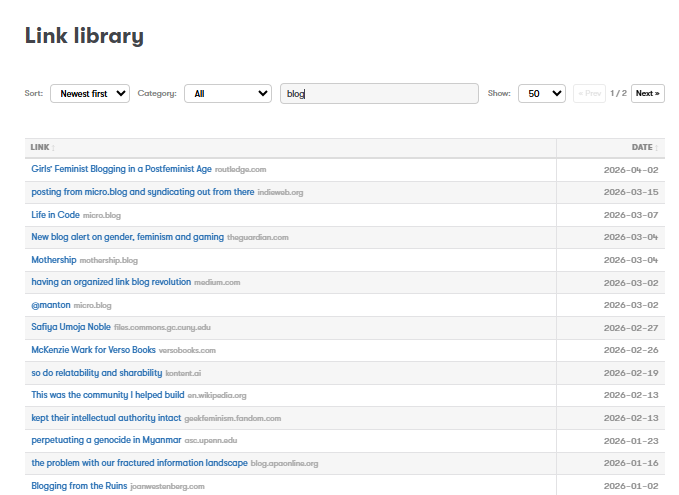
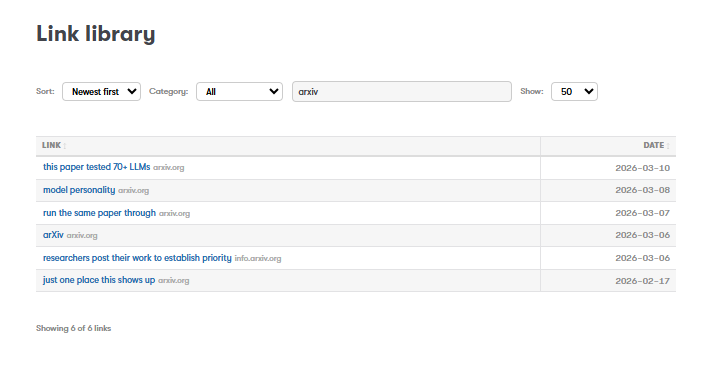
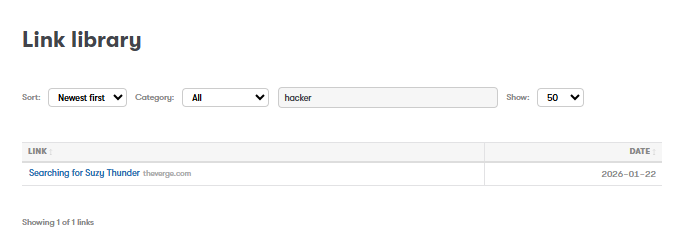
Testing a new feature I created using a mix of open source code and Claude, hoping I didn’t break my own site. I pulled together a dynamic link library using a Hugo partial and some shortcode that automatically catalogs all of my outbound links into sortable lists.
Just ran across Paul Robert Lloyd’s talk on using tools and approaches from the indie web to build the Internet we want. Talking points and slides at the link.
Playing with a link archive that produces a sortable list of each of my outbound links. An okay start.
The cost of moving to token-based access to tech, rather than seat-based licenses based on employee headcount.
If digital millennials are interested in what was being written about them when they were going off on Tumblr, they should read “Girls’ Feminist Blogging in a Postfeminist Age” by Jessalynn Keller.
Another cool and relevant resource related to digital feminisms, “Digital Black Feminism” by Catherine Knight Steele. This work pulls narratives from existing literature about Black women’s technology beginning in the 19th century, linking ideas, fields and methods across the work of many writers.
While poking around for other academic sources on feminist blogs, I found this article from 2016, “The Trouble with White Feminism: Whiteness, Digital Feminism and the Intersectional Internet.” The complete article is embedded in the page.
In 2007, S&F Online dedicated an entire issue to feminist blogs with essays on race, anonymity, access and audience. The blogs are mostly dead links now but the academic record holds up. Important names: Clancy Ratliff, Tedra Osell.
The first woman I found online was Shelley Powers of Burningbird, around 2000-2001. Then, if you wanted to read women writing about technology (or anything else) with any critical depth, you had to go looking because those writers were not respected or recognized by brick and mortar institutions.
“Last mile” issues around AI in Harvard Business Review. Digital technologies work best in optimal environments, while most real world environments are nonoptimal and arguably non-optimizable.
An observation on feminist writing and Jezebel: Throughout history, a lot of time and energy has been spent mediating how and whether certain kinds of people talk to one another. The feminist blogosphere, for all its faults, was the first time lateral, public, unmediated conversation happened among women at scale. Many kinds of women were there that had no space at other tables. And it was very messy, and very revealing, because it was the first time that happened at scale for all to see.
Some thoughts:
Being a writer for pay is an unusual and vanishing proposition, according to Baffler. “Fifty-six percent of the respondents rely on side jobs to survive.”
Dip into the Diffusion Bias Explorer to explore how the text-to-image models like Stable Diffusion v1.4, Stable Diffusion v.2 and DALLE-2 represent different professions and adjectives.
What Midjourney (AI) thinks university leaders look like. Of course, the technology reflects old ideas about expertise and leadership, but AI adds the ability to reproduce these biases times infinity.