A new study suggests that countries who report more positive experiences with social media also feel more positive about AI. It seems to come down to tech regulation and trust.
A new study suggests that countries who report more positive experiences with social media also feel more positive about AI. It seems to come down to tech regulation and trust.
New numbers from Pew Research on how teens used social media and AI chatbots in 2025.
I just completed my first attempt at coding using AI, in this case having Claude assist me with putting together a simple client-side OPML parser using Dave Winer’s Feedland service.
Winer’s original script is pretty slick, and includes a list of all my feeds with titles, URLs, and categories; click-to-expand functionality to see the 5 most recent posts from each feed; clickable post titles that open articles in new tabs; sort options (by title or by update); and automatic updates when I change my FeedLand subscriptions.
You can check it out here: Feeds
The official documentation method didn’t initially work because Hugo (the blogging software behind micro.blog) was wrapping client-side templates around the script. The toolkit requires server-side dependencies that don’t exist on static sites like micro.blog, and we hit a cascade of missing JavaScript dependencies (jsonStringify, servercall, etc.). Each fix revealed another dependency, leading to some “sunk cost” frustrations for me. I kept trying because I wanted to see if Claude could pull it together. Through trial and error, I got to a point where the OPML file was rendered correctly without server dependencies or complex external libraries.
Time invested: ~3 hours (including wrong turns)
Time it should take: 10 minutes
AI extended my code reach beyond my practical skillset by quite a lot. I now have a dynamic and dedicated place to read and share news feeds as I wish. Though even when generative AI works and works well, I have significant concerns about the intellectual property implications of AI, and this project brought those tensions into sharp focus. The AI could only help me because it was trained on documentation and intellectual work from the open source community, contributions made freely in the spirit of knowledge sharing, not to train commercial AI systems. I tapped into their expertise by paying Anthropic $15 a month. While I’m grateful for the accessibility this provides to non-developers like me, I recognize there’s an unresolved ethical question about whether this use respects the intent and labor of the original creators. The feat is incredible; the foundation it’s built on deserves careful consideration.
After the exercise was complete, I asked Claude how I could have improved my prompting to make this process easier, and in short, Claude said I could have been a web developer. But since I’m not, here’s what it recommended:
✅ When the process isn’t working, question the process mid-stream. Most people either give up or keep following bad advice deeper into rabbit holes. Stop and question the LLM’s process and ask for alternatives to force a reset.
✅ Push for usability. Keep bringing the conversation back to what you actually need the end result to do, not what’s technically impressive or “correct.” In my case, this meant repeatedly asking “can I click through to the articles?” rather than getting lost in discussions about CORS proxies or JavaScript syntax. Focus on outcomes, not implementation details.
✅ Ask for complete solutions. Instead of trying to mentally patch together incremental changes across multiple responses, ask the LLM to provide fresh, complete code each time. This prevents copy-paste errors and ensures you’re always working with a coherent, tested solution. There’s more than one way to crack an egg, but you want the whole egg regardless.
After all that, I got it to work but can’t figure out how to make it show up in my header menu, with or without Claude. TBD.
In recent history I stopped posting on most social media and moved to the fediverse. I still browse the social platforms to keep up with trends and friends, but I only post on my private IG and here.
What I share here is separate from but related to my professional life — I’m thinking out loud and making room for rough, unfinished ideas. I write mainly for myself, but if others find it useful, that’s great. The practice of reading and reflecting makes your thinking stick, and I am from a certain time and place, so this is how I approach learning and communicating about what I’m learning. It’s a habit.
While this is my preferred approach, I acknowledge that sharing unfinished ideas publicly is risky and you have to accept accountability for the messiness that comes with that. But I also know that working through your vulnerability through the act of writing lets you tap into your most creative, innovative self and test your ideas against an evolving sense of what’s good. The potential for an audience, however real or implied, keeps you more honest and less self-indulgent. Despite the trade offs, I think it’s worthwhile.
As I add to this page, I’ll be thinking out loud about digital rhetoric and communication alongside emerging technology, and linking back to foundational ideas I see reflected online today. Occasionally I’ll say something longer.
Big news in ecommerce: TikTok Shop is now bigger than ebay.
While I’m cleaning up the cruft around my social presence, I’m finding more references to the heyday of blogging that explain how people organized online (Web 1.0) before the era of platforms (Web 2.0). One is this interview with Jill Filipovic, my one-time co-blogger and comrade at Feministe, with the folks at LGM who interviewed me on the subject a few years ago. Jill and I differed (and still do) on the meat of many issues, but have a lot of our thinking in common about how to handle disagreement and advance our ideas in common (and risky!) spaces. She’s welcome in my foxhole anytime.
I appreciate this oral history project by LGM because the articulation of our processes then (before automation) provides a lot of instruction about how to organize and think about communication outside of increasingly toxic and irresponsible social platforms today. One idea that is relevant today is around pluralism. In our case, we practiced pluralism on subjects and perspectives within a defined domain, “feminism.” In practice, making it work before true automation meant we lived with a lot of decision points around moderating a raucous community. Back then, we had our CMS and set up a list of community expectations, iterating as we went, then let the community rip. Collectively, this approach created a robust and vibrant interactive community of peers and moved our interests forward as a cohort. Between her interview, where she talks through the decision points we faced, and mine, where I talk more about the tools and their limitations, there is a lot for people who want to organize people digitally while thinking outside of the algorithm.
There are certain pieces of writing I return to when thinking about our relationship with technology. Donna Haraway’s “A Cyborg Manifesto,” published in 1985, is one of them. Despite being forty years old, it continues to offer insights into how we understand technology’s role in our lives.
Haraway used the cyborg, a hybrid of machine and organism, as a metaphor for understanding identity in an increasingly technological and scientific world. Her central argument was this: because the traditional boundaries we’ve relied on are breaking down with the rise of STEM, computers and factory automation, a tenuous new order is emerging, blurring the lines between human and machine, physical and digital, natural and artificial, gender and biology, moral and immoral. The world order was undergoing a remodel, the guys were designing the game board for the next era, and she worried that refusal meant catastrophic and strategic losses to research, creating the cyborg metaphor to challenge her cohort to consider her angle. Many women in academia resisted the political push for STEM, concerned about the impact on the humanities. This was critical stuff in the mid-1980s, especially in a global (and academic) context of collective civil rights struggle across very different coalitions, amid the science and all of its implications. She wrote it as a salvo appealing to fellow academic feminists not to be so skeptical of new and emerging computer technology that they lose on emerging opportunities. To her, the implication of these new technologies meant new political landscapes and platforms for discussion and iteration.
Haraway challenged the either/or categories that dominate these debates: online versus offline, human versus machine, authentic versus artificial, even good and bad. Instead, she proposed we’re already living in a world of hybrids and overlaps and contingencies and compromises, where identity and experience are shaped by our relationships with technology and science and capitalism rather than existing separately from it. Whether you wear glasses, take daily medicine, strum a guitar, drive a car, or regularly log into a device for work or leisure, our lives are heavily augmented by layers of tech already. Your cyborg self is already here. We are already deeply technical creatures, living in concert with machines.
Haraway invites us to dabble in the Matrix, to take off your trench coat and stay awhile, to see what it feels like in the moral relativism and ambiguity. Within this web of complexity lies a lot of opportunity.
Tl;dr: the cyborg metaphor is a permission structure and a thought exercise: Instead of asking if or whether to accept tech, she asks you to consider something more pragmatic, how your cyborg self might use and shape technology to assert your particular existence, politics and interests across the network. This is an if/then that is simultaneously empowering, cynical, dystopian, ironic and futurist, but allows us to set aside some limiting binaries and narratives when thinking about the specter of new technology.
I miss Twitter because I’m full of big opinions and inappropriate one-liners. Anyway, here’s an analysis from WIRED on the implications of this month’s AWS outage.
Very much enjoying the Netflix series “Dark Winds,” based on the series of novels by Tony Hillerman. Not only does the storytelling slap, but it’s visually beautiful, with sweeping Southwest vistas and a fleet of classic vehicles that look so good in widescreen.
Purdue Exponent students distributed 3,000 copies of a special “solidarity edition” newspaper in Bloomington after IU spanked their student paper for insubordinance, ending the IDS print edition and firing their director. The media landscape in Indiana is bleak, generally, after years of disinvestment, so student reporters fill a social and political gap that the free market left behind. Given those conditions, the wider community depends on student media, much like public radio, to fill the information gaps. Also, these campuses are situated in communities where it can be very socially uncomfortable to be a squeaky wheel. So. As alum, I’m proud of the Exponent for this brave and newsworthy show of heart. 💐
Gap capitalized on the Sidney Sweeney “good genes” controversy by doing this collab with Katseye, the global pop group where each member is a different nationality. Each member of the pop group dances through in black and brown jeans.
I graduated from college right before the 2008 recession and bounced through some unpromising temp jobs until an opportunity emerged for a permanent position. Sometimes you just need to get in where you fit in, and so I did. That’s how I came to work for a regional cable company that used federal money to expand the new national broadband network, extending out to the rural communities dotting central Indiana.
It was a front row seat to the national broadband expansion efforts of the early 2000s. Our business ran right across the state, spanning the 80 or so miles from Attica to Kokomo, which included several small cities with large manufacturers, two public research universities, and several community and liberal arts colleges. The strip of broadband fiber at the core of our service followed existing highways and electrical lines that split the corn and soybean fields from town to town, feathering out to more rural areas from there.
I worked a variety of roles there that put me face-to-face with a classic technical problem: the last mile. On many occasions, someone would come in looking pensive, and explain that the fiber had been extended all the way from town to their hamlet, and yet there was no plan to connect their property to the pole. Over time the pattern was clear: while the network was expanded, the cost of running a physical line to each individual property was too expensive and specific at scale. These customers often left without a path forward despite all their efforts and ours.
The “last mile problem” refers to the logistical challenges and high costs associated with the final leg of delivering goods or services to the end customer. It’s often the most difficult and expensive part of the supply chain, despite being a relatively short distance. The pattern shows up everywhere: public transit can get commuters most of the way most of the time, but that final leg of the journey remains specific and individual and problematic. E-commerce companies promise drone delivery solutions, scooter and bike-share apps claim to solve urban mobility gaps, but these technological optimizations remain persistently stubborn at scale, running up against the messy realities of sidewalks, intersections, and actual human behavior.
Tl;dr: I’ve been turning over this suspicion that AI automation will hit a classic “last mile problem,” especially in the public sector.
AI systems, particularly LLMs, are like those systems—they work incredibly well in their intended domain, processing and manipulating information. But because they’re fundamentally an information-only approach, that creates their own last mile problem when we try to implement them in physical and context-specific environments. Public institutions are uniquely specific — they are often the originators and producers of knowledge and the keepers of original policy, tasked with making the rubber hit the road. Additionally, the need for comprehensive data protection required by public workers and institutions fundamentally hamstring potential applications.
Actually implementing recommendations is where you hit the last mile. This is the work of public administration.
Imagine an AI application trained on every facilities management manual ever written and tuned to synthesize best practices for HVAC optimization. It can analyze years of energy usage data and recommend precise temperature adjustments for different zones of a building, but can’t feel that the third floor is always stuffy, or know that the facilities manager retired last year and took decades of institutional knowledge with him. Building A’s HVAC system was installed in 1987 and has a manual keypad. Building B’s system interfaces with the campus-wide monitoring system, but unreliably, and investigation is slated for later, someday, when resources allow. Professor Smith has taught in Room 204 for 25 years and will blow up your spot before moving to a different classroom for maintenance. Your engineers who manage these spaces are balancing human teams, who have time off and training and other priorities they manage in life. So, you need staff who understand the quirks of each area, the history of each system, the politics of which departments will accept changes and which will flood your inbox with complaints. You need someone who knows that the third floor always runs hot because of a design flaw from 1974, and that the solution isn’t more precise control but a $50,000 renovation that’s been deferred for a decade because a glittering new project across campus takes priority.
Imagine this tangle of questions and contingencies times infinity on every university campus in existence. Universities are like cities—they’ve been built and rebuilt over decades or centuries, with layers of systems and fiefdoms that weren’t designed to work together. AI recommendations assume a level of standardization that simply doesn’t exist. Every AI implementation in higher ed requires navigating multiple constituencies with different priorities and power structures. It’s like trying to redesign traffic patterns in a neighborhood where the residents, business owners, commuters, and city planners all have veto power and conflicting interests.
So. When looking at efficiency efforts spinning up across the education sector, I’m feeling pensive, trying to understand how exactly the house gets connected to the pole.
The promise of new tech in higher ed needs to more deeply consider the translation costs: the human labor, institutional knowledge, knowledge documentation and local adaptation required to bridge between the usefulness of tech and specific realities of public university work. Public employees want modernization and don’t want to fall behind. We want systems that work. We are also balancing a great deal of change and pressure as a sector, with fewer material resources than ever. We need less marketing and more right-sizing in the claims around AI against the political and tech realities of public administration.
This disconnect between technological promise and implementation reality becomes even more critical as higher education faces increased political scrutiny. When tech vendors promise that AI will solve efficiency problems or reduce administrative costs, institutions are under immense pressure to deliver measurable results quickly. But the translation costs we experience don’t disappear just because the political pressure to modernize increases.
The institutions that thread this needle will be the ones that accurately assess these translation costs upfront and set expectations accordingly—not the ones that assume the technology will magically bridge the gap between digital and physical, abstract and specific.
Deactivated my Twitter account after fifteen years (sheesh).

A quick read by a singular voice, heavy on descriptions of the New York art and music scene of the 90s. Like many punk memoirs, it’s a tribute to the many names that made the movement and a memorial for a city that no longer exists. Gordon’s voice is kind and bold, curious and smart. Her descriptions of growing up in LA and coming of age in New York are painterly and poetic. Her takes are generous for all but one person: her ex-husband.
All my respect to her for opening and closing the books with her raw reflections on Thurston’s mundane and deeply uncool betrayal.
Finished reading: Girl in a Band by Kim Gordon 📚
The Bookshelves feature of Micro.blog is easily my favorite of this platform. It sits right at the intersection of medium and function: as a reader I want to keep track of things, but I don’t need so much infrastructure around it. Just some checkmarks and a place to dash off my immediate thoughts.
I’ve been keeping my virtual bookshelf up to date while pushing myself to take on a bunch of literary fiction, but I’m tired, reader. So instead of laboring on with a pile of good books I didn’t really want to read, I lined up a bunch of rock n’ roll memoirs for the summer while I manifest camping, hammocks and time otherwise spent by a lake.
My posts from micro.blog are pushing to Mastodon but not Bluesky. Why?
The internet says Joann fabrics is going to declare bankruptcy, putting a huge market of individual crafters without access to in-person retail craft spaces into a tailspin. It’s likely they will ask their creditors to restructure their debt, making them able to keep some stores open. The whole market relies heavily on in-person shopping (it’s a textural and sensory shopping experience, which is the point!) and hasn’t pivoted well to e-commerce.
This is one of my favorite pet subjects. Globally, the arts and crafts market overwhelmingly caters to women and children and it’s HUGE, commanding a very dedicated and loyal customer base. And still, it struggles.
Despite an influx of crafters during the shutdown, retail craft stores have struggled to strike a balance between sustainable e-commerce and in-person retail strategies. Other issues: For months after the pandemic, the Joann’s in my neighborhood struggled to keep the place stocked and staffed, exacerbated by skyrocketing shipping costs and shifts in the retail worker market after the shutdowns. Kids went back to school, cooling the market for arts and crafts activities on which to spend their time. And with lagging incomes and cost of living increases eating into people’s spending money, customers just don’t have the bandwidth they may be used to.
In my experience, customers don’t love shopping at a Michaels or a Joann’s, but they appreciate the ability to get what they need, mostly on demand, and to do so in-person where you can handle the materials before you buy them. Fiber arts people, for example, put a lot of importance on the weight, texture and color of their tools and materials - and for good reason! Pleasant tools make for a pleasant experience - and for pleasant outcomes. Indie retailers corner this market by keeping inventory low, building relationships with customers, creating affinity using social media marketing and by nurturing community with digital learning and forums. Crafters from around the world can share tricks, tools, patterns and finished items with like-minded people. The large-scale retailers can’t compete with that and haven’t really tried.
It’s unclear what’s next, but I’m thinking of all the people who live in places that can’t sustain a standalone fabric or yarn store. Rural makers can sometimes find tools and materials in resale markets like Facebook Marketplace, and sometimes you can find decent stuff at the local flea, or at specialty shop, such as a small machine repair shop that works on sewing machines. A lot of those folks won’t have a store to go to, and will have to travel to shop in person or resort to online retailers that don’t meet their needs.

I’ve been waiting for this one because it’s a story I know well. It is an impeccably reported book covering how young women navigated a compromised, stigmatized, coercive landscape around unplanned pregnancies in the late 20th century. Sisson is a comprehensive writer whose reporting is deeply empathetic, based on her personal experience as an activist and academic working in reproductive justice alongside extensive research. She discusses the history of the adoption movement at length, connecting it to other institutional family separation movements, and considers it alongside the choice to abort unplanned pregnancies and against the decision to parent anyway, often in a deeply compromised social and political climate.
My deep appreciation to her for telling these stories and telling them well.
Currently reading: Relinquished by Gretchen Sisson 📚
I finished my latest quilt on my birthday, a Halloween quilt made from precuts (no pattern) that I started in 2021? 2022? I don’t know how old it is. It’s been languishing.
I don’t love shoving a huge quilt through my lil sewing machine, so I still hand quilt these puppies using 6-strand embroidery floss. It’s hard on my hands but gives the final quilt so much texture and weight.
These photos are of the quilt fresh out of the washing machine. Super crinkly and cat-approved.
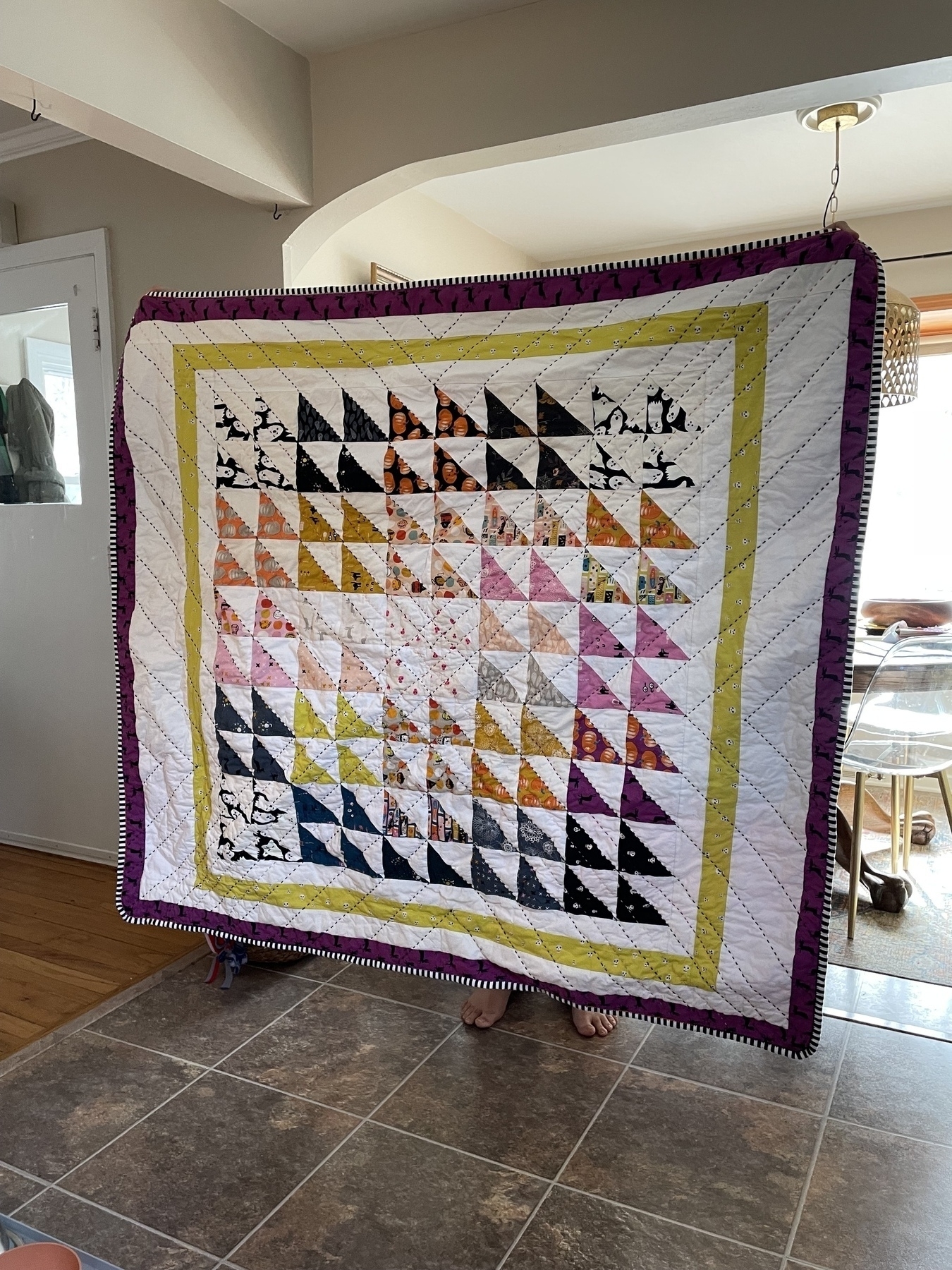
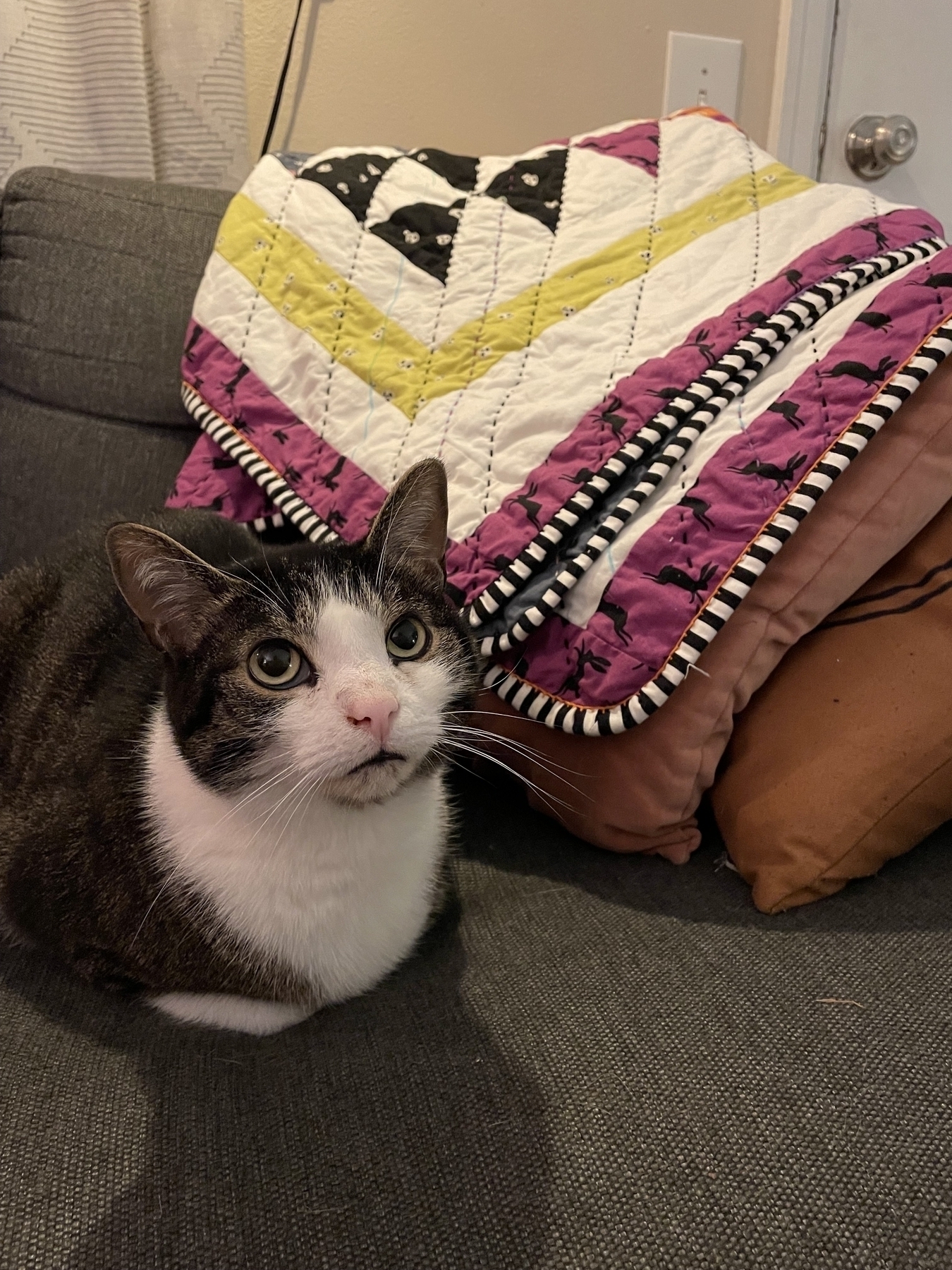
I had a great birthday yesterday.

This is the kind of book that connects the dots on some big ideas, primarily how traditional gender roles intersect with capitalism to produce the economy, and in turn, how these systems, tensions and behaviors then reproduce inequality. It’s also, at the root, about how ideas form reality. By reframing some of the feminist classics - and the Marxist ones, too - the writers recast some of our old stories about how the world works, and set up a framework for future scholarship across a number of disciplines.
This is an intensely academic and dialectical book by some of the best thinkers who work at the intersection of Marxism and feminism, and worthwhile for anyone thinking about how work, labor, gender, sex, and culture press on the individual and the collective alike.
If this feels too heavy but you like the subject, check out the editor’s later book, “Feminism for the 99%.” It’s similar in form to bell hooks’ classic “Feminism is for Everybody” but with a clear collectivist and activist call to action.
Finished reading: Social Reproduction Theory by Tithi Bhattacharya 📚
I just spent a pile of money on books, with the goal of reading for pleasure every day, and with the intention of sprinkling some light stuff around my generally serious reading preferences. While I usually read like a dad, heavy on the serious memoirs and book-length nonfiction explainers, I’m trying to take on some lighter reads because mom needs a little sugar with her medicine.
So far, I’m doing an okay job of keeping track of my reading habits here, which is why I ponied up for a paid membership to this site at all: flotisserie.micro.blog/books/

After a stint as an English major and as a writer myself, I got into a habit of reading dozens of articles a day instead of longer form writing: books. I spent a lot of energy in 2023 getting back to books. Thanks to a great book club (you know who you are) and making space to settle in with a great book in a cozy spot, here are my favs from 2023:
📚 Monica Potts, “The Forgotten Girls”
I’ve followed Potts’ career since she was a student blogger turned journalist in the aughts, so seeing her publish this book was a little personally gratifying, too. Potts brings her reporting background to this memoir about coming of age in Arkansas, one of the poorest, reddest states, with lengthy explorations of the economic and social policies that create conditions in which women struggle to thrive. She compares her childhood against a friend who didn’t get out of dodge, and explores what makes the difference in areas where people get left behind.
I really enjoyed this read for so many reasons, and was pleased that Potts’ voice is empathetic, smart and searching despite the challenging material. A mix of memoir and sociology. Very recommended.
📚 Timothy Egan, “A Fever in the Heartland”
In the roaring twenties, my home state of Indiana was a hotbed of racist activity. The KKK rose to their peak power with something like one in three adult Hoosiers counting themselves among their ranks, by leveraging evangelical churches, law enforcement, and local politicians to curry influence and power. This is ultimately a story about a deathbed testimony that broke the spell, when the telling of the Grand Dragon’s secrets, cruelties and perversions finally brought a public reckoning with the Klan.
📚 Barbara Kingsolver, “Demon Copperhead”
Like Dickens did with “Copperfield,” Kingsolver does with “Copperhead.” This novel explores how institutional poverty harms children, set in an American South that, frankly, felt familiar coming from the lower Midwest. It lives up to the hype and was vindicating and familiar. I listened to this audiobook on a long road trip and the narrator nailed it.
(I forgot how much I love Kingsolver. I finished this and turned around and reread “Poisonwood Bible” - about the hubris of American missionaries in Congo - on a camping trip. It holds up.)
📚 Britney Spears, “The Woman in Me”
Yanno, I didn’t think this would be on my list either, but here we are. Come for the juicy tell-all, stay for the damning details on how Britney’s abusive father, codependent mother and opportunist sister ensnared one of the world’s biggest stars into an abusive conservatorship and stole her time, money and autonomy. Consider at length why we ask young starlets to run through these gauntlets in exchange for our attention. It’s neither the complete portrait of the artist nor the feminist manifesto I wish it was, but I came away from it with more empathy and respect for her and what horrors she’s weathered right under our noses. It’s giving “Yellow Wallpaper,” but pop. Free Britney.
📚 Patrick Radden Keefe, “Empire of Pain: The Secret History of the Sackler Dynasty”
This is a giant tome of a book that nevertheless provides a riveting and thorough history of who knew what when and why it matters. It’s also a study of impunity among the super-rich, and how their money and influence reaches into the public commons. It turns out a lot of modern fiction deals with addiction, opioids in particular, so this became a foundational book for a lot of other reads on this year’s list.
If you don’t want to read the book, but want to know more about the Sacklers and their terrible, coercive global influence, don’t miss the documentary “All the Beauty and the Bloodshed,” which follows artist, activist and addict Nan Goldin as she fights against and grieves for all that opioids have taken from her, and from us. It’s a beautiful testament to art, community and the disenfranchised - and currently streaming on MAX.
I’m building my list for 2024, so let me know what you recommend!
Currently reading: A Fever in the Heartland by Timothy Egan 📚
Despite being from Indiana, I feel like I’ve heard very little about this book, which covers the rise of the Indiana KKK in the early 1900s. The book’s central story revolves around the Grand Dragon, a bad man whose bad acts finally land him in enough trouble that the powers that be couldn’t ignore his non-KKK activities any longer. The point, however, is that they ignored most of his activities because institutional power was both in the Klan’s pocket and was leveraged to recruit members up and down the state. Egan takes a powerful, uncomfortable look at how the KKK organized white, Protestant people against everyone else using social and professional organizations and churches, and how they helped shape neighborhood vigilantes into police forces tasked with protecting property and morality.
Fellow Hoosiers will recognize a lot of familiar names, towns and players. That photo in the NYT book review was taken in Marion, Indiana, for example. I’m finishing up an anecdote that takes place in Logansport. New Castle, Muncie, Ft. Wayne, Terre Haute are also places of interest. A reader on Twitter reminded me that the KKK tried to purchase Valparaiso University, once one of the most prestigious private universities this side of the Mississippi. Examples abound. It’s unsurprising to read that Indianapolis was nearly taken over by the Klan in the 1920s, considering how many in the statehouse openly endorse exclusionary opinions today.

Finished reading: The Woman in Me by Britney Spears 📚
Come for the juicy tell-all, stay for the damning details on how Britney’s abusive father, codependent mother and opportunist sister ensnared one of the world’s biggest stars into an abusive conservatorship, and consider at length why we ask young starlets to run through these gauntlets in exchange for our attention. It’s neither the complete portrait of the artist nor the feminist manifesto I wish it was, but I came away from it with more empathy and respect for her and what horrors she’s weathered.
I was invited to submit to the pop culture fiber craft show at Gallery 1988 again this year. Last year I sold a large Kris Jenner meme quilt. I was delighted to be included and nervous about how my work would be received, and was chuffed to be one of the first artists whose work sold.
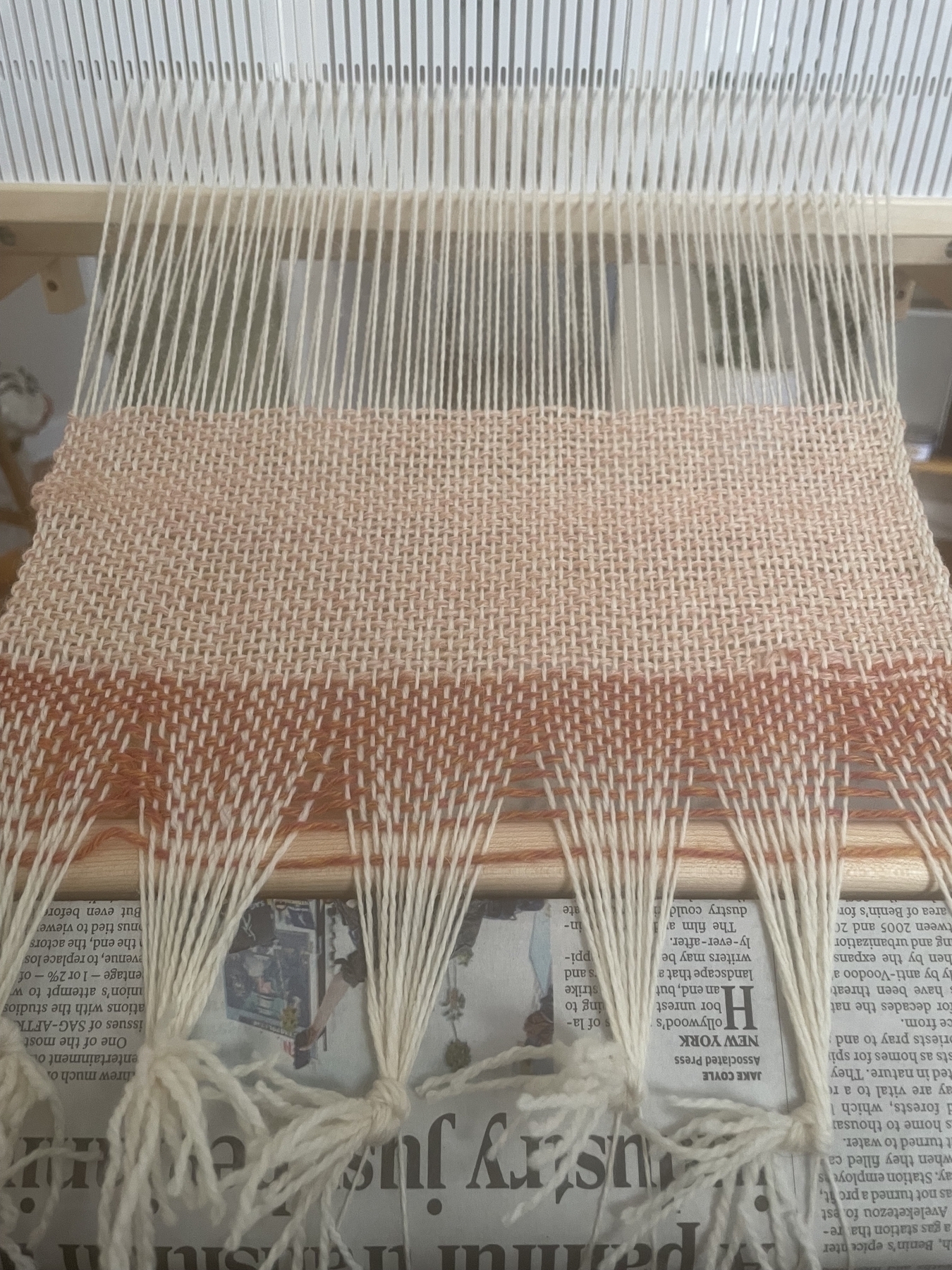
I immediately took that money and bought a rigid heddle loom. I had recently taken a class and loved it, and also needed a new way to use up some of my growing yarn stash.*
I’ve had the loom in a box since this summer and finally got it put together this week.
It took me a book, several hours and Youtube videos to properly dress the loom, and I got it mostly put together - with some tension issues, but good enough to start weaving - last night. I would guess I’ve had the yarn I put on it for twenty years, and it feels good to finally put it to use while I get started.
I’m still debating what to do for this year’s show. I want to do a Dril quote, but I’m also thinking of something more commercial. 🧶
Created some artsy fartsy rules for myself where I have to finish something old before I start something new, just to keep some momentum going on existing projects.
I have several outstanding embroidery, quilting, knitting AND crochet projects, and a loom I refuse to assemble until I knock out one or two of these other ones. My two biggest priorities are a giant garter stitch shawl that I began pre-pandemic and really want to finish because it’s so beautiful - and so boring to knit - and a gigantic crochet mosaic blanket that is teaching me the ins and outs of crochet. After that, some half-hearted quilt pieces, a wholecloth quilt and two flimsies that need to be quilted and bound. And some lingering embroidery projects and a head full of new ideas. My friend gave me some antique glass she’d like me to engrave this winter.
Meanwhile I finished a hat for the kiddo last night and she was so pumped she wore it to school this morning. 🧶