A colleague hosted a nice discussion of the work of David Dylan Thomas, who advocates for using human-centered design concepts to bring humanity back to tech. New and novel approaches abound, especially on whether and how to let engagement metrics drive decisions on design teams.
Noble’s argument throughout is that the governance conversation has gotten too high-level and universalizing while the actual outputs of these systems have profound day-to-day consequences for specific people today. She named the role of AI in the recent gerrymandering of Louisiana and Indiana as examples, and called for tripling down on long-term social science research about AI’s impacts. She also pointed out that philanthropy is retreating from feminist academic and organizational work because that work originates from the same dynamics that critique philanthropy itself, precisely at a point when this research is sorely needed. A lot of money is moving in AI, and very little of it is funding the people best positioned to study how it impacts everyone downstream.
D’Ignazio was asked directly whether feminist generative AI at scale is possible. Her answer was no, with caveats, given who owns the technology today and the current emphasis on profit motive. She suggested it is more important to consider how to organize around our relationship to technology, and how we might approach questions of profit and ownership, policy and decision-making, and data and tech governance.
She provided an example of a reasonable use case by walking us through a project from her Data + Feminism Lab. The example is documented at length in her recent book “Counting Feminicide: Data Feminism in Action,” where her team partnered with activists who scour news reports to document the gender-related killing of women and girls, including cisgender and transgender women. The lab built a very lightweight AI-based approach that streamlines the scanning and identification of news stories as possible cases to include in their project, supercharging their work (note: very similar to how the NYT uses AI to analyze data for reporting). In this example, the AI’s job is task-scoped, democratically co-determined with the people who use it, and small. Smith picked this up: there is an idea baked into the current LLM moment that AI must scale to make it marketable, and the alternative is using purpose-built models that are right-sized against a body of work.
Christin spoke at length about how embodiment is one of the primary focuses of feminist theory, and how AI perpetuates the “disembodied” illusion of technology, and how this dynamic shows up in everything from the marketing to UX to user comprehension. This spoke to my thoughts on how the single-interface design of LLM chat reproduces Haraway’s “god trick,” knowledge that presents as universal while concealing the specific and situated position it comes from.
The parallel I kept returning to, listening to this, is one I think about often with my own cohort of early bloggers, women who grew up alongside the rise of the internet — and then the rise of ad tech. The internet of the late 1990s and early 2000s was being shaped by several camps: writers, students, information architects, and user-centric researchers who saw it as an information access network and a space of possibility; entrepreneurs and opportunists who saw it as a channel for marketing, monetization and extraction; and a smaller boycott camp that wanted to limit and refuse the whole personal computing and digital revolution altogether.
It was generally considered weird to be a girl on a computer or a woman on the internet — so weird that many of our peers didn’t recognize us at all — and we were there anyway, making stuff, witnessing, learning, advocating, producing, influencing. So when I watch some of my old peers, many of whom are professional writers and academics today, treat LLMs as a question of refusal rather than a condition to engage with critically, I worry we are abdicating a responsibility at precisely the moment when our technical and rhetorical expertise applies. Their refusal has good logic: user-centric researchers and communities engaged extensively with the early internet and the extractive camp won anyway, so why expect a different outcome here?
But Noble’s work on algorithmic bias attributes that failure not to engagement, but to the institutional and financial disadvantages that user-centric approaches operated under relative to gargantuan commercial interests. David and Goliath. That gap does not close through abstention. Understanding the trade-offs around tech, producing knowledge and analysis that does not depend on investors and marketers to frame the platform and the questions, requires presence. Refusal cedes so much ground.
Overall, the recommendations from the panel were practical. Noble called for people with capital (and the political will to spend it) to consider how to put money toward socially responsible research and development. D’Ignazio called for alternative funding infrastructure outside of venture capital logic, and pointed at European digital sovereignty models as worthy of consideration here. She also gestured at the popular AI Skeptics reading group as one current example of mad-and-commiserating-as-organizing that is creating safe psychological space for people to talk about AI and its tradeoffs. Christin’s recommendation was community organizing, on the grounds that LLMs are unpopular with a lot of people who feel there is no space to say so, and that finding those spaces is itself worthy because it provides shared language and awareness of others’ knowledge and experiences.
Personally, it was refreshing to hear reflections on the work (and the feelings) of being inside institutions that are being reshaped by AI, and being responsible for some of how that reshaping gets communicated and absorbed. I’m thinking about the incredible value of interdisciplinary governance, and how the commitment to governance is a specific position, and all the margins to consider.
Further reading:
Catherine D’Ignazio and Lauren Klein, Data Feminism. The foundational text on applying intersectional feminist thinking to data science practice.
“Two things can be independently true about social media. First, there is no evidence that using these platforms is rewiring children’s brains or driving an epidemic of mental illness. Second, considerable reforms to these platforms are required, given how much time young people spend on them.”
I’m seeing grunge icons L7 in concert with Amyl and the Sniffers this summer and have been reading a lot about the ’90s indie rock era in the meantime. One frame I keep encountering positions grunge as regional punk musicians navigating a global, corporate pop mainstream – awkward, crass and vulgar, but in the big leagues all the same. Reading the Auf der Maur bio reminded me that a lot of the punk scene was steeped in ideas about social roles and archetypes and oriented around upending them – or at least giving them a healthy challenge. This subculture was also populated by poets and artists in the classical sense. The retro polish around ’90s pop culture has flattened that texture, but it was genuinely a thing.
The era also introduced the woman rock star, introducing women who wrote and performed with full creative authority, not just as muses, groupies or singers. The reception from fans and critics was mixed, and the discourse around Courtney Love in particular was gross and volatile. Most of the positions she was vilified for read as entirely unremarkable today. I was a teenager during all of this, too young to meaningfully participate, but the aesthetic dominated my early adolescence. At the time I loved Tori Amos and PJ Harvey like kids now love Chappell Roan. What I forgot over time is how literary the era was, and how romantic, both in the literary sense and in relation to the New Romantics of the 1980’s. Big culture lessons for a starry-eyed teenager.
L7’s music is not that deep – it’s metal for meatheads, by design – but their politics and presence were. While poking around, I found that L7 was one of four bands featured in the 1995 documentary film Not Bad For a Girl, which was co-produced by Love and Kurt Cobain. The film focused on several all-female indie punk bands and won Best Documentary at the New York Underground Film Festival in 1996. I’ve never heard of it before now. It got middling reviews from critics then, and it’s not available streaming in full in English, unless you’re viewing it here at this dubious Google Drive link – which I will do and report back.
Poell argues AI is entangled with platform capitalism through shared infrastructure, reinforcing concentration of the market. The hype obscures local realities of adoption, putting public alternatives in the position of proving their existence alongside advocating for their place in the market.
Looking back at the feminist blogging era with the benefit of my current experience, I’d argue that what made Feministe different from our peer blogs was the commitment to convening the audience and sharing the platform without packaging it up for or selling to advertisers. That was largely my boundary – with as much market space as it commanded for the time, it was never monetized at scale, though individual contributors were free to use it as they wanted to build their audiences. We eventually committed to a small advertising carousel to cover hosting costs.
I recall someone balking at me for refusing to broadly monetize when I spoke at Blogher in 2005, but it was a hard line, for better or worse.
This post and the accompanying graphs have been a trending topic on social all weekend, particularly on Twitter/X, which is negatively implicated in the findings. In short, social media looks weirder than ever.
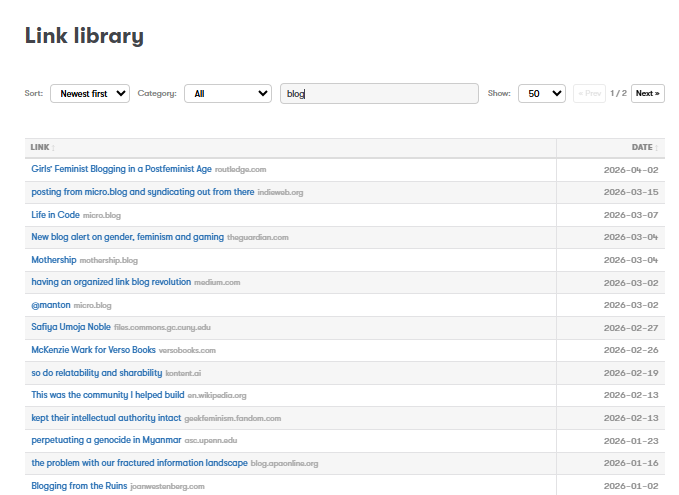
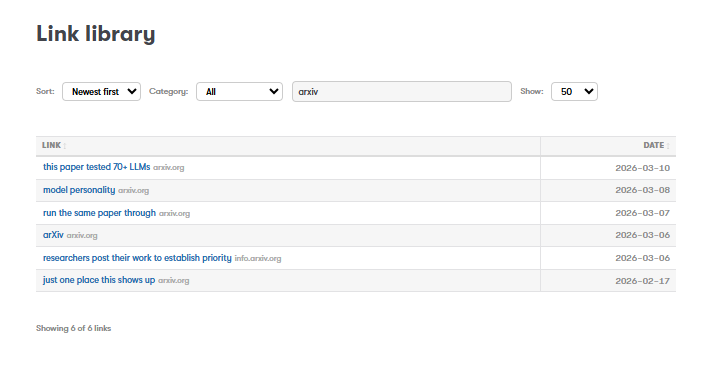
Testing a new feature I created using a mix of open source code and Claude, hoping I didn’t break my own site. I pulled together a dynamic link library using a Hugo partial and some shortcode that automatically catalogs all of my outbound links into sortable lists.
Both books were published on March 10, and both authors are talented, with impressive bylines, with significant followings baked in. Incidentally, they come from the same cohort we loosely refer to as “feminist blogging,” though both would probably bristle at the description. And both use autoethnographic methods to leverage their personal lives to tell bigger stories about social, cultural and economic dynamics (a common method among feminists, where the personal is often made explicitly political). Lemieux goes further by including a series of essays by other Black single mothers at the end of her book, expanding the frame from memoir into something more collective, a full bloom.
West’s book has gone ultra viral over the last few weeks while Lemieux’s has found significantly less footing. West’s work is being spectacularized in real time, while Lemieux’s support has been mostly grassroots, respectful (thankfully), and largely limited to Black media outlets and NPR. This reproduces one of the oldest patterns in feminist media: a white woman’s confessional work circulates as universal or spectacular (West is being treated like a spectacle currently, which is great for sales and visibility but comes with negative trade-offs), while a Black woman doing rigorous, arguably more structurally ambitious work gets categorized as niche, an outlier. That this is happening within the very audience that would generally name and critique this dynamic in any other context makes it worth sitting with.
While I respect both authors and their bodies of work, I am looking forward to Lemieux’s book because I know firsthand how difficult it is to get a publisher and an audience for serious, foundational work like this. I suspect it will prove relevant long after the viral moment is over.
Rapper Afroman is going ultra viral this week as his “Lemon Pound Cake” trial plays out in the news. He captured the raid on security cameras in his home and used the footage in a series of songs, videos and merch. He ultimately did not face charges after the search, and argues (with evidence) that the police broke his door and stole $400, which provides the platform and substance for everything that followed. He argues the police shouldn’t have been there at all, and didn’t follow protocol when they were, and that as a citizen and artist he’s expressing his feelings about it in his preferred medium. Is this a winning legal strategy? Time will tell.
In the meantime he’s winning at public opinion. The trial is shaping up in the public view as a defamation vs. free speech trial, with the artist’s prolific work about this no-knock raid performed at his house, itself arguably unethical, held up as harassment by the officers who did the job. True crime, legal experts and court watcher accounts are going gangbusters providing cultural and legal analysis alongside video of court testimony. It helps that the court footage is a rich text — both hilarious and revealing.
My digital presence has been deliberately fractured for years, so I’m watching how this site stitches together my breadcrumbs through SEO, with the serious stuff and throwaway asides alongside the occasional hilarity. Currently one of my top Google results.
NYT on the trend of “Luddite teens.” I have a growing suspicion that various neo-Luddist trends will largely map to class identity. In some areas of the world, in some areas of the US, Facebook is the internet, yellow pages and water cooler, and the internet experience is entirely mediated by apps.
Doing numbers on Twitter/X this week: this paper tested 70+ LLMs on open-ended prompts and found they all produce strikingly similar outputs. Worse, the systems used to improve models actively penalize diversity, reinforcing the convergence.
One of the more useful things you can do with an LLM is hold up a few ideas side by side and apply lenses to them. I know this history pretty well, so I asked a series of LLMs, why is Wisconsin’s cultural identity and cohesion stronger than Indiana’s, from a historical and business perspective?
Each LLM will give us more or less the same story, different flavor. Within the industry, the differences across the models reflect “model personality.” Asking “why” instead of “whether” will probably drive the answer to favor Wisconsin. Using multiple lenses (two states, historical + business, identity + cohesion) forces the LLM to cross-reference across more of its training data, which tends to produce a more comprehensive answer.
Functionally: all of them acknowledge hard historical truths within the subject matter and don’t shy away from critical perspectives, which is good. Both Gemini and Copilot include in-line links, which lets you judge the output’s authority in the moment as a reader. I liked Copilot’s more than I expected here. Claude’s answers are more lyrical and do provide more context, and yet do not encourage checking against outside sources by providing links within the output. And you can see that even with the good writing skill calling out hard bans on certain structure, Claude plows right through them.
Model personality: Claude favors sociological answers to Copilot’s economic answers. Claude is also highly intellectual and narrative by comparison, and that narrative style can mask nuance by sinking relative context within the storytelling. Gemini simplifies, boosts and cheerleads where the others don’t, and really goes hard on Wisconsin’s reputation as a drinking and Packers state when there are stronger structural arguments in play. Copilot is tricky because it looks authoritative like a briefing, which also makes it easily “extractible” for the user, but every citation requires authentication unless this is one of those “good enough” tasks.
As a writer, something I find annoying across the whole spread is the semantic reveal. LLMs are semantic machines, and it is persistently revealed in ways that are weird to the human ear. All of them go out of their way to describe things as “structural,” “connective” as in “connective tissue,” “load-bearing” and “legible.”
Finally, I included a second tab where I asked Claude for analysis across the four outputs, where it suggests that my framing of the question is altogether kind of problematic. It shows how a strong prompt is sometimes also a bad approach.
There are a lot of possible takeaways here, but I’d rather set aside the question of which tool is “good” or “bad” or “better” and think more about the patterns across the tools and their implications.
One of the tricky things about consumer AI tools like Claude and Gemini is that the experience varies widely depending on the person using it, and it’s not always clear why. I have spent a lot of time learning the tools so I can advise on them in my work, and this variance of experience has become a frustrating part of the deal.
I manage a team of writers and creatives at work, and we are expected to be familiar with the tools, despite complex and sometimes hostile feelings about the political and environmental implications of this sector. That’s quite a pickle, organizationally, managerially. Borrowing from Haraway, I thought, okay, what if we take these tools seriously as a team of writers and creatives and put our professional standards up against them?
Among other exercises, I did a couple of comparisons on my team that help create discussion around the “plausibility” question. People dismiss LLM outputs as being merely plausible answers, rather than accurate or factual ones. And that’s correct; they are, and that’s the design. In many cases, plausibility is fine. Take Wikipedia, for example, which we understand to be a pretty good source, a plausible source, unless you’re writing a formal paper requiring original sources.
I digress. Ultimately, we needed to understand together that LLMs are not a WYSIWYG tool and talk through the implications.
I asked everyone to run the same paper through their LLM of choice, prompting it for a plain language summary. We then copied and pasted it into a shared doc, and compared and contrasted for discussion. Upon discussion, we had several takeaways, including that they were all similar in spirit but sometimes varying wildly in style and approach.
Knowing that algorithms are responsive and not static, we did it again later in the day and copied and pasted our outputs into the shared doc. We compared and contrasted the difference between AM and PM. Again, it was similar in spirit but varied in style and approach. Some changed dramatically. One team member whose morning summary had been jokey and conversational received a much more staid and serious version in the afternoon.
At the time, I asked Claude to explain the variance: “Even with the same prompt and source material, LLMs don’t produce identical outputs each time. This is by design — there’s a degree of randomness (called “temperature”) in how the model selects words, which means each run produces a slightly different path through the text.”
Anyway, this got our gears turning on how (and whether) to approach LLMs as a team and as individuals and led to good group discussion. (It’s important to create space for criticism and critical approaches here.) It also gave us more confidence as a team responding to this new layer of complexity in our work, and helping our professional contacts and peers think about how to approach the tools and when and whether to use them. There will be tasks where AI-based tools are “good enough,” and tasks where they are not.
The swirl of mystery and speculation around this sector has people up in arms, and it’s useful to have approaches that give people firsthand experience and to see how the experience works for others. The god trick of the singular interface turns out to be a bear for navigating it in the workplace, where our work is foundational, prosocial and specific.
A note on Ezra Klein: I’ve been looking across the NYT’s breathless reporting on the AI industry and seeing very few women represented across the commentary. Klein’s tech coverage tends to center a fairly narrow circuit of sources: founders, researchers, and policy thinkers who are overwhelmingly male and concentrated in a few institutions, and generally assert the inevitability of disruptive AI as a matter of course. Meanwhile, Anthropic and others are anticipating that career ladders where women are concentrated will be impacted, some claiming professional women’s jobs will dry up or disappear entirely.
I looked over his podcast guests for the last year and noticed that among his tech-focused guests, almost all white, almost all men, almost none of them are women. A rough count of eight podcasts (nine if you stretch) with accompanying commentary only produced two women, both economists. Klein’s brand is the guy who does the reading, the big ideas guy. So it’s worth asking what he’s reading and whose ideas he considers big. While he probably wouldn’t disagree with Gebru or Crawford or Noble on the substance, his current body of commentary is pulled toward the perspectives of people who have the most to gain from the technology’s expansion and the least exposure to its costs.
She draws on Acemoglu and Restrepo’s concept of “so-so” technologies and traces a pattern from MOOCs to DOGE, where each iteration promises transformation but delivers incremental improvements at best and labor displacement at worst. The real danger, she argues, is that AI’s most compelling use case in the current political environment is threatening, demoralizing workers and justifying cuts, not revolutionizing how work gets done.
Cottom has been one of the writers I keep returning to because she is not dismissing the technology or retreating into reactionary nostalgia. She looks past the product announcements to the political economy underneath them. Who benefits from the hype cycle? What happens to the institutional infrastructure (education, research, public expertise) that AI claims to augment and simultaneously threatens to starve? She’s also very active on Instagram (and promoting a new documentary) and tracing the news around AI and higher ed in real time.
LLMs have a default house writing style with identifiable patterns: sentence fragments for emphasis, “not X, but Y” constructions, lots of hard contrast, atmospheric openings, heavy use of em dashes, and heavy use of marketing language. This reflects the semantic construction of an LLM. Custom instructions can override these defaults. A custom skill is a set of instructions within your account that modify how the model generates text. When you paste instructions into your profile settings, Claude reads them at the start of every conversation and adjusts its output accordingly.
I began using Claude daily for light writing tasks about six months ago, and over that time I started cataloging the patterns I was consistently editing out, including the terrible “not X, but Y” construction that showed up in nearly every response, and persistent em dashes used as all-purpose connectors when other punctuation is more appropriate.
I went through several iterations of bullying Claude into submission, narrowing the scope each time, before arriving at this version, which focuses specifically on writing mechanics and hard prohibitions.
You’ll need a paid Claude plan (Pro, Max, Team, or Enterprise). Free-tier accounts don’t have access to custom skills.
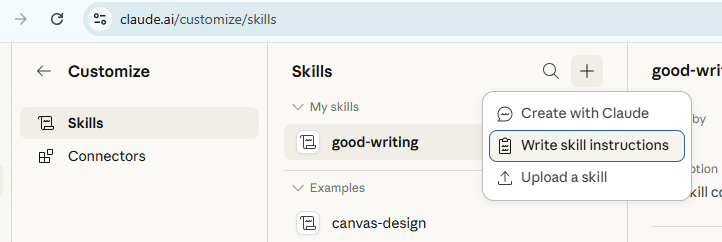
• Within the app, navigate to Customize > Skills and Create new skills
• Select add a new skill and Write skill instructions
• Copy and paste the copy from this file into the skill, making note of the name and description boxes. Feel free to tinker.
• Save your changes.
Note: The instructions in the linked file are Claude’s work, not mine. They came out of months of conversation, where Claude would analyze my style notes, and the file evolved from there. They read a little strangely because of that process. If I’d written them from scratch, they’d sound different. But looking at the file you can see what Claude responds to and how it works.
Claude will apply these instructions to every new conversation going forward. Existing conversations won’t pick up the change, so start a fresh chat to test it. If and when Claude struggles to apply the skill, call it out specifically in the prompt, such as, “Revise this for length using the good writing skill.”
The skill specifies constraints in a few categories and the instructions are plain text. As you go, you can also ask Claude to analyze previous conversations for suggested additions to the skill, which Claude will produce and implement within the chat. Each rule operates independently, so removing one doesn’t affect the others.
Claude processes custom instructions at the start of every conversation, before it generates any output. The instructions function as constraints on the model’s default behavior. The model doesn’t always follow every instruction perfectly and the results vary by task. You will still need to edit.
This new report from Anthropic is depressing at best, as it tries to measure which employment sectors carry the most exposure around AI expansion into the economy. In short, the tech is likely to impact two groups the hardest: educated professional women, and young workers for whom the career ladder will never materialize. In a right-side-up world, this would change the political dynamics of any policy response considerably. In this one, I don’t know.
Anthropic’s positioning here is curious, very god tricky. They are claiming the mantle of responsibility and transparency while predicting an inevitable end nobody wants, that they’re also selling as a service.
I still think much of the forecasting is oversold – the tech performs well in optimized environments, and last mile issues are a perennial concern in any engineering venture because the practical world is non-optimal. Time will tell, and there are big incentives in play. But the hunger and animus around the forecast feel bad.