An observation on feminist writing and Jezebel: Throughout history, a lot of time and energy has been spent mediating how and whether certain kinds of people talk to one another. The feminist blogosphere, for all its faults, was the first time lateral, public, unmediated conversation happened among women at scale. Many kinds of women were there that had no space at other tables. And it was very messy, and very revealing, because it was the first time that happened at scale for all to see.
Some thoughts:
When I started in 2001, the most viewed website about feminism on the internet was a solo blog by a man in Portland.
I just pulled Mindy Seu’s “Cyberfeminism Index” off my shelf, a veritable tome, and the feminist sites don’t even make the table of contents. Which is not an indictment of the book, but an example of how ephemeral all this is online.
You can see this on Twitter in the live debate about what Jezebel was and wasn’t, a conversation happening mostly through collective remembering. Jezebel joined the pack of blogs at some point, and they were big dogs, but they weren’t responsible for the creation or steering of the digital movement. They were a glossy, spendy repackaging of the organic thing, backed by real investors. It’s wild to see the entirety of the movement attributed to Jezebel by young Twitter, given that most of the indies kept Jezebel at arms’ length until much later. They were pretty widely considered a corporate interloper in a grassroots arena, though in hindsight that wasn’t right either.
The first time the indie bloggers gave Jezebel their day was when they published the untouched photographs of Faith Hill on the cover of Redbook, a women’s magazine. The Redbook post tore the veil off the beauty industry in real time. Until then, the idea that “celebrities are photoshopped” and “photos are retouched” was almost an urban myth, which is easy to forget given the ubiquity of filters and AI now. Then, you heard about it but couldn’t confirm it for yourself unless you had firsthand experience. Retouching was a discrete industry practice, digital tools were still expensive and clunky, and all of it was surrounded by a lot of tradecraft and secrecy. The mystery of celebrity image management exploded with an animated gif on a public-facing post, and it was rad.
One of the more useful things you can do with an LLM is hold up a few ideas side by side and apply lenses to them. I know this history pretty well, so I asked a series of LLMs, why is Wisconsin’s cultural identity and cohesion stronger than Indiana’s, from a historical and business perspective?
Each LLM will give us more or less the same story, different flavor. Within the industry, the differences across the models reflect “model personality.” Asking “why” instead of “whether” will probably drive the answer to favor Wisconsin. Using multiple lenses (two states, historical + business, identity + cohesion) forces the LLM to cross-reference across more of its training data, which tends to produce a more comprehensive answer.
Functionally: all of them acknowledge hard historical truths within the subject matter and don’t shy away from critical perspectives, which is good. Both Gemini and Copilot include in-line links, which lets you judge the output’s authority in the moment as a reader. I liked Copilot’s more than I expected here. Claude’s answers are more lyrical and do provide more context, and yet do not encourage checking against outside sources by providing links within the output. And you can see that even with the good writing skill calling out hard bans on certain structure, Claude plows right through them.
Model personality: Claude favors sociological answers to Copilot’s economic answers. Claude is also highly intellectual and narrative by comparison, and that narrative style can mask nuance by sinking relative context within the storytelling. Gemini simplifies, boosts and cheerleads where the others don’t, and really goes hard on Wisconsin’s reputation as a drinking and Packers state when there are stronger structural arguments in play. Copilot is tricky because it looks authoritative like a briefing, which also makes it easily “extractible” for the user, but every citation requires authentication unless this is one of those “good enough” tasks.
As a writer, something I find annoying across the whole spread is the semantic reveal. LLMs are semantic machines, and it is persistently revealed in ways that are weird to the human ear. All of them go out of their way to describe things as “structural,” “connective” as in “connective tissue,” “load-bearing” and “legible.”
Finally, I included a second tab where I asked Claude for analysis across the four outputs, where it suggests that my framing of the question is altogether kind of problematic. It shows how a strong prompt is sometimes also a bad approach.
There are a lot of possible takeaways here, but I’d rather set aside the question of which tool is “good” or “bad” or “better” and think more about the patterns across the tools and their implications.
You might call this a taste test: Obsessed with the story about the McDonald’s CEO and how his LinkedIn-style videos selling the McD’s franchise have escaped containment, leading to one of the funnier CEO/product marketing dynamics in recent history. Burger King’s CEO swooped in, holding widely-marketed listening sessions with customers and to demonstrate his love for the Whopper in contrast with the deeply weird McD’s videos. Must read: Internet long-hauler Katie Notopoulos on how direct-to-public marketing works when the public is more familiar with the product than the org’s leaders.
My teenager thinks fast food is cool and subversive (cue the sound of one hundred moms groaning) and she and her friends regularly talk shop. They are Taco Bell fans and think burger stops are kind of gauche. Not gauche: Baja Blast.
The last time I went truly viral was in April of 2020 in the height of the COVID shutdown. I posted a tweet and walked away from my phone. By the time I checked back, my notifications were out of control.
The next morning, I got a message from an old friend familiar with my handle. “I think I saw your account on Good Morning America?” Hilariously, there I was, and I couldn’t even claim responsibility for the meme.
I’ve spent most of my time on the internet as a pseudonymous account, using my first name only, or using a handful of handles (incl feministe, fauxrealtho, flotisserie, paired with punny names like “Petty White” and “Frieda People,” a convention from the Tumblr years). Even as a visible personality online, I was only known by my first name and URL and/or handle. In recent years I de- and reactivated some of my socials, so some of these breadcrumbs no longer exist, but I’ll do my best.
Pseudonymity allows writers to explore complex ideas in digital spaces while protecting their identity, location, and other identifying factors, while also maintaining a throughline of identity and storytelling.
There are a lot of trade offs in using a pseudonym, especially around how to claim credit for your work. But people use them because they give you the privacy to be honest, real, weird, authentic, and to escape the creep of modern social media presence into high stakes spaces like the workplace. This dynamic was kind of the impetus behind the era of “weird Twitter,” where people using pseudonymous social handles routinely threw out funny, absurdist one-liners to impress their friends and followers, while taking a turn at the social media slot machine. Not every post or joke lands in a way that converts to numbers, but some do, and it’s fun to try.
I’ve written a little previously about how the English program I was a part of used fiber arts to illustrate the fundamentals of technical writing, but one of their other methods of teaching the internet was through board games. Games, like the internet, and much like writing, provide rules and structure for communication and engagement, but everything that happens inside the container of game board and game play is a mystery until it emerges through human interaction. So goes the internet (and to some extent, so goes AI). Games and gaming were used as a method to think through what it means to create rules of play, then let a community rip through the model – and many of the thinking and skills involved around game design apply in social digital spaces, from chat rooms and Teams channels to the open seas of the WWW. The longer you’ve been playing the slot machine, the more you get a feel for the kind of thing that will get seen and read, and who among your readership will take your content to the next level.
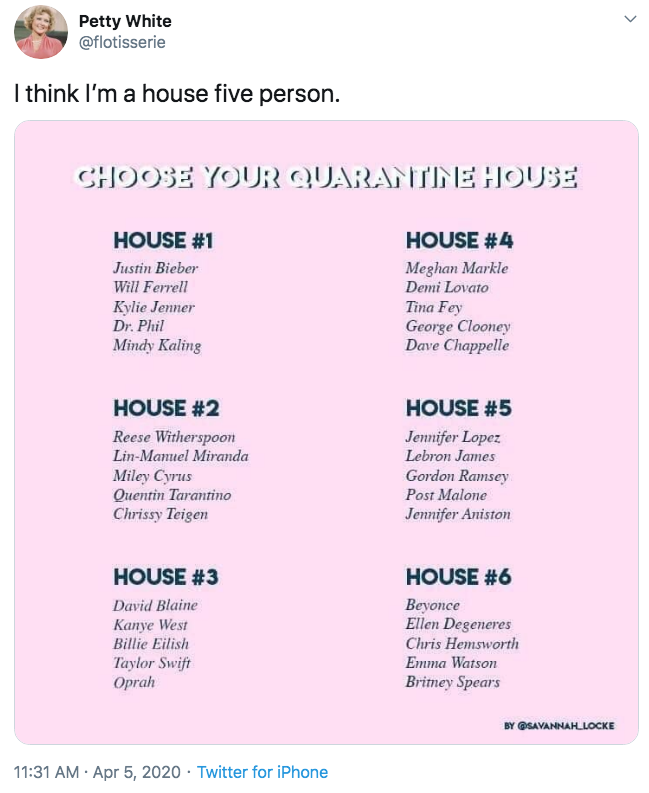
The meme was a list of six hypothetical celebrity households: pick one to quarantine in.
It had been circulating on Facebook, started by a Christian influencer named Savannah Locke. I encountered it deep in a Real Housewives fan group, and felt the pull of a good parlor game. In April 2020, everyone I knew was sitting at home, fretting about the COVID-19 pandemic looming over all of us, so I shared it with minimal ceremony, a couple of buddies with a slightly larger following hit retweet, and within two days the tweet was being cited by The Cut, Time, the Washington Post, ABC News, and others. Know Your Meme documented it for posterity. Several outlets named me as the originator, but trust, I was only trying to delight my friends with low grade Facebook content. I couldn’t find the original meme at the time – Locke appears to have had a name change that scrambled my search. But hey, as these things go, nobody earned a dime or promoted anything weird, so no harm, no foul. Business Insider managed to credit it correctly, so a special kudos to their editor.
The core game mechanism behind the meme is forced choice: constraints generate opinions and opinions generate activity. Each “house” also represents a personality type. House 3 is chaos, House 6 is aspirational, House 5 is the one where someone is definitely cooking and someone is definitely yelling about it. The choices are arbitrary, which invites curiosity about who grouped what and why. In short, this meme offered a light conversation starter at the right time, with low stakes, high personal reveal, and endlessly discussable combinations. It also drew from existing memes and games that are popular online, like “where you sitting” in the proverbial lunch room. This one became news because of the timing and gamability, not because I was particularly clever, but hey.
What does it feel like to go so viral? It’s hilarious, strangely affirming, and also a little crazy-making. It opens the door to a whole lot of wild people and ideas on the internet, not all of them flattering or welcome. Virality is sometimes paired with incredible harassment and requires “more condolences than congratulations.” But as far as this particular experience went – hilarious, whoops, and wow. It just felt like a Lebron James, Post Malone and Jennifer Aniston hang would be a good time.
When I started building websites in the late ’90s, the line between writing and coding didn’t really exist. A person probably learned HTML because she had something to say and needed a place to put it. The internet was free and anonymous and it felt audacious to put your stuff online, like flinging a message in a bottle out to sea. The code was a container for the ideas that rendered them onscreen, and every post and page you published was both a piece of your thinking and a brick in something larger.
People forget that the early web was a writing community. Writers, or bloggers, built their own sites, maintained their own archives, linked to each other deliberately. A blogroll was both a reading list and a show of solidarity, a trackback was a way of saying, “I see you, I’m thinking with you.” The technical architecture - RSS feeds, permalinks, comment threads - existed to organize the writing and the writers’ thoughts, and to push their ideas forward on the open web.
This worked for a time. Communities of writers, most of them without institutional backing or media credentials, built new bodies of knowledge together through interacting as readers and writers, communicating across a foundation of code. The work didn’t stay online. It spilled into conference halls and state houses and newsrooms and policy discussions. As the body of communication built, it created something that accumulated over time. These people influenced mainstream journalism, shaped public conversations, launched careers and movements. In many ways, the national political conditions we face today are a reaction to that movement, and how it allowed regular people to influence the world through the democratization of mass communication.
Midway through the aughts, the brick and mortar publishers and venture capitalists started looking across the landscape, at all the writers creating fantastic content, largely for free, and sucked them into their content and editorial teams. Google Reader lost institutional and financial support as writers moved off the open web and onto publishing platforms, often backed by VC money, that measured the quality of your work by engagement. The addition of algorithmic feeds further broke down this structure – the algorithm doesn’t measure whether your work contributed to shared understanding, but whether it generated a click, a share. The code changed, and the writing changed with it.
The writers changed with it, too. The blogger became the influencer. Bloggers operated in a gift economy of ideas: you wrote to think, to argue, to contribute, and your standing in the wider community came from the quality of your work and contributions over time. Was it a meritocracy? No, but the conditions made it possible for a regular person to talk with experts as peers, which upended traditional power structures around authority and expertise (in both directions, good and bad). Meanwhile, influencers operate in a heavily capitalized attention economy where engagement converts to dollars. The audience is a market to press for money.
The gendered dimension of this shift matters as well. The early blogosphere was full of women writing sharp, rigorous work about politics, culture, parenthood, identity, and technology — work that was explicitly feminist and anti-racist and genuinely moved public conversations. This was the community I helped build (Feministe.us was my project, a community platform of writers and commenters whose coverage and discussion broadly fell under, but was certainly not limited to, the topic of feminism). When the monetized platforms absorbed that energy, the commercial model recast women’s online authority almost entirely in terms of consumer influence. What could we sell? And to whom? The framing around our work went from “this person has important ideas” to “this person can sell things to a niche market.” Meanwhile, men who’d built audiences through tech or political blogging were more likely to be absorbed into mainstream media as columnists and analysts, roles that kept their intellectual authority intact. The influencer label, with all its connotations of superficiality, landed disproportionately on women, and it stuck.
There’s a class piece here, too. The platform model offered something the early blogosphere mostly didn’t — a way to get paid. For women who’d been doing enormous amounts of unpaid intellectual labor building online communities, the question of monetization wasn’t shallow. The implications of information centralization and monetization were as present then as they are now with LLMs and AI. Some people figured out the social platforms and worked their way into viable digital careers. Platforms offered a lot of perks, but all of the perks had a backstop. Corporate interests introduced the problems of advertising, audience and sponsorship, which meant reorienting your individual practice around maximizing your commercial value over and above your intellectual contribution and community management skills. It often meant giving away some or all of your IP rights.
For most people, new system didn’t offer a viable way to get from “respected independent writer” to “respected, protected and compensated writer.” Many of us found ourselves in positions too precarious to take the leap into freelancing and social media, and some, like me, got regular jobs doing regular stuff. Some married money. And in the meantime, some folks figured out how to get into real journalism, which looks much different in 2026.
My undergrad experience in college really shaped my approach to the internet. I was an English Education major at the time, in the early 00s, when the internet was around but mostly the wheelhouse of scholars and nerds. I was a nerd, learning code as a vehicle for writing, primarily to amuse myself and my friends.
The English department was an embattled unit within a school within a college of a STEM-centric university whose administration was perennially annoyed by the Humanities and their writing requirements. One of the English department’s survival tactics was to grow their approach to technical writing, getting deep into the question of how technology changes, shapes and shifts reading, writing and literacy. Thus they organized loosely around an emerging field called “digital rhetoric.”
For a time this was the top rhetoric and composition program in the field, populated by scholars from scrappy programs. My closest mentor, an English PhD from Wayne State in Detroit, studied race and gender representation in video games and how programmers (particularly Black and trans programmers) write themselves into existence through code, design and other aesthetic and storytelling choices. Outsiders had a really hard time understanding how this work belonged in an English department, but ultimately, she was focused on the question of authorship and how the author is projected throughout her work, a classic literary debate. She treated video games as texts and gamers as an audience, an approach that foretold many things about our current political era.
In this space, “digital” doesn’t just mean content on a screen. The concept is more complex, including social, cultural and rhetorical dimensions, in addition to shifts through time. Digital “texts” and practices exist on a continuum with print and other media, rather than in isolation, transforming how persuasion and communication work, both separately and together.
I took all these lessons and ran with them. This is where my approach to the internet is situated, and there are a few truisms that I learned from that time and era that further position my writing and approach.
Writing is code, code is writing
Writing and code are fundamentally the same thing in digital contexts. Both are systems of symbols that create meaning and action through semantic rules. The line between “content” and “container” blurs in digital spaces. A blog post is the copy on the page – and it’s also the metadata, the responsive design that adapts to different screens, the accessibility markup that makes it readable by screen readers. Each of these elements is written (coded) and each carries rhetorical weight and communicates something to the audience, intended or not. If you understand these relationships, you understand how the internet works as a social and information system.
This convergence of digital and material amplifies the concept of intertextuality, the idea that all texts reference, respond to and build upon other texts. In the classroom, intertextuality often focuses on plays and novels, and explores how authors speak and refer to one another’s work over time. In music, this is the study of sampling and referencing and why.
In digital environments, intertextuality becomes literal and functional. Code libraries reference other code libraries. Websites link to and embed other websites. APIs allow different platforms to communicate and share data. A single digital text might pull content from multiple sources simultaneously – a Twitter embed, a YouTube video, a Google Map – creating a networked document that exists across multiple platforms and authors. Virality builds rhetorical velocity through layers of meaning being added by individual users in real time, creating new texts and contexts through iteration and sharing.
Writing makes reality
A lot of students of this era took up knitting. It was trendy, yes, but the professors also taught knitting as an applied example of technical writing, and how writing produces a material reality.
Knitting patterns are technical writing in its purest form. A pattern is a set of instructions that must be precise, unambiguous, and reproducible, the same goals as any technical document. Pattern writers use specialized notation (K2tog, SSK, yo) that functions like code, compressing complex physical actions into standardized symbols that individuals interpret using sticks and string. The pattern must account for different skill levels, anticipate common errors, and provide enough context for the knitter to understand not just what to do, but why.
Good instructions and an able translator may result in a wearable delight: a sweater, a scarf, a cozy and colorful pair of socks. When a pattern fails the result is the same as failed technical documentation: confusion, wasted time and an unusable product. Piles of string. Dumb, useless sticks. It is an incredibly strong reminder that technical writing isn’t confined to manuals and protocols. It exists anywhere complex processes need to be communicated clearly and consistently so others can replicate results – including in your granny’s yarn basket.
So that’s how I learned to knit. Digital rhetors link physical practices to digital ones to illustrate highly conceptual ideas about writing and social networks. And one reason why digital spaces like Ravelry deserve recognition as thoughtful, functional social platforms is that this link between conceptual and material is made explicit in the digital knitting community. Designed for information sharing among a particular audience, decisions about information architecture and community management reasonably cascade from the mission, so Ravelry has remained a reasonably healthy community experience for most users despite its massive size and sprawling discussion. It remains an example of positive social dynamics online, unlike its behemoth competitors.
Always returning to Haraway
Many thinkers and texts built out this field of thought, but Cyborg Manifesto sits at the forefront for me. Writing during the Reagan era, with the populace freaking out about the rise of biotechnology and personal computing all around her, Haraway entered debates about whether women should enter male-dominated, militaristic fields like engineering and computer science, bringing an overtly feminist lens to questions of technology and power.
One major takeaway from Haraway’s work is the importance of rejecting binary thinking around technology and science. This approach aligns with other humanist and feminist perspectives that foundationally believe technology is by, about, and for the human experience, thus providing new and novel sites for political struggle. This gave people frustrated by tech a permission structure for interacting with technology rather than avoiding or abstaining from it entirely.
If these questions of knowledge and power remain central to technology, we want the people making those decisions to share our values and interests, and to be in the room when decisions are made. This argument is ripe for various challenges, which is why it was such a provocative starting point for cyberpunks and cyberfeminists alike.
Sharing is caring
This was an open source culture that meant sharing not just finished products, but the breadcrumbs and other attempts at learning along the way. It requires the safety that supports a yes/and culture, where people can collaborate with transparency, in spite of, or in consideration of, the ugly stuff and the many unknowns.
We let public and private live alongside each other without rigid boundaries about professionalism and polish. Your serious professional work could sit next to a meme, which could sit next to a picture of your cat, and none of it diminished the other.
This was an intentional acknowledgment that people are multifaceted, and that the digital spaces we inhabit should reflect that complexity. Putting the personal and the real alongside the artificiality of digital communications builds a relationship between the viewer and creator in ways that carefully curated, brand-managed presences just can’t (also: yawn).
Vulnerability, humor, expertise, horror, scholarship, and joy coexist, as in real life.
Something else I noticed in my experimentation with AI and creative writing: Claude prefers a mid-length, declarative sentence, while I prefer a lot of variety in my prose. Sentence variety is a primary consideration in any text-based communication approach. Write accordingly.
About fifteen years ago, when I began to take my work and career more seriously, I turned toward other women in my orbit who were in the same phase of life. For many years now we have supported each other through our various iterations, talking interviews and talent and resumes and obstacles and salary alongside art and life and leisure, staying connected through a mix of persistent digital communication and travel.
These women underpin everything I’ve built since, and I am so grateful for their observations and experience, and for the pleasure of seeing how we have grown into our choices over time.
Personal support means everything; assemble your team.
The move from a structuralist account in which capital is understood to structure social relations in relatively homologous ways to a view of hegemony in which power relations are subject to repetition, convergence, and rearticulation brought the question of temporality into the thinking of structure, and marked a shift from a form of Althusserian theory that takes structural totalities as theoretical objects to one in which the insights into the contingent possibility of structure inaugurate a renewed conception of hegemony as bound up with the contingent sites and strategies of the rearticulation of power.
This was my era in college, and I remember feeling challenged and overwhelmed as an undergrad trying to read theory for the first time. So today, I asked Claude.ai to put it in plain language, just to see what would happen. Here’s the after:
Scholars used to think that capitalism shaped society in consistent, predictable patterns. But newer thinking focuses on how power works—how it repeats, overlaps, and gets reshaped over time. This brought time into the picture and moved away from older theories that treated social structures as fixed. Instead, recognizing that structures can change opened up a new way of understanding power: it's tied to specific moments and strategies, and it's always being renegotiated.
This book isn’t in Epilogue so I can’t log it properly, but it’s an okay primer on change communication. For higher ed, the emphasis on engaging leadership and governance is handy. 📚
“Writing is a practical skill—particularly since most of our online communication is text-based to begin with. …Done well, it means you’re contributing signal, instead of noise.”
“… every text is connected to other texts by citations, quotations, allusions, borrowings, adaptations, appropriations, parody, pastiche, imitation, and the like. Every text is in a dialogical relationship with other texts. In sum, intertextuality describes the relationships that exist between and among texts. What follows is a discussion of the strategies of intertextuality.”
In recent history I stopped posting on most social media and moved to the fediverse. I still browse the social platforms to keep up with trends and friends, but I only post on my private IG and here.
What I share here is separate from but related to my professional life — I’m thinking out loud and making room for rough, unfinished ideas. I write mainly for myself, but if others find it useful, that’s great. The practice of reading and reflecting makes your thinking stick, and I am from a certain time and place, so this is how I approach learning and communicating about what I’m learning. It’s a habit.
While this is my preferred approach, I acknowledge that sharing unfinished ideas publicly is risky and you have to accept accountability for the messiness that comes with that. But I also know that working through your vulnerability through the act of writing lets you tap into your most creative, innovative self and test your ideas against an evolving sense of what’s good. The potential for an audience, however real or implied, keeps you more honest and less self-indulgent. Despite the trade offs, I think it’s worthwhile.
While I’m cleaning up the cruft around my social presence, I’m finding more references to the heyday of blogging that explain how people organized online (Web 1.0) before the era of platforms (Web 2.0). One is this interview with Jill Filipovic, my one-time co-blogger and comrade at Feministe, with the folks at LGM who interviewed me on the subject a few years ago. Jill and I differed (and still do) on the meat of many issues, but have a lot of our thinking in common about how to handle disagreement and advance our ideas in common (and risky!) spaces. She’s welcome in my foxhole anytime.
I appreciate this oral history project by LGM because the articulation of our processes then (before automation) provides a lot of instruction about how to organize and think about communication outside of increasingly toxic and irresponsible social platforms today. One idea that is relevant today is around pluralism. In our case, we practiced pluralism on subjects and perspectives within a defined domain, “feminism.” In practice, making it work before true automation meant we lived with a lot of decision points around moderating a raucous community. Back then, we had our CMS and set up a list of community expectations, iterating as we went, then let the community rip. Collectively, this approach created a robust and vibrant interactive community of peers and moved our interests forward as a cohort. Between her interview, where she talks through the decision points we faced, and mine, where I talk more about the tools and their limitations, there is a lot for people who want to organize people digitally while thinking outside of the algorithm.