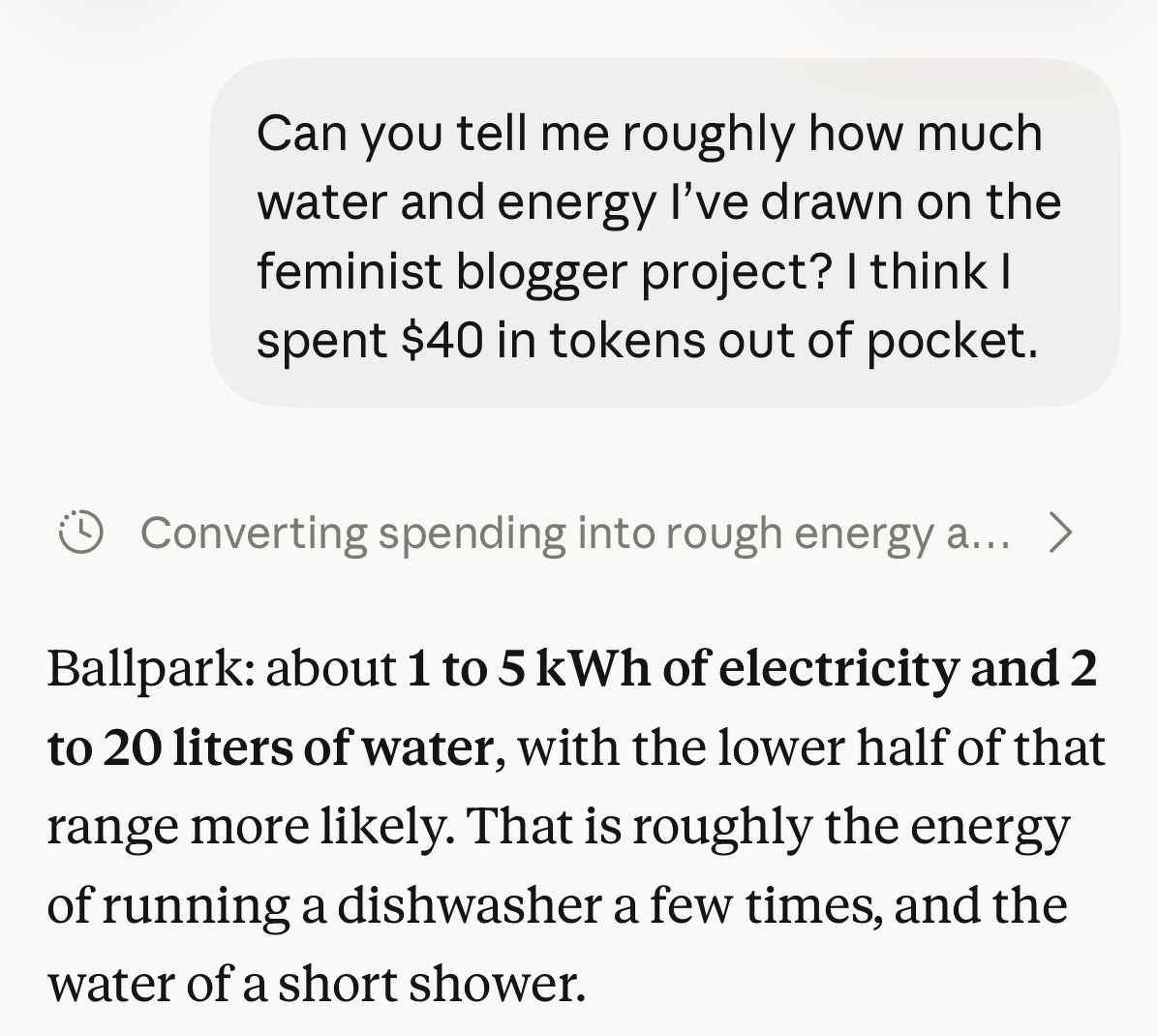
Access to tech: Enterprise level. Claude Pro plus added tokens (~$40 out of pocket after I ran through Claude Pro’s compute).
Process: Gemini pulled a roster based on the Roberts article in Jezebel. I strongly suspect my call for a “roster” shaped the inputs and outputs, making this cohort of writers look like a crew of fantasy football players or Marvel characters. All stats.
I asked Claude to analyze the data from my perspective, which includes people and details that aren’t part of the formal record, allowing for compare and contrast. To get here, I had to publish and republish the prompt almost forty times to better anonymize the data while protecting the writers included.
The “thickness” heuristic applied is totally made up - Claude took my thoughts about Donna Haraway and McMillan Cottom’s work and wove them through my thoughts about information architecture that I first learned from Dr. B.
Claude scanned the final draft for legal and privacy concerns. Everything here is publicly available online today, because it is currently live or lives somewhere as a ghost in the machine, whether via Wikipedia or the Wayback Machine or otherwise.
Blog note: Because of how my blog is set up to automagically find Wayback links for old URLs, if I publish my reference list, it would open a social and informational can of worms. So the (extensive) reference list will continue to live on the Claude report rather than being indexed into my link library.
I gave Claude permission to look across public data, crack windows and open doors, and to annotate and proceed as it worked, rather than keeping the decisions with me, then shaped the final strawman into what’s here. This took about half a day to pull together - yammering at the data within the Claude interface until it looked reasonable. Imagine having resources and a data scientist apply themselves here, with long reach and memory, with implications for trust, safety, consent and memory in every direction.
In the meantime Claude shut me down for the week (too much compute). I had to wait until this morning to ask Claude how much energy it took to run this report as I did, as a rookie and everyday practitioner.
When tech enthusiasts discuss federation today, they usually mean open protocols like ActivityPub or Mastodon. But in the 2000s, the feminist blogosphere was one of the earliest, most powerful examples of practical Web 2.0 federation, a decentralized, cross-site architectural network where open web standards powered a global ideas lab.
Instead of sitting inside a single corporate platform (like today’s X, Meta, or Substack), early blogs like Feministe, Reappropriate and Jezebel functioned as individual nodes in a federated ecosystem. Open protocols linked them, letting theory, critique and discussion travel seamlessly across independent servers, seeding some of the political conditions we face today.
1. Federated communication engine: CMS and protocol
Before quote-tweeting or tagging existed, the open web used Trackbacks and Pingbacks. If a post on Feministe analyzed an article about reproductive rights, a writer on Racialicious or Shakesville could respond on their own site. The underlying blogging software (Movable Type, WordPress) would automatically send an XML RPC “ping” back to Feministe.
Socially, this created architecture for ideas: a ping automatically listed the response essay in Feministe’s comment section or sidebar. Readers didn’t just consume one blogger’s singular and authoritative opinion; they could immediately follow the thread across five different independently hosted platforms. This created an inter-site conversation tree, allowing complex ideas to be cross-examined, refined, or challenged without any single person controlling the narrative.
2. Blogroll as federated curation and mutual discovery
Before algorithmic feeds dictated what readers saw, blogs relied on the Blogroll, a curated list of links in the site’s sidebar. Blogrolls formed a human-curated, decentralized routing layer. When a high-traffic node like Feministe added a smaller, independent blog (such as a disability rights blog like FWD or a smaller blog like Crunk Feminist Collective) to its blogroll, it directed server traffic directly to that independent domain.
Socially: This was a non-algorithmic way to expand the collective’s political consciousness. It allowed marginalized perspectives to build their own audiences and force mainstream feminist sites to engage with race, class, disability and queer theory. The blogroll mapped an intellectual community in real time – with strong caveats.
3. Open syndication protocols
The Architecture: Feeds ran on RSS (Really Simple Syndication), an open XML standard. Readers used independent RSS aggregators (like Google Reader or Bloglines) to subscribe directly to a site’s feed.
Socially: RSS meant no algorithm stood between the writer and the reader—no engagement bait, no rage-farming optimization, and no platform throttling links. Writers could publish 5,000-word, dense theoretical essays knowing their subscribers would receive the complete text in chronological order as designed. This structural stability gave writers the freedom to experiment with complex, “thick” personal narratives and political theory.
4. Real-time stress testing and spillover moderation
Because the blogosphere was a network of independent domains, each site maintained its own “house rules” and moderation policies. If a topic proved too controversial or toxic for one comment section, the conversation naturally federated outward. A reader who felt silenced or misunderstood in one blog’s comments could launch their own blog, write their response, and ping back into the original discussion.
Socially, this prevented any single author from monopolizing the narrative. It created a system of checks and balances where academic concepts (like intersectionality, rape culture, or microaggressions) were stress-tested across dozens of distinct, interconnected communities simultaneously.
Thinking about this architecture today
The feminist blogosphere proved that decentralized web protocols can generate deep, movement-building intellectual work. When platforms like Facebook, Twitter, and corporate media conglomerates centralized the internet in the 2010s, they broke those open connections. Conversations were locked behind platform walls, trackbacks were abandoned and RSS was marginalized, breaking, fencing and otherwise moderating independent community connections.
Rebuilding a modern “ideas lab” with modern federated protocols (like Webmentions, ActivityPub, RSS, and static site architecture) is simply picking up the technical blueprint OG feminist bloggers used to transform digital culture two decades ago.
I found out about a hyperlocal newsletter in my neighborhood and had to share. The Monroe Street Tattler offers print delivery and email distribution, and reports only on the hard local news, such as dog walk water bowl locations and the best fries in the neighborhood, among other ephemera.
A linklog is a dated list of outbound links, maybe a tag, and a note about why it’s worthwhile. But that little note does two things at once, and together they make for a better web.
First, it’s a way of organizing the web. The web doesn’t sort itself, so finding good information depends on someone curating and tracking interesting content, preferably on the open, free internet. It acts as a customizable bookmark library: newest at the top, tags to group items, and a line explaining why the link was worthwhile. This is similar to what del.icio.us did, where people grouped and tagged links, creating a rough filing system.
Second, it’s a social act. An outbound link points to someone else’s work, so a linklog is essentially a renewable engine for sending traffic to other people and places. It stays renewable because the content is easy to sort and remix: a URL’s relevance no longer depends on where an algorithm or activity feed happens to place it, so older links can keep resurfacing instead of scrolling out of reach. That’s the precise opposite of what big platforms design for audiences; platforms such as Twitter, Instagram and Facebook quietly bury posts with outbound links to keep your attention (and dollars) on their site and with their advertising customers, losing relevance after one interaction. A linklog explores the opposing dynamic: it willingly hands your audience and attention away while crediting your forebears, comrades, mentors and co-conspirators. It turns the rough digital filing system into a “folksonomy,” if you will.
Compare these dynamics to an algorithmic feed on a platform. An algo also sorts the flood of content, but computer magic does the sorting, and someone else monetizes your attention and relationships and hoards your data. “Engagement” for these companies is primarily a measure of how long you stay on their platform with their content. The goal is to keep you scrolling and the ad revenue rolling. But over here on the indie internet, our goal is to build human communities online and connect people to quality information, tools, ideas and processes.
In this sense, a linklog is an easy way to be an opinionated curator and a decent neighbor at once, by hosting and sharing with thoughtfulness and deliberation. Out here, my data is also likely being scraped, but I have far more control over what data is findable, shared, and shareable, and over what is investigable and degradable over time.
Community Notes was meant to democratize moderation power (and spare platforms the burden of thinking through moderation). Instead, a new paper shows that 20% of users cast 80% of ratings, and removing just ten active note writers from the pool changes what happens to nearly 5,000 community notes.
I can’t believe it’s mid-August. I’m terribly behind on my reading list. Still, I did want to draw attention to this entertaining and extremely shareable article on the glory of Record Head, a legendary record store in Milwaukee. Make sure to watch their public access TV commercials at the link.
The Harris digital campaign head does a post-campaign autopsy of the conditions that impacted the DNC’s 2024 presidential strategy, with lessons learned. I enjoyed this read because it was so close to the work that there are relevant takeaways for other public marcomms practitioners.
Some media and ad-tech operations hire “clippers,” people who cut and distribute high volumes of short video across social platforms, to manufacture cultural relevance. The strategy in short: volume generates attention, and attention confers legitimacy.
When I was young, there was a pay phone on every corner and a central landline in every home. We don’t live in that world anymore – in our world, phones and other personal devices are part of our daily processes for school, work and family logistics and communication with friends, family and the broader world. Same for kids with devices.
While this issue roils locally, my kiddo’s locker was broken for two months this year, and while waiting for repair, she got dinged for having her device in her pocket in class when the locker wasn’t a secure option. She had shoes stolen from her locker in the meantime, proving the point.
I spoke with my kiddo at length to get her thoughts. Her takeaway as an 8th grader is that kids have second and third secret devices that they hide from parents and teachers already – often, mom and dad’s old devices slipped from a junk drawer and connected to wi-fi. She suggested we adults don’t fully appreciate the kids’ ingenuity around their devices, and how they view their phones and tablets as the means to get and stay connected with one another.
While talking, I was reminded of the dance between students and the school system’s IT department during the COVID-19 shutdown. In our community, the kids were in remote learning for a full year and a half, and the IT department chased them around their approved digital tools like a game of whack a mole, shutting down access to chat and collaboration. In the meantime, almost no socialization happened between students that wasn’t directly observed by teachers, on camera. By 2021, the kids were engaged in secret, digital note-passing, chatting within Google docs and slide decks to avoid teacher surveillance. Where there is a will, there is a way.
Looking back at the feminist blogging era with the benefit of my current experience, I’d argue that what made Feministe different from our peer blogs was the commitment to convening the audience and sharing the platform without packaging it up for or selling to advertisers. That was largely my boundary – with as much market space as it commanded for the time, it was never monetized at scale, though individual contributors were free to use it as they wanted to build their audiences. We eventually committed to a small advertising carousel to cover hosting costs.
I recall someone balking at me for refusing to broadly monetize when I spoke at Blogher in 2005, but it was a hard line, for better or worse.