She draws on Acemoglu and Restrepo’s concept of “so-so” technologies and traces a pattern from MOOCs to DOGE, where each iteration promises transformation but delivers incremental improvements at best and labor displacement at worst. The real danger, she argues, is that AI’s most compelling use case in the current political environment is threatening, demoralizing workers and justifying cuts, not revolutionizing how work gets done.
Cottom has been one of the writers I keep returning to because she is not dismissing the technology or retreating into reactionary nostalgia. She looks past the product announcements to the political economy underneath them. Who benefits from the hype cycle? What happens to the institutional infrastructure (education, research, public expertise) that AI claims to augment and simultaneously threatens to starve? She’s also very active on Instagram (and promoting a new documentary) and tracing the news around AI and higher ed in real time.
A smart take on nonconsensual deepfakes, considering them not just as a social issue but as a cybersecurity issue, as they’re often connected to broader financial and social harassment campaigns.
LLMs have a default house writing style with identifiable patterns: sentence fragments for emphasis, “not X, but Y” constructions, lots of hard contrast, atmospheric openings, heavy use of em dashes, and heavy use of marketing language. This reflects the semantic construction of an LLM. Custom instructions can override these defaults. A custom skill is a set of instructions within your account that modify how the model generates text. When you paste instructions into your profile settings, Claude reads them at the start of every conversation and adjusts its output accordingly.
I began using Claude daily for light writing tasks about six months ago, and over that time I started cataloging the patterns I was consistently editing out, including the terrible “not X, but Y” construction that showed up in nearly every response, and persistent em dashes used as all-purpose connectors when other punctuation is more appropriate.
I went through several iterations of bullying Claude into submission, narrowing the scope each time, before arriving at this version, which focuses specifically on writing mechanics and hard prohibitions.
You’ll need a paid Claude plan (Pro, Max, Team, or Enterprise). Free-tier accounts don’t have access to custom skills.
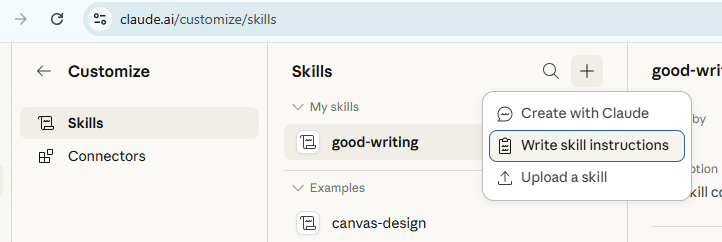
• Within the app, navigate to Customize > Skills and Create new skills
• Select add a new skill and Write skill instructions
• Copy and paste the copy from this file into the skill, making note of the name and description boxes. Feel free to tinker.
• Save your changes.
Note: The instructions in the linked file are Claude’s work, not mine. They came out of months of conversation, where Claude would analyze my style notes, and the file evolved from there. They read a little strangely because of that process. If I’d written them from scratch, they’d sound different. But looking at the file you can see what Claude responds to and how it works.
Claude will apply these instructions to every new conversation going forward. Existing conversations won’t pick up the change, so start a fresh chat to test it. If and when Claude struggles to apply the skill, call it out specifically in the prompt, such as, “Revise this for length using the good writing skill.”
The skill specifies constraints in a few categories and the instructions are plain text. As you go, you can also ask Claude to analyze previous conversations for suggested additions to the skill, which Claude will produce and implement within the chat. Each rule operates independently, so removing one doesn’t affect the others.
Claude processes custom instructions at the start of every conversation, before it generates any output. The instructions function as constraints on the model’s default behavior. The model doesn’t always follow every instruction perfectly and the results vary by task. You will still need to edit.
This new report from Anthropic is depressing at best, as it tries to measure which employment sectors carry the most exposure around AI expansion into the economy. In short, the tech is likely to impact two groups the hardest: educated professional women, and young workers for whom the career ladder will never materialize. In a right-side-up world, this would change the political dynamics of any policy response considerably. In this one, I don’t know.
Anthropic’s positioning here is curious, very god tricky. They are claiming the mantle of responsibility and transparency while predicting an inevitable end nobody wants, that they’re also selling as a service.
I still think much of the forecasting is oversold – the tech performs well in optimized environments, and last mile issues are a perennial concern in any engineering venture because the practical world is non-optimal. Time will tell, and there are big incentives in play. But the hunger and animus around the forecast feel bad.
Some content notes: while I haven’t quite figured out how much I want to broadcast this space, I have put a couple of feedback mechanisms into place, including an email loop as well as turning on comments for those logged into micro.blog, Bluesky and Mastodon. If you’re reading along, say hello.
I have pretty strong feelings against the use of AI around military operations, based on my hands-on experience with the tools. When the tech’s creators say the tech isn’t ripe for warfare, that’s strong feedback. And I agree, with the risks and implications around trust, marketing and hallucinations, it’s not even really ripe for the consumer marketplace, much less drone warfare. Whether or not artificial intelligence tech should be used for war is, of course, at the root of Haraway’s thesis, which we like to noodle with around these parts.
You might call this a taste test: Obsessed with the story about the McDonald’s CEO and how his LinkedIn-style videos selling the McD’s franchise have escaped containment, leading to one of the funnier CEO/product marketing dynamics in recent history. Burger King’s CEO swooped in, holding widely-marketed listening sessions with customers and to demonstrate his love for the Whopper in contrast with the deeply weird McD’s videos. Must read: Internet long-hauler Katie Notopoulos on how direct-to-public marketing works when the public is more familiar with the product than the org’s leaders.
My teenager thinks fast food is cool and subversive (cue the sound of one hundred moms groaning) and she and her friends regularly talk shop. They are Taco Bell fans and think burger stops are kind of gauche. Not gauche: Baja Blast.
Apparently one thing LLMs excel at is deanonymization at scale. The original promise of pseudonymity online was social and normative, over and above any question of technical depth: decent people don’t try to unmask you, because why. What strikes me today is how what used to be unacceptably antisocial behavior online is now both automated and unremarkable.
Over the last couple of weeks, I asked a couple of chatbots what could be known about me from this pseudonymous site, where I am more intentional about what I choose to reveal and conceal. It pulled the obvious but also drew conclusions based on a few geographic points I’d made in context that were both revealing and correct. I also noticed that it only drew from the top two pages of information - anything beyond page two of posts wasn’t part of the compute. Archives are for humans?
People assume that there is some computer magic on the backend where the LLMs connect all your account logins behind the scenes, but no, in fact it does all this through inference, by linking your digital trail, your friends, your breadcrumbs of likes and hearts and follows, and obvs your posts, into a picture of who you are, practically and demographically.
The Guardian has a long-running series where readers answer one another’s questions, which gives a pretty good point-in-time survey of how people of a certain demographic are feeling on a given subject. This week’s question is on AI futures: “what would happen to the world if computer said yes?”