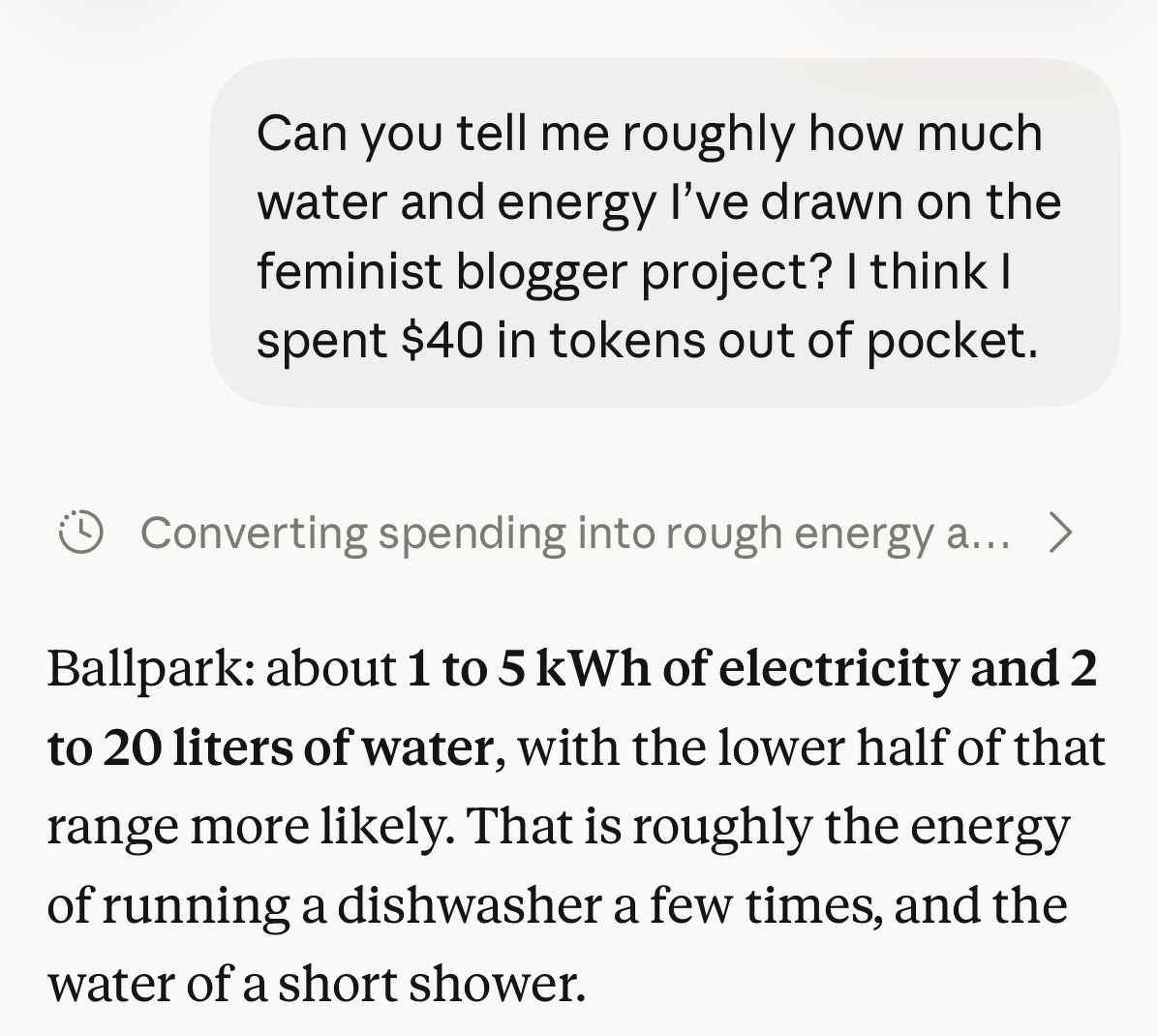
Access to tech: Enterprise level. Claude Pro plus added tokens (~$40 out of pocket after I ran through Claude Pro’s compute).
Process: Gemini pulled a roster based on the Roberts article in Jezebel. I strongly suspect my call for a “roster” shaped the inputs and outputs, making this cohort of writers look like a crew of fantasy football players or Marvel characters. All stats.
I asked Claude to analyze the data from my perspective, which includes people and details that aren’t part of the formal record, allowing for compare and contrast. To get here, I had to publish and republish the prompt almost forty times to better anonymize the data while protecting the writers included.
The “thickness” heuristic applied is totally made up - Claude took my thoughts about Donna Haraway and McMillan Cottom’s work and wove them through my thoughts about information architecture that I first learned from Dr. B.
Claude scanned the final draft for legal and privacy concerns. Everything here is publicly available online today, because it is currently live or lives somewhere as a ghost in the machine, whether via Wikipedia or the Wayback Machine or otherwise.
Blog note: Because of how my blog is set up to automagically find Wayback links for old URLs, if I publish my reference list, it would open a social and informational can of worms. So the (extensive) reference list will continue to live on the Claude report rather than being indexed into my link library.
I gave Claude permission to look across public data, crack windows and open doors, and to annotate and proceed as it worked, rather than keeping the decisions with me, then shaped the final strawman into what’s here. This took about half a day to pull together - yammering at the data within the Claude interface until it looked reasonable. Imagine having resources and a data scientist apply themselves here, with long reach and memory, with implications for trust, safety, consent and memory in every direction.
In the meantime Claude shut me down for the week (too much compute). I had to wait until this morning to ask Claude how much energy it took to run this report as I did, as a rookie and everyday practitioner.
While I still go back to Haraway’s “Situated Knowledges” for the argument that every view comes from somewhere, these days, the writer I read most closely on technology is Dr. Tressie McMillan Cottom.
Haraway asks where a knowledge claim is standing, while Dr. Tressie asks who pays for it. Lower Ed traced how for-profit colleges sold credentials to audiences the rest of higher education had shut out. In a TikTok mini-lecture on AI, politics, and inequality, she carried that analysis forward using Daniel Greene’s “access doctrine,” which holds that the answer to economic inequality is more skills rather than more support, and which universities facing their own precarity have leaned into. Audrey Watters and Ed & Class both wrote it up.
Her question fits my work life better right now while AI begins to show up in procurement, policy and training decks, and her ongoing attention to pedagogy keeps the conversation tied to what happens between a teacher and a student. I read Haraway for the epistemology and Dr. Tressie for the current evidence of how it plays out in real classrooms.
El Wiscorican is a perennial fav, offering a short but very customizable menu. Vegetarian and vegan options are regularly available for those among us who like to keep it light. They’ll ask if you want it spicy – but whatever your expectations are around spice levels, dial it back. The great north is suspicious of the virtues of capsaicin. (I recommend the fried plantains.)
Saigon Sandwich has one of the best banh mi sandwiches in town, which is pretty wild given that this sandwich is produced by a single person in a box trailer. But with fresh bread and ultra-fresh ingredients, it’s a really good one. Nothing beats a fresh banh mi with good bread and snappy veggies.
Madison boasts (at least) two great fresh juice trucks – Fresh Cool Drinks and Natural Juice – and you’re as likely to find them at the end of State Street as you are at the Saturday farmers’ markets. They both make excellent juice concoctions on the spot, and sell delicious, fresh vegetable spring rolls packed with fresh, local produce.
A composition teacher friend shared this paper on social media: Lester Faigley’s “Literacy after the Revolution”, the essay version of his 1996 CCCC Chair’s address. In it, the author argues that the economic impacts of the digital revolution had begun to undo an older commitment, formed in the Civil Rights era, to teaching literacy as a path toward equality. He further argues that writing instruction was being reorganized around tools owned by a few firms (then: Netscape, Microsoft) at a moment when wealth was concentrating upward. Faigley left us with the question of whether educators can hold onto literacy-for-equality while the tides run against it.
Thirty years later, the worry has a new face: AI will do young people’s writing for them and their thinking with it. Ultimately, Faigley believed the need for the skills that composition teaches will keep growing, not despite, but because of our need to convey information in and around that technology and the humanity it serves in a complex society. Does that suspicion hold water today?
“Students who spoke to ESPN said that betting is an accepted part of day-to-day life and that they learned about their school’s gambling culture immediately after arriving on campus. A 2023 NCAA survey of 18- to 22-year-olds found that 51% of the women and two-thirds of the men have bet on sports.”
A colleague hosted a nice discussion of the work of David Dylan Thomas, who advocates for using human-centered design concepts to bring humanity back to tech. New and novel approaches abound, especially on whether and how to let engagement metrics drive decisions on design teams.
What I learned during that time is that a great deal of veterinary research is about looking for health patterns across species. While not all carcinogens act identically across species, most known cancer-causing agents affect both dogs and people in similar ways. Because dogs share our homes and have similar biological responses to toxins, scientists track canine cancers as an early-warning system for human health risks and to research viable interventions to treat them.
In any case, while I don’t know the ins and outs of the specific laws in play here, this is a disappointing outcome when it comes to the science.
I attended the Clayman Institute’s talk on Gender, Power and Artificial Intelligence earlier this month. They now have the session shared on YouTube for posterity. There are many topics and ideas here to chew on as this AI moment develops, and I recommend giving their angles some consideration.
Noble’s argument throughout is that the governance conversation has gotten too high-level and universalizing while the actual outputs of these systems have profound day-to-day consequences for specific people today. She named the role of AI in the recent gerrymandering of Louisiana and Indiana as examples, and called for tripling down on long-term social science research about AI’s impacts. She also pointed out that philanthropy is retreating from feminist academic and organizational work because that work originates from the same dynamics that critique philanthropy itself, precisely at a point when this research is sorely needed. A lot of money is moving in AI, and very little of it is funding the people best positioned to study how it impacts everyone downstream.
D’Ignazio was asked directly whether feminist generative AI at scale is possible. Her answer was no, with caveats, given who owns the technology today and the current emphasis on profit motive. She suggested it is more important to consider how to organize around our relationship to technology, and how we might approach questions of profit and ownership, policy and decision-making, and data and tech governance.
She provided an example of a reasonable use case by walking us through a project from her Data + Feminism Lab. The example is documented at length in her recent book “Counting Feminicide: Data Feminism in Action,” where her team partnered with activists who scour news reports to document the gender-related killing of women and girls, including cisgender and transgender women. The lab built a very lightweight AI-based approach that streamlines the scanning and identification of news stories as possible cases to include in their project, supercharging their work (note: very similar to how the NYT uses AI to analyze data for reporting). In this example, the AI’s job is task-scoped, democratically co-determined with the people who use it, and small. Smith picked this up: there is an idea baked into the current LLM moment that AI must scale to make it marketable, and the alternative is using purpose-built models that are right-sized against a body of work.
Christin spoke at length about how embodiment is one of the primary focuses of feminist theory, and how AI perpetuates the “disembodied” illusion of technology, and how this dynamic shows up in everything from the marketing to UX to user comprehension. This spoke to my thoughts on how the single-interface design of LLM chat reproduces Haraway’s “god trick,” knowledge that presents as universal while concealing the specific and situated position it comes from.
The parallel I kept returning to, listening to this, is one I think about often with my own cohort of early bloggers, women who grew up alongside the rise of the internet — and then the rise of ad tech. The internet of the late 1990s and early 2000s was being shaped by several camps: writers, students, information architects, and user-centric researchers who saw it as an information access network and a space of possibility; entrepreneurs and opportunists who saw it as a channel for marketing, monetization and extraction; and a smaller boycott camp that wanted to limit and refuse the whole personal computing and digital revolution altogether.
It was generally considered weird to be a girl on a computer or a woman on the internet — so weird that many of our peers didn’t recognize us at all — and we were there anyway, making stuff, witnessing, learning, advocating, producing, influencing. So when I watch some of my old peers, many of whom are professional writers and academics today, treat LLMs as a question of refusal rather than a condition to engage with critically, I worry we are abdicating a responsibility at precisely the moment when our technical and rhetorical expertise applies. Their refusal has good logic: user-centric researchers and communities engaged extensively with the early internet and the extractive camp won anyway, so why expect a different outcome here?
But Noble’s work on algorithmic bias attributes that failure not to engagement, but to the institutional and financial disadvantages that user-centric approaches operated under relative to gargantuan commercial interests. David and Goliath. That gap does not close through abstention. Understanding the trade-offs around tech, producing knowledge and analysis that does not depend on investors and marketers to frame the platform and the questions, requires presence. Refusal cedes so much ground.
Overall, the recommendations from the panel were practical. Noble called for people with capital (and the political will to spend it) to consider how to put money toward socially responsible research and development. D’Ignazio called for alternative funding infrastructure outside of venture capital logic, and pointed at European digital sovereignty models as worthy of consideration here. She also gestured at the popular AI Skeptics reading group as one current example of mad-and-commiserating-as-organizing that is creating safe psychological space for people to talk about AI and its tradeoffs. Christin’s recommendation was community organizing, on the grounds that LLMs are unpopular with a lot of people who feel there is no space to say so, and that finding those spaces is itself worthy because it provides shared language and awareness of others’ knowledge and experiences.
Personally, it was refreshing to hear reflections on the work (and the feelings) of being inside institutions that are being reshaped by AI, and being responsible for some of how that reshaping gets communicated and absorbed. I’m thinking about the incredible value of interdisciplinary governance, and how the commitment to governance is a specific position, and all the margins to consider.
Further reading:
Catherine D’Ignazio and Lauren Klein, Data Feminism. The foundational text on applying intersectional feminist thinking to data science practice.
A professor asked students to self-report AI usage on their homework, leading to lots of confusion and uproar. Points aside, it’s clear people want more clarity up front about when and whether to use LLM tools. In the meantime, treating students like they’re guilty until proven innocent is a bad MO.
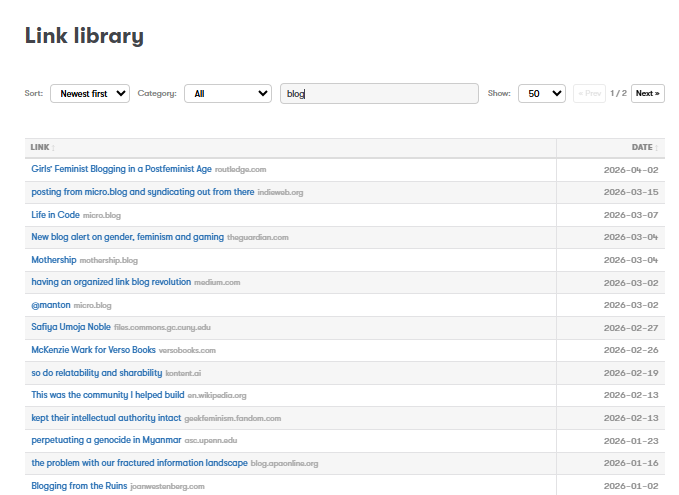
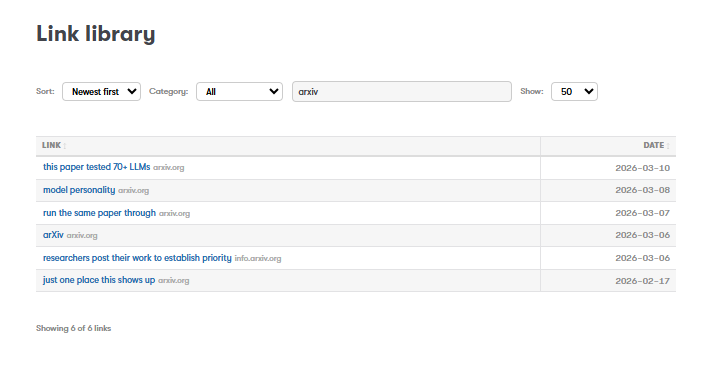
Testing a new feature I created using a mix of open source code and Claude, hoping I didn’t break my own site. I pulled together a dynamic link library using a Hugo partial and some shortcode that automatically catalogs all of my outbound links into sortable lists.
I’ve been dismayed to find out how much schoolwork happens in Google Classroom in 2026, especially since the COVID shutdown accelerated the shift. My kiddo has received a good deal of math instruction through digital modules, and I’ve learned that if I want her experience to be different, I need to be prepared to pay out of pocket for a private tutor (a scenario taken for granted by much of the commentariat). At the same time, I learned that our local school district is struggling to keep up with the costs of all the hardware and software it committed to over the years, ostensibly for educational continuity, equity and access. Do we need the tech or not? Who decides what it means and how it’s applied? Chicken, egg.
I think it would be foolish to throw up our hands and say the kids need paper and pencil and nothing else, and yet that’s where the discourse is going. I have low confidence that our current landscape will produce a sane and reasonable solution to this tangle – even Haidt is selling you a product here. Until then, we need to consider what it means to offload the costs, accountability, and responsibility for this technology onto school districts, parents, and children, many of whom do not have the time, resources, or know-how to curate an ideal tech experience on nights and weekends.
She draws on Acemoglu and Restrepo’s concept of “so-so” technologies and traces a pattern from MOOCs to DOGE, where each iteration promises transformation but delivers incremental improvements at best and labor displacement at worst. The real danger, she argues, is that AI’s most compelling use case in the current political environment is threatening, demoralizing workers and justifying cuts, not revolutionizing how work gets done.
Cottom has been one of the writers I keep returning to because she is not dismissing the technology or retreating into reactionary nostalgia. She looks past the product announcements to the political economy underneath them. Who benefits from the hype cycle? What happens to the institutional infrastructure (education, research, public expertise) that AI claims to augment and simultaneously threatens to starve? She’s also very active on Instagram (and promoting a new documentary) and tracing the news around AI and higher ed in real time.
The move from a structuralist account in which capital is understood to structure social relations in relatively homologous ways to a view of hegemony in which power relations are subject to repetition, convergence, and rearticulation brought the question of temporality into the thinking of structure, and marked a shift from a form of Althusserian theory that takes structural totalities as theoretical objects to one in which the insights into the contingent possibility of structure inaugurate a renewed conception of hegemony as bound up with the contingent sites and strategies of the rearticulation of power.
This was my era in college, and I remember feeling challenged and overwhelmed as an undergrad trying to read theory for the first time. So today, I asked Claude.ai to put it in plain language, just to see what would happen. Here’s the after:
Scholars used to think that capitalism shaped society in consistent, predictable patterns. But newer thinking focuses on how power works—how it repeats, overlaps, and gets reshaped over time. This brought time into the picture and moved away from older theories that treated social structures as fixed. Instead, recognizing that structures can change opened up a new way of understanding power: it's tied to specific moments and strategies, and it's always being renegotiated.
French overlooks how smartphones and social media raised the stakes on debate and discussion, transforming campus discourse. Today’s students worry that one viral misstep (in countless directions) may define them forever.
If you spend time around cycling and pedestrian advocates, the debate between bans and regulations is familiar territory. When I got deep into road biking, where I learned to ride long distance through a red state with almost no bike infrastructure outside tight urban and exurban areas, one of the best things I did was take road classes through the League of American Bicyclists. You learn the rules of the road from a cyclist’s perspective and practice skills like riding with car traffic under expert guidance, including how to change a flat on the side of the road in the height of summer, gritty with sweat and road grime.
The challenge is that bike education isn’t standardized, so most cyclists never learn the fundamentals anyway. Many of us learned as kids and haven’t had a refresh since. I get stomach pain when I see people riding at night without a light, going too fast on a dedicated path, and adults riding their bike on a pedestrian sidewalk. But when I think about e-bike bans and pedestrian right-of-way debates, it strikes me that outside of getting a driver’s permit for car drivers, there’s essentially no infrastructure for learning how to share roads and paths safely. We’re trying to regulate behavior most of us didn’t learn in earnest.
UW-Madison is among universities seeing federal terminations of international student visas. Public research universities have come to rely on these students to offset funding cuts. The losses are both financial and cultural.
This book isn’t in Epilogue so I can’t log it properly, but it’s an okay primer on change communication. For higher ed, the emphasis on engaging leadership and governance is handy. 📚
In recent history I stopped posting on most social media and moved to the fediverse. I still browse the social platforms to keep up with trends and friends, but I only post on my private IG and here.
What I share here is separate from but related to my professional life — I’m thinking out loud and making room for rough, unfinished ideas. I write mainly for myself, but if others find it useful, that’s great. The practice of reading and reflecting makes your thinking stick, and I am from a certain time and place, so this is how I approach learning and communicating about what I’m learning. It’s a habit.
While this is my preferred approach, I acknowledge that sharing unfinished ideas publicly is risky and you have to accept accountability for the messiness that comes with that. But I also know that working through your vulnerability through the act of writing lets you tap into your most creative, innovative self and test your ideas against an evolving sense of what’s good. The potential for an audience, however real or implied, keeps you more honest and less self-indulgent. Despite the trade offs, I think it’s worthwhile.
Writing for the public in an age of anxiety: “This article identifies five topoi of this new rhetorical landscape—presence, persistence, permeability, promiscuity, and power—describing the anxieties and affordances they present for student writers, the dispositions toward writing they foster, and the challenges and opportunities they pose for composition. This framework provides a critical vocabulary for compositionists seeking to help those who negotiate emerging networked publics.”