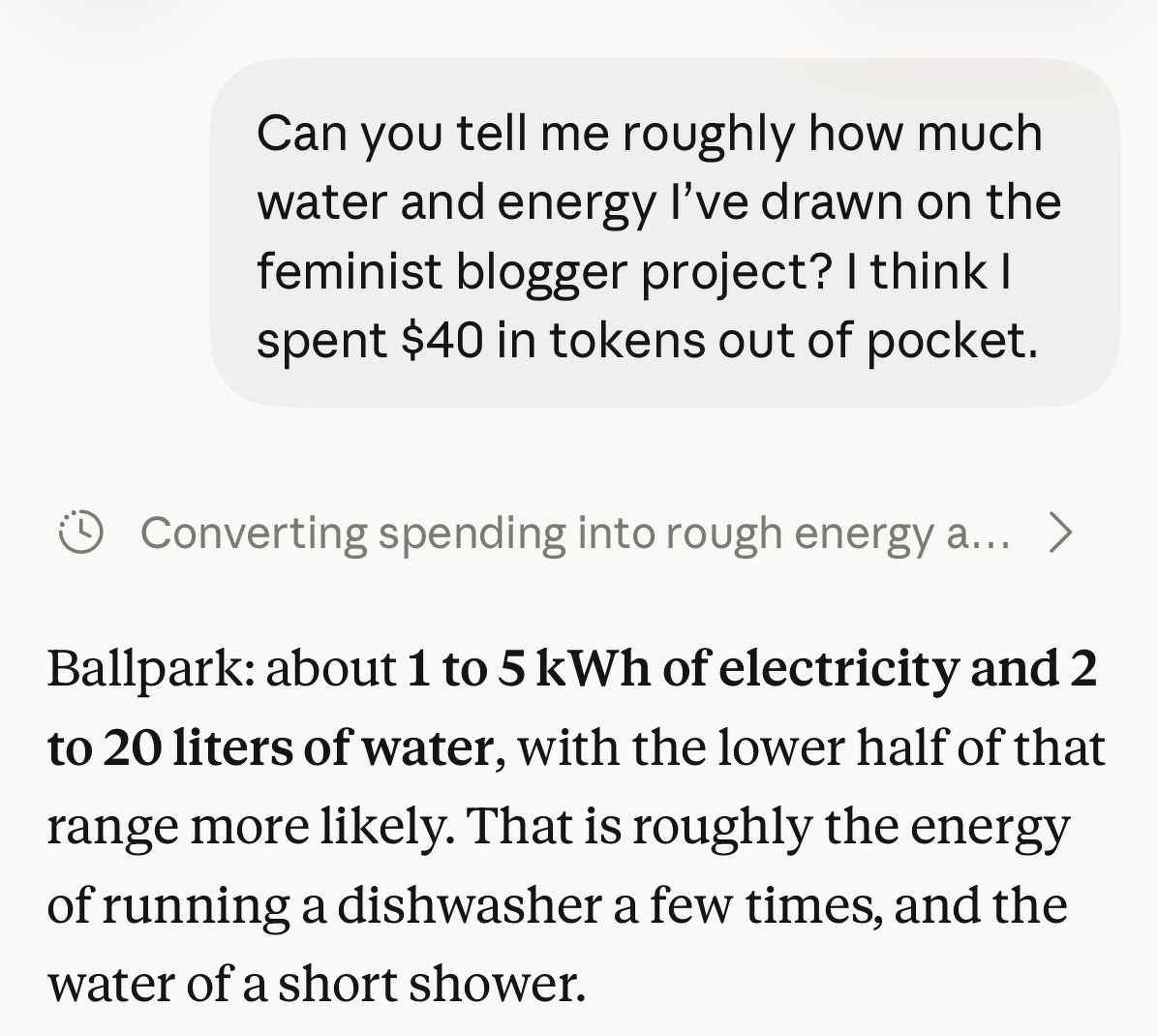
Access to tech: Enterprise level. Claude Pro plus added tokens (~$40 out of pocket after I ran through Claude Pro’s compute).
Process: Gemini pulled a roster based on the Roberts article in Jezebel. I strongly suspect my call for a “roster” shaped the inputs and outputs, making this cohort of writers look like a crew of fantasy football players or Marvel characters. All stats.
I asked Claude to analyze the data from my perspective, which includes people and details that aren’t part of the formal record, allowing for compare and contrast. To get here, I had to publish and republish the prompt almost forty times to better anonymize the data while protecting the writers included.
The “thickness” heuristic applied is totally made up - Claude took my thoughts about Donna Haraway and McMillan Cottom’s work and wove them through my thoughts about information architecture that I first learned from Dr. B.
Claude scanned the final draft for legal and privacy concerns. Everything here is publicly available online today, because it is currently live or lives somewhere as a ghost in the machine, whether via Wikipedia or the Wayback Machine or otherwise.
Blog note: Because of how my blog is set up to automagically find Wayback links for old URLs, if I publish my reference list, it would open a social and informational can of worms. So the (extensive) reference list will continue to live on the Claude report rather than being indexed into my link library.
I gave Claude permission to look across public data, crack windows and open doors, and to annotate and proceed as it worked, rather than keeping the decisions with me, then shaped the final strawman into what’s here. This took about half a day to pull together - yammering at the data within the Claude interface until it looked reasonable. Imagine having resources and a data scientist apply themselves here, with long reach and memory, with implications for trust, safety, consent and memory in every direction.
In the meantime Claude shut me down for the week (too much compute). I had to wait until this morning to ask Claude how much energy it took to run this report as I did, as a rookie and everyday practitioner.
Machines and machine learning change the ways we think about humans and humanity. In cyberspace, we create “digital doubles,” or data doubles, or digital human twins (DHTs), and now these digital doubles move through assemblages of AI systems. New politics are emerging from this tangle.
In our community, the kids were in remote learning for a full year and a half, and the IT department chased them around their approved digital tools like a game of whack a mole, shutting down access to chat and collaboration. In the meantime, almost no socialization happened between students that wasn’t directly observed by teachers. By 2021, the kids were engaged in secret, digital note-passing, chatting within Google docs and PPT slide decks and Pinterest DMs to avoid teacher surveillance on their approved tools. Where there is a will to socialize, there is a way.
Business Insider provides an update on how teen social media bans are going in Australia, and it’s not great! After a few months, kids steadily got back online, nearing or matching pre-ban levels.
Question for parents: How are you teaching your teens to stay safe and think about safety and security while they surf, shop, chat and learn on their digital apps and devices? Are you sharing books, articles and videos with one another? If so, which ones? I’m asking for a friend; the friend is me.
A smart take on nonconsensual deepfakes, considering them not just as a social issue but as a cybersecurity issue, as they’re often connected to broader financial and social harassment campaigns.
The education sector is a big target for cyber attacks, with higher ed being one of the largest and most sensitive targets for bad actors. A recent study shows that education is unprepared as a sector and many institutions lack resources to support a thoughtful and robust cybersecurity program.
There’s a reasonable argument that this is the single biggest breach of public data by private person, ever. NYT gift link: www.nytimes.com/2025/02/1…