# F L O T I S S E R I E
> Follow @flotisserie on Micro.blog.
---
# 2026-10-01
*2026-10-01* — https://flotisserie.micro.blog/2026/10/01/within-this-report-the-llm.html
Within this report, the LLM reflected my concern about my old blog appearing to be the center of these old networks. In fact, this is an effect of me pouring into the model. It says:
_The compiler appears on this page more often than her place in the blogosphere warrants. That emphasis is an effect of how large language models work: the models that compiled the page (Gemini and Claude) build their output from the material in front of them, and the compiler's recollections were the fullest source they had, so her name attached to claims as their source and her own path filled more of the page than the record supports. This version names her less and marks firsthand claims as "firsthand."_
I asked Claude why LLMs work this way:
**Context outweighs training data.** A model has two sources: what it absorbed in training and what sits in the prompt. For feminist blogs of the 2000s, the training data is thin and scattered. Many of those blogs are dead links, partial Wayback captures, or sites that only show up as names in other people's blogrolls. Your recollections, by contrast, were dense, specific, and right there in the context window. Generation is conditioned on that context, so the model draws the words, names, and connections it gives the highest probability from the prompt far more than from faint training memories. The fullest source sets the terms for everything else.
**Source and subject merge.** When you write "I remember that X linked to Y," the text contains two facts: something happened between X and Y, and you are the one reporting it. [LLMs are semantically responsive to triangulation of meaning ~LB] Models don't track provenance well, so the narrator's name tends to drift into the content. "Compiler recalled" turns into "Compiler was part of," and the person reporting a network becomes a node in that network. Your note's phrase "her name attached to claims as their source" describes this accurately. It is a familiar failure in summarization, and it gets worse as the documents get longer.
**Detail density reads as importance.** Where the record is thin, the model fills gaps by extending whichever thread has the most material, and that thread was your path. A blog you described in four sentences gets more space, more connections, and more apparent centrality than one you mentioned in passing. The page ends up showing how much the compiler knew about each blog. That is a different quantity from each blog's place in the network, and nothing in the process separates the two.
**Training data favors the same names.** Feministe is one of the better-documented blogs from that period. It was archived, cited in academic work, and linked from other surviving blogs. So the model's background knowledge already over-represents the blogs that left records, and your recollections reinforced that bias instead of offsetting it.
**Tuning rewards engagement with user material.** Preference training rewards responses that use what the user supplied. A model that set aside half your recollections as over-represented would probably have been rated lower during training, so it leans toward incorporating whatever it was given.
**Two models compound the effect.** Gemini's output became Claude's input. The second model received a document that was already weighted toward you and treated that weighting as part of the record. Each pass inherits the previous pass's emphasis and adds no correction, because neither model has an outside reference point.
The compiled page presented one person's situated knowledge as a neutral overview, which is close to Haraway's "god trick." Labeling claims "firsthand" puts the situation back on the page. For the notes you plan to write, a useful test is whether that label changes how the model weights claims when it compiles the next version, or only how readers weight them. I expect it changes only readers' weighting unless the prompt also tells the model to give unsourced firsthand claims less space than claims with external citations.
If I were trying to explain this to someone back home, I'd say the business model inverts and empowers compute across the domain of "word processing," which includes semantic code. And because of the dynamics around the single-user interface, it lends more data authority to those outputs than is warranted. At the same time, there is obviously demonstrable value here, but it remains loose and weirdly ungovernable - like the [ghosts in the machine are perhaps us](https://micro.blog/books/9780063443679) after all.
---
# 2026-10-01
*2026-10-01* — https://flotisserie.micro.blog/2026/10/01/reddit-is-ending-rss-because.html
[Reddit is ending RSS](https://www.reddit.com/r/modnews/comments/1wubgvt/continuing_our_infrastructure_updates_whats/) because it's easy to scrape, which is a bummer. Another silo.
---
# 2026-09-30
*2026-09-30* — https://flotisserie.micro.blog/2026/09/30/history-of-the-nwi-hell.html
History of the [NWI “Hell is Real” sign](https://nwitimes.com/opinion/columnists/jerry-davich/article_eed8b622-f3b1-11ef-b28d-9bef18878401.html). More on [Reddit](https://www.reddit.com/r/Indiana/s/KKrxRLFEUY). And more from [Reuters](https://www.reuters.com/article/sports/motor-sports/us-highways-lead-to-heaven-and-hell-for-drivers-idUSNOA050713/) in 2007.
---
# 2026-09-30
*2026-09-30* — https://flotisserie.micro.blog/2026/09/30/a-friend-of-the-blog.html
A friend of the blog recently observed that consultants like Deloitte come to conclusions about technology at the same time as normies and practitioners - because their work is the same, only one is outsourced. Feels like we’re in one of those moments on several tech and social layers.
---
# 2026-09-30
*2026-09-30* — https://flotisserie.micro.blog/2026/09/30/why-good-memes-are-like.html
Why good [memes are like mirrors](https://observer.com/2012/05/a-meme-is-a-mirror-and-when-you-look-into-it-you-see-yourself/). See also: [danah boyd](https://en.wikipedia.org/wiki/Danah_boyd).
---
# Case study
*2026-09-30* — https://flotisserie.micro.blog/2026/09/30/case-study.html
🎵: [Before the Water Gets Too High - Parquet Courts](https://www.youtube.com/watch?v=7s65Zc6ULbo)
**Access to tech:** Enterprise level. Claude Pro plus added tokens (~$40 out of pocket after I ran through Claude Pro’s compute).
**Process:** Gemini pulled a roster based on the [Roberts article in Jezebel](https://www.jezebel.com/how-the-internet-killed-feminism-1839983896). I strongly suspect my call for a "roster" shaped the inputs and outputs, making this cohort of writers look like a crew of fantasy football players or Marvel characters. All stats.
I asked Claude to analyze the data from my perspective, which includes people and details that aren’t part of the formal record, allowing for compare and contrast. To get [here](https://claude.ai/artifact/BGQENXPUPdoJWZTbkZY67K), I had to publish and republish the prompt almost forty times to better anonymize the data while protecting the writers included.
The "thickness" heuristic applied is totally made up - Claude took my thoughts about Donna Haraway and McMillan Cottom's work and wove them through my thoughts about information architecture that I first learned from Dr. B.
Claude scanned the final draft for legal and privacy concerns. Everything here is publicly available online today, because it is currently live or lives somewhere as a [ghost in the machine](https://www.youtube.com/watch?v=s8EU5Sm9GQY), whether via Wikipedia or the Wayback Machine or otherwise.
- Blog note: Because of how my blog is set up to automagically find Wayback links for old URLs, if I publish my reference list, it would open a social and informational can of worms. So the (extensive) reference list will continue to live on the Claude report rather than being indexed into my link library.
I gave Claude permission to look across public data, crack windows and open doors, and to annotate and proceed as it worked, rather than keeping the decisions with me, then shaped the final strawman into what’s here. This took about half a day to pull together - yammering at the data within the Claude interface until it looked reasonable. Imagine having resources and a data scientist apply themselves here, with long reach and memory, with implications for trust, safety, consent and memory in every direction.
In the meantime Claude shut me down for the week (too much compute). I had to wait until this morning to ask Claude how much energy it took to run this report as I did, as a rookie and everyday practitioner.
---
# 2026-09-30
*2026-09-30* — https://flotisserie.micro.blog/2026/09/30/creation-in-the-age-of.html
[Creation in the age of AI](https://harper.masson.us/portfolio/creation-in-the-age-of-ai/).
---
# 2026-09-30
*2026-09-30* — https://flotisserie.micro.blog/2026/09/30/on-living-through-this-long.html
On [living through this long, slow boring](https://www.nytimes.com/2026/09/29/opinion/boring-politics-exhaustion.html?unlocked_article_code=1.FFE.gqHz.69FxRZCSqNF8&smid=nytcore-ios-share).
---
# 2026-09-30
*2026-09-30* — https://flotisserie.micro.blog/2026/09/30/before-enterprise-cmss-there-were.html
Before enterprise CMSs, there were blogs. Before blogs, [there were zines](https://youtu.be/k5Qa0SqAZRc?is=a2un0MZHFiWEQuxz).
---
# 2026-09-30
*2026-09-30* — https://flotisserie.micro.blog/2026/09/30/harvard-business-provides-a-roundup.html
Harvard Business provides a roundup of articles and research showing [practical uses (or not) of AI in the workplace today](https://hbr.org/2026/09/a-collection-of-hbrs-most-insightful-research-on-ai-at-work?tpcc=orgsocial_edit&utm_campaign=hbr&utm_medium=social&utm_source=linkedin).
---
# 2026-09-28
*2026-09-28* — https://flotisserie.micro.blog/2026/09/28/eve-ewing-on-the-slow.html
[Eve Ewing on the slow disaster encroaching on Chicago’s South Side](https://southsideweekly.com/a-slow-and-steady-disaster/), and a relevant companion to the NHJ piece circulating so widely this week. [Also related](https://flotisserie.micro.blog/2026/09/25/gary-indiana-reading-list.html).
---
# 2026-09-27
*2026-09-27* — https://flotisserie.micro.blog/2026/09/27/why-cool-is-hard-to.html
Why [cool is hard to imitate](https://docs.google.com/presentation/d/1_pwJyQVBNRBT9KLF-rvVk1ntjWk2X8xhQqIiQY5ItLI/edit?usp=drivesdk).
---
# 2026-09-27
*2026-09-27* — https://flotisserie.micro.blog/2026/09/27/garbage-day-asks-what-are.html
Garbage Day asks what all the new [embedded AI agents](https://www.garbageday.email/p/am-i-too-boring-to-need-an-ai-agent) are for.
---
# 2026-09-27
*2026-09-27* — https://flotisserie.micro.blog/2026/09/27/plain-language-guide-on-how.html
Plain language guide on how [LLMs are shifting the AI market right now](https://www.theaicowboys.com/blog/large-language-models-llms-ai-engineering-2026).
---
# 2026-09-27
*2026-09-27* — https://flotisserie.micro.blog/2026/09/27/trend-watch-defanging-consumer-surveillance.html
Trend watch: [Defanging consumer surveillance technology by emphasizing cuteness](https://www.theguardian.com/fashion/2026/sep/26/charming-and-disarming-how-metas-technology-packed-muse-harnesses-the-power-of-cuteness).
---
# 2026-09-27
*2026-09-27* — https://flotisserie.micro.blog/2026/09/27/how-highly-formalized-government-processes.html
How [highly formalized government processes are slowing down AI governance at the state level](https://www.nytimes.com/2026/09/27/technology/ai-government-regulation.html?smid=nytcore-ios-share).
---
# Feminist blog cohorts: a (semi-) authoritative remapping using AI
*2026-09-26* — https://flotisserie.micro.blog/2026/09/26/feminist-blog-cohorts-an-authoritative.html
🎵: [Let’s Dance - David Bowie](https://youtu.be/VbD_kBJc_gI?is=-cGHiU-WAMC6rne2)
I’ve spent the last few months annoyed with the incomplete retrospectives around writers and writing online and how we all got here. At work, I use a portfolio perspective to understand working groups, and used a couple of AI approaches to build out a highly contextual, and likely contested, [interactive map charting some of the major players and influences around the feminist blog years, the major platforms, their cultural impacts and major publications](https://claude.ai/artifact/BGQENXPUPdoJWZTbkZY67K). These are case studies and cohorts based on my personal angles mixed with authoritative resources, including a highly annotated bibliography.
Does this feel slimy? I concede it may. But it demonstrates the value of personal writing and thoughtful design in digital spaces despite its many gaps and flaws.
Enjoy and tinker. Feedback is welcome. I’ll have some notes on my approach and why many of these [findings remain heavily qualified](https://flotisserie.micro.blog/2026/02/27/ai-and-the-god-trick.html) in the coming weeks.
---
# 2026-09-25
*2026-09-25* — https://flotisserie.micro.blog/2026/09/25/konstantinos-komaitis-has-started-a.html
[Konstantinos Komaitis](https://www.techdirt.com/user/konstantinos-komaitis/) has started a ten-part series at Techdirt called [The Metric Is Not the Mission](https://www.techdirt.com/2026/09/21/the-metric-is-not-the-mission-history-rarely-announces-itself/). It traces how Big Tech went from building the open internet to reshaping it around its own metrics and incentives. Part I argues that the recurring fights over content moderation, privacy, recommendation algorithms, and AI are symptoms of one long shift.
Search, social networks and recommendation systems solved real problems of navigation and abundance. Eventually each solution becomes the environment itself, and [continues to be optimized for incentives that benefit the companies behind tech solutions](https://www.techdirt.com/2025/12/17/when-the-internet-grew-up-and-locked-out-its-kids/). His phrase for how we've been reading the news about tech is "paying attention to the weather while overlooking the climate."
The historical framing will only pay off if later installments name specific mechanisms and the people who made the decisions, and I'm reading the rest to see whether they do. New parts come out twice a week, with a full PDF at the end.
---
# 1000 Mountains: a Gary, Indiana, reading list
*2026-09-25* — https://flotisserie.micro.blog/2026/09/25/gary-indiana-reading-list.html
🎵: [A Thousand Mountains - Freddie Gibbs and The Alchemist](https://www.youtube.com/watch?v=k3OTpuNep_o)
Yesterday I cut through Gary to get around a traffic jam on the toll road and picked up the Dan Ryan and the Skyway. Since living in Madison, I've made some version of that drive more times than I can count. I grew up south of Gary, at the edge of what a colleague called “[the Chicago ombré](https://southsideweekly.com/a-slow-and-steady-disaster/),” and in my twenties my friends and I spent our weekends in The Region, thrifting our way across Lake County and hitting 18+ hip hop clubs in East Chicago. ([King Von measured the same gradient from the city side in "Took Her to the O.](https://en.wikipedia.org/wiki/Took_Her_to_the_O)”) To many, Gary is the city you drive through on the way to somewhere else.
The Skyway has a long political history: Chicago built it in 1958 with revenue bonds, then the bonds defaulted in 1963, and the city spent the next few decades catching up on deferred maintenance, according to [Louise Nelson Dyble's history of the road](https://trid.trb.org/view/1240128). In 2005, the Daley administration leased it for 99 years to Cintra and Macquarie for $1.83 billion, making it the first existing toll road in the country to be privatized. Eleven years later, the consortium [sold the lease](https://chicago.suntimes.com/2016/6/24/18448534/canadian-consortium-buys-chicago-skyway-lease-rights-for-2-8-billion) to three Canadian pension funds for $2.8 billion. The crossing now costs $8.10 in a car, and [CBS Chicago reports](https://www.cbsnews.com/chicago/news/chicago-skyway-tolls-increase-2026) that tolls have gone up more than 200 percent since the lease, about three and a half times the rate of inflation.
Indiana saw the incentives in this arrangement and followed along. In 2006, then-governor Mitch Daniels leased the Indiana Toll Road to the same Macquarie-Cintra group for 75 years and $3.8 billion, and he used the money to pay for [Major Moves](https://www.in.gov/indot/current-programs/major-moves/), his statewide highway program. [Stateline's 2012 retrospective](https://stateline.org/2012/06/19/indiana-highway-building-ramps-up-as-daniels-term-winds-down/) called the lease one of the most divisive things Daniels did as governor. The bill passed without a single House Democrat, and the Region hated it. At a [town hall in Crown Point](https://www.wthr.com/article/news/daniels-faces-tough-comments-from-toll-road-lease-opponents/531-795ee306-550a-4bd3-b791-d717a221bc65), one resident told Daniels the deal amounted to taxation without representation. The operator [went into Chapter 11 in 2014](https://en.wikipedia.org/wiki/Indiana_Toll_Road_Concession_Company), and an Australian fund bought the lease the next year for $5.7 billion. A big share of the original money built [I-69](https://www.in.gov/indot/projects/i69/) between Evansville and the Crane Naval Base, at the other end of the state. When Eric Holcomb later [approved a truck toll hike in exchange for another $1 billion](https://www.nwitimes.com/news/local/govt-and-politics/state-to-receive-billion-in-exchange-for-allowing-higher-truck/article_640a7253-34cb-5bfe-a7fd-5b653ba4ef86.html), he had to deny in public that the Region was once again paying for highways its drivers would never use.
The state keeps the paperwork on deals like these. The [Indiana State Archives](https://www.in.gov/iara/home/) [opened a new downtown building](https://indianacapitalchronicle.com/2026/09/24/inside-indianas-new-downtown-archives-where-state-history-gets-a-new-home/) in Indianapolis on Thursday after 25 years in a "temporary" warehouse on East 30th Street, a former RCA record-stamping plant whose roof leaked partly because people shot holes in it. An old combination safe in the new building holds the state's original constitutions, Jim Jones's church incorporation papers, and Donald Trump's application for a casino in Gary. Upstairs, a conservator expects to spend four to six weeks piecing together a Porter County survey map that had broken into fragments. The reading room is open to the public Tuesday through Saturday, and the staff asks you to make an appointment so they can pull the boxes before you arrive.
**[Gary has been on the wrong end of these deals](https://flotisserie.micro.blog/2026/02/20/as-a-true-blue-hoosier.html) since before it had a name.** Paige Williams's [New Yorker piece on Gary and U.S. Steel](https://www.newyorker.com/magazine/2025/02/17/gary-indiana-and-the-long-shadow-of-us-steel) asks whether a company town once called "the most miserable city in America" can remake itself. U.S. Steel founded Gary in 1906 to house the workers for its mills, and [in 1920 Carl Sandburg published a poem about how the people running the place saw those workers](https://allpoetry.com/The-Mayor-Of-Gary).
Freddie Gibbs grew up on Gary's east side, and Jeff Weiss has profiled him twice. The [2021 profile in The Ringer](https://www.theringer.com/features/2021/3/10/22319899/freddie-gibbs-grammy-nomination-profile-alfredo-alchemist) catches Gibbs around his Grammy nomination for *Alfredo* and opens on a 2009 visit to his Van Nuys apartment, where [Gibbs told Weiss that robbing freight trains](https://www.nytimes.com/2026/09/23/opinion/ai-politics-railroads-history.html?smid=nytcore-ios-share) was a popular hobby back home. Weiss's earlier piece, [The Miseducation of Freddie Gibbs](https://www.powmag.net/p/the-miseducation-of-freddie-gibbs-2), adds that one of Gibbs's teachers got fired for robbing them too.
(Weiss, bless him, professes not to understand the [rabbit metaphor](https://en.wikipedia.org/wiki/Rabbits_and_hares_in_art) present throughout Gibbs’ work, yet confidently persists.)
Gibbs's father, Warren Tipton, spent about twenty years on the Gary police force and later sang with [the Chi-Lites](https://vocalgroup.org/inductees/the-chi-lites/). He died in May, and [AllHipHop's obituary](https://allhiphop.com/features/freddie-gibbs-mourns-father-warren-tipton-singer-who-once-competed-against-michael-jackson/) places him in the same Gary music scene that produced the Jacksons. That detail stuck with me because my ex-father-in-law was a police officer and chief of police downstate during the same years, and also played drums in a local band. [Jamelle Bouie has historically described](https://www.nytimes.com/2023/02/03/opinion/police-violence-democracy.html) police departments as "jobs for the boys," a steady public paycheck handed to working-class men, and that fits both of their careers better than anything about their relationships to law and order. In towns where the mills were shedding jobs, a badge was one of the few paychecks that came with a pension, and a man who could sing still needed that safety net.
**Policing in the Region** has much uglier chapters than that. The Chicago Sun-Times has spent years [covering the federal case against the Sin City Deciples](https://chicago.suntimes.com/the-watchdogs/2025/06/20/biker-gang-sin-city-deciples-gary-indiana), a motorcycle club founded in Gary in 1967. One member admitted he worked as a Gary police chaplain while killing two men, one of them the son of a former Gary police chief. The Chicago Reader's [Tiger King of the Midwest](https://chicagoreader.com/arts-culture/tiger-king-of-the-midwest/) profiles Roy "Roy Boy" Cooper, who ran a tattoo shop called the Badlands with Bengal tigers in cages next to the chairs. Tattooing was illegal in Indiana then, and Cooper's lawyer reportedly steered him to Gary because the police had bigger problems than a tattoo shop — as long as it paid its taxes. Media Burn has [raw footage](https://mediaburn.org/?p=32835) of Cooper setting a leashed tiger on a pool table while his wife runs through the rest of their animals, which included a grizzly bear and a baboon. In the video, Lady Cooper recommends taking the animals out in public, to the grocery store, socializing them on the locals.
Anderson went through the same collapse with auto parts. General Motors moved in during the 1920s and eventually ran [two divisions there](https://andersonmchs.com/delco-remy-and-guide-lamp/), Delco-Remy for electrical systems and Guide Lamp for headlights. By the time Jon Alpert made [Dirty Driving: Thundercars of Indiana](https://www.hbomax.com/movie/733a25c4-93d9-4f2f-b2f2-c53a5366719d) for HBO in 2008, a town that once had 33,000 GM jobs had empty factories and shuttered stores, and what was left of it went to [the Anderson Speedway](https://andersonspeedway.com/) every Friday night. The Herald Bulletin [caught up with one of the film's drivers](https://www.heraldbulletin.com/community/hbo-film-documents-anderson-life-racing/article_ef3870ba-8939-5944-8745-183f0d4434a3.html), Sammy Hawkins, as he flew home from the New York premiere to a Firestone job in Noblesville that he expected to lose. His line in the film is that Anderson doesn't make cars anymore, but it can still race them and wreck them.
**Music in Gary** started in the mills. Joe Jackson ran a crane and played guitar in a band called the Falcons, which [never got a record deal](https://encyclopediaofarkansas.net/entries/joseph-walter-5988/), so he kept the mill job and trained his sons into the Jackson 5 instead. Their first contract came from [Steeltown Records](https://en.wikipedia.org/wiki/Steeltown_Records), a Gary label, in 1967, and "Big Boy" was a local hit before Motown signed them. Most people in a mill town who can sing still need the day job, and the ones who make it usually leave.
[Detroit turned its losses](https://www.nytimes.com/2026/09/25/opinion/ezra-klein-podcast-abdul-el-sayed.html?unlocked_article_code=1.EFE.w8YL.BO1GiRgg3_F0) into techno. Juan Atkins, Derrick May, and Kevin Saunderson learned Kraftwerk and Parliament from a late-night DJ called [the Electrifyin' Mojo](https://detroithistorical.org/learn/encyclopedia-of-detroit/electrifying-mojo), and by 1987 more than half of Detroit's manufacturing, retail, and wholesale base was gone, as [SPIN reported in 1998](https://www.spinmagazine.com/2019/11/juan-atkins-derrick-may-kevin-saunderson-carl-craig-detroit-techno-october-1998-feature-a-tale-of-two-cities/). Midstory's [Built to Boom](https://www.midstory.org/built-to-boom-how-cars-and-culture-drove-detroits-music-scene/) traces the line from the assembly plants through Motown to techno, and May describes sampling industrial noise, traffic, and construction into his tracks.
The techno ran straight into the rap Jorjiana grew up on. NPR's piece on [how Detroit and Flint became havens for rap dark horses](https://www.npr.org/2023/07/27/1189985872/how-detroit-and-flint-became-havens-for-rap-dark-horses) credits the producer Helluva with a "basement sound" of ominous pianos and synth stabs, which he built by crossing West Coast gangsta rap with Detroit techno, and it describes the Flint rappers as a crew of flippant, vulgar jokers. [Flintside's history of the Flint scene](https://www.flintside.com/features/flint-hip-hop-golden-age.aspx) shows how a co-sign from Detroit's Peezy lifted Rio Da Yung OG and everyone around him. Lil Yachty [spent years showing up on Michigan records](https://packs.substack.com/p/lil-yachty-is-finding-himself-in), and he later vouched for Jorjiana too.
**[Jorjiana is 21, and a single mom, and from Michigan City, just down the shore from Gary](https://www.simonandschuster.com/books/My-Mothers-Daughter/Tracy-Clark-Flory/9781668083321).** The Times of Northwest Indiana [profiled her recently](https://www.nwitimes.com/life-entertainment/local/music/article_bb62c49f-3b0c-5fcf-9d7c-808617725351.html) after "ILBB2" took off, and her [Complex interview](https://www.complex.com/music/a/j-rose/jorjiana-doesnt-even-know-what-an-industry-plant-is) covers a childhood spent moving between relatives while her parents struggled with addiction. By her account, her music career started with screwing around with her friends around town. She and her friends were bored during the pandemic, so they freestyled in her car, and she posted the results, doing actual numbers. She told [Justin Moran](https://justinmoran.substack.com/p/whos-that-jorjiana) that her friends talked her into cross-posting the TikTok clips to Instagram, which she barely used, and that's where the A&Rs found her. At the time she didn't know what an A&R was. In [a clip Complex posted](https://www.tiktok.com/@complexmusic/video/7488410757634329886), she admits she doesn't know who Freddie Gibbs is either, so what ties her to Gary is the shoreline more than any influence. She should get familiar with his catalog (and a metronome!).
Plenty of good bands started as friends goofing off: Devo began as a satirical art project at Kent State, and the Maels studied graphic design and film at UCLA before Sparks. Edgar Wright's [The Sparks Brothers](https://www.empireonline.com/movies/news/the-sparks-brothers-edgar-wright-documentary-first-trailer) spends a lot of time on how they built their act for [Top of the Pops closeups](https://www.kexp.org/read/2022/12/21/50-years-of-music-1974-sparks-this-town-aint-big-enough-for-both-of-us/). Both bands treated the dominant screen of their time as part of the instrument. Jorjiana's screen is the short-form feed, and I've been watching her work it for the last year or so: snippets of songs previewed, clips pushed to every platform, [a freestyle on On The Radar](https://www.youtube.com/watch?v=qlrn9GgBYt0) at the end of 2024 that brought more than a dozen labels calling, [a GloRilla remix](https://en.wikipedia.org/wiki/ILBB2), and co-signs from Lil Yachty and GloRilla.
**If you want to know** what Gary is doing now, read [Capital B Gary](https://gary.capitalbnews.org/), which covers the city more consistently than anyone else. Start with their [feature on Koney King](https://gary.capitalbnews.org/koney-king-restaurant-gary/), a Broadway diner that has been serving chili for more than a century, and then look through their [2024 year in photos](https://gary.capitalbnews.org/through-our-lens-the-stories-that-shaped-gary-in-2024/), which has residents cleaning up parks on the East Side and crowds on the beach for the eclipse.
I, myself, [had a run-in with a white supremacist Indiana biker gang in my twenties in West Lafayette, also connected to a money-laundering tattoo shop](https://en.wikipedia.org/wiki/Hammerskins). Someday I’ll commit the story to paper.
**Other notes:** Akron went through its own version a decade later, with rubber instead of steel. Midstory's history of [how Akron became "the new Liverpool"](https://www.midstory.org/how-akron-became-the-new-liverpool-of-punk-music/) describes Devo, Tin Huey, the Bizarros, and the Rubber City Rebels as kids from factory families trying not to follow their fathers into the plants. The scene got its home during one of the longest rubber workers' strikes in the city's history, when the Rubber City Rebels took over a rubber workers' bar called the Crypt, as PBS Western Reserve tells it in [It's Everything, and Then It's Gone](https://www.pbswesternreserve.org/productions/its-everything-and-then-its-gone/). Chris Smith's [2024 Devo documentary](https://consequence.net/2025/07/devo-documentary-netflix-release-date) picks up the story from Kent State and follows the band into the early days of MTV.
A recent article on the [Indiana Quaker community's place in the Underground Railroad](https://fpinews.org/rural/2026/09/24/quaker-meeting-house-underground-railroad-pendleton-2/).
---
# Two steps forward, one step back
*2026-09-25* — https://flotisserie.micro.blog/2026/09/25/two-steps-forward-one-step.html
While I still go back to Haraway's ["Situated Knowledges"](https://www.jstor.org/stable/3178066) for the argument that every view comes from somewhere, these days, the writer I read most closely on technology is [Dr. Tressie McMillan Cottom](https://en.wikipedia.org/wiki/Tressie_McMillan_Cottom).
Haraway asks where a knowledge claim is standing, while Dr. Tressie asks who pays for it. [*Lower Ed*](https://en.wikipedia.org/wiki/Lower_Ed) traced how for-profit colleges sold credentials to audiences the rest of higher education had shut out. In a [TikTok mini-lecture on AI, politics, and inequality](https://www.tiktok.com/@black_was_genius/video/7426166861240323370), she carried that analysis forward using [Daniel Greene's "access doctrine,](https://logicmag.io/distribution/the-access-doctrine/)" which holds that the answer to economic inequality is more skills rather than more support, and which universities facing their own precarity have leaned into. [Audrey Watters](https://2ndbreakfast.audreywatters.com/when-knowledge-is-dangerous-but-information-is-power/) and [Ed & Class](https://ghost.edandclass.com/ai-politics-and-inequality-from-tressie-mcmillan-cottom/) both wrote it up.
Her [March 2025 *Times* column](https://www.nytimes.com/2025/03/29/opinion/ai-tech-innovation.html) argued that the fantasy appeals to risk-averse organizations because it promises control and oversight. [Neil Selwyn's notes on the column](https://criticaledtech.com/2025/05/13/acknowledging-the-mid-ness-of-educational-ai-notes-on-tressie-mcmillan-cottom-2025/) apply it directly to educational AI.
Her question fits my work life better right now while AI begins to show up in procurement, policy and training decks, and her ongoing attention to pedagogy keeps the conversation tied to what happens between a teacher and a student. [I read Haraway for the epistemology](https://flotisserie.micro.blog/2025/11/01/returning-to-haraway.html) and [Dr. Tressie for the current evidence](https://flotisserie.micro.blog/2026/03/06/reaching-back-to-to-put.html) of how it plays out in real classrooms.
---
# 2026-09-25
*2026-09-25* — https://flotisserie.micro.blog/2026/09/25/noted-because-im-using-gemini.html
Noted: Because I’m using Gemini to find and complete resources related to the earliest blog years, I’m citing a [Clancy](https://english.louisiana.edu/node/210) throughout my project, which the LLM keeps pulling back to center events and articles related to the [Clancy trial](https://www.cornellsun.com/article/2026/09/how-social-media-hijacked-the-lindsay-clancy-trial).
---
# How long before Claude or Gemini cite a new webpage?
*2026-09-25* — https://flotisserie.micro.blog/2026/09/25/how-long-before-claude-or.html
Neither company publishes a timeline, and most of the numbers floating around come from SEO consultants, so treat this as rough. The short answer is that Gemini usually gets there faster because it searches Google's index, while Claude appears to search Brave's, which fills in more slowly.
Gemini grounds its answers in Google Search, so its lag is roughly Google's indexing lag. That can mean a few days for a page on an established site and two to six weeks for everything else. If your robots.txt blocks [Google-Extended](https://developers.google.com/search/docs/crawling-indexing/google-common-crawlers), Gemini won't use your pages for grounding at all.
Anthropic hasn't officially named its search provider, but the evidence points to Brave: Brave is on [Anthropic's subprocessor list](https://trust.anthropic.com/subprocessors), and one analysis found about 79% of Claude's cited URLs in Brave's top 10. [Brave mostly discovers pages that already rank on Google or Bing, or that enough Brave browser users visit](https://merj.com/blog/how-brave-search-discovers-new-pages). For a low-traffic site, that can take weeks or months.
If you paste a URL directly into either chat, the model reads the page right away without waiting on any index. To check whether you're findable, search your domain on [search.brave.com](https://search.brave.com/) and in [Google Search Console](https://search.google.com/search-console/about). Blocking ClaudeBot, the training crawler, doesn't stop Claude from citing you; [Claude-SearchBot](https://support.claude.com/en/articles/8896518-does-anthropic-crawl-data-from-the-web-and-how-can-site-owners-block-the-crawler) is the one that governs search.
Fellow [SEO/GEO nerds](https://flotisserie.micro.blog/2026/02/13/ive-been-writing-about-how.html) are citing an average of six days to show up in Google’s systems, though it is sometimes taking as long as thirty days on smaller, less-visited sites.
---
# 2026-09-25
*2026-09-25* — https://flotisserie.micro.blog/2026/09/25/grief-resources-from-fellow-internet.html
[Grief resources](https://www.sayheylenee.com/grief-resources) from fellow internet long-hauler [Lenée](https://www.sayheylenee.com).
---
# 2026-09-24
*2026-09-24* — https://flotisserie.micro.blog/2026/09/24/watched-the-craft-with-the.html
🍿 Watched The Craft with the teenager tonight. Her observation: “Everyone looks so normal in the nineties. Look at their teeth!”
---
# 2026-09-22
*2026-09-22* — https://flotisserie.micro.blog/2026/09/22/machines-and-machine-learning-change.html
Machines and machine learning change the ways we think about humans and humanity. In cyberspace, we create "digital doubles," or data doubles, or digital human twins (DHTs), and now these [digital doubles move through assemblages of AI systems](https://link.springer.com/article/10.1007/s00146-025-02632-z?fromPaywallRec=false). New politics are emerging from this tangle.
---
# 2026-09-22
*2026-09-22* — https://flotisserie.micro.blog/2026/09/22/reading-about-personalized-llms-and.html
Reading about [personalized LLMs and the risks of the digital twin metaphor](https://link.springer.com/article/10.1007/s00146-026-02875-4).
---
# 2026-09-21
*2026-09-21* — https://flotisserie.micro.blog/2026/09/21/witch-doctor-erykah-badu-and.html
🎵: [Witch Doctor - Erykah Badu and The Alchemist](https://www.youtube.com/watch?v=zbJulCKneRM)
Over the weekend, I asked Gemini to examine the career trajectories of the authors in [this 2019 Jezebel article by Soraya Roberts, which covered the ins and outs of the major conflicts that erupted over the feminist blogs](https://www.jezebel.com/how-the-internet-killed-feminism-1839983896).
(I am [sad to hear that Soraya passed away last month](https://defector.com/soraya-roberts-was-a-great-critic-and-a-great-hang). During her research for this article, I enjoyed discussing the technical details that created these spaces and how our collective work facilitated everything that came afterward, or didn't. I know Soraya was hanging a lot of her career on this article and felt it was poorly handled at the time, speculating it was because the voices most implicated by the research now manage the levers of publishing.)
Knowing Google has the juice for search, including all the missing bits deprecated over time, I asked it what technical and social lessons were learned, assuming Gemini could treat that work like a portfolio and provide a business analysis with the full benefits of hindsight.
Per Gemini, links added by me:
**Looking back at the mid-2000s**, the feminist blogosphere achieved extraordinary cultural breakthroughs, but it also operated with distinct technical and social failings and prejudices. By treating cyberspace as a purely ethereal or detached realm, bloggers unintentionally reproduced offline power dynamics, a [phenomenon known as the "digital twinning" of cyberspace](https://www.science.org/doi/10.1126/sciadv.aeh8260).
Viewed through a critical, retrospective lens, four major areas show where different choices around technology, institutional strategy, and social solidarity could have altered digital feminism's trajectory.
**1. Technical: platforms are not neutral**
The early blogosphere largely treated technical tools (like WordPress, Blogspot, Google Search, and ad networks) as neutral pipes rather than [profit-driven entities with embedded incentives](https://www.wiley.com/en-us/shop/general-philosophy/platform-capitalism-p-9781509504862). Bloggers built incredible social capital on free or cheap third-party services without owning the underlying code or digital infrastructure. When Web 2.0 shifted toward algorithmic feeds and centralized social media (Twitter, Facebook), bloggers willingly migrated their engagement to those platforms to chase larger audiences.
- **Protocol-Level Investment:** Instead of relying on proprietary platforms, the cohort could have invested in building and maintaining independent digital commons, including [federated software](https://flotisserie.micro.blog/2026/09/21/old-playbook-new-eyes.html), cooperative hosting collectives and shared digital archives owned directly by the movement.
- **Data Sovereignty:** Early writers rarely anticipated how their essays, comment sections and personal narratives would be scraped, monetized, and eventually used as training data for commercial algorithms and search engines. Establishing strict open-source licensing (such as [Copyleft](https://www.gnu.org/licenses/copyleft.html) or [peer-production licenses](https://wiki.p2pfoundation.net/Peer_Production_License)) and sovereign archiving practices could have protected intellectual labor from platform extraction.
**2. Reproducing social hierarchies online**
["Digital twinning" can mean several things in context](https://journals.sagepub.com/doi/10.1177/14614448251338284), but in our case it refers to the way [online spaces mirror (and often amplify) offline power structures like race, class, disability and educational privilege](https://link.springer.com/article/10.1007/s00146-025-02692-1). While early blogs claimed to be radical open spaces, their structures often recreated corporate and academic gatekeeping.
Many of the highest-profile blogs were anchored by white, college-educated, urban writers who inadvertently treated their lived experiences as the "default" feminist lens. Marginalized writers, particularly Black, Indigenous, AAPI, disabled, and trans writers, frequently had to demand inclusion, fight for citation, or build separate spaces ([Racialicious](https://carmenvankerckhove.substack.com/p/success-made-me-miserable-so-i-walked), [Crunk Feminist Collective](https://www.crunkfeministcollective.com/), [Reappropriate](https://reappropriate.co/), [FWD/Disabled Feminists](https://disabledfeminists.com/)) to address the dominant blogs' weak spots.
- **Resource and Power Redistribution:** Rather than treating traffic and ad revenue as individual metric wins, major sites could have operated as resource-redistribution networks—directly funding, platforming, and sharing domain authority with writers from marginalized backgrounds from the outset. This is what Feministe.us aimed to do with [our rotating lineup of guests](https://flotisserie.micro.blog/2026/04/07/while-poking-around-for-some.html), with mixed results.
- **Rethinking "public" vulnerability:** The blogosphere heavily rewarded raw, highly personal exposure ("confessional blogging"). However, this cost was asymmetric: white, middle-class bloggers often parlayed personal exposure into book deals, while marginalized bloggers faced severe offline economic risk, doxxing and targeted harassment for sharing the same level of personal detail. Many of us also needed to earn a paycheck with benefits. Depending on your demographics, angles and timing, writing opportunities were limited, and only a small fraction of the talent generated in the collective saw durable career impacts. A more intentional approach would have prioritized pseudonyms, pen names, shared authorship, and safety-first rhetoric.
**3. The siren song of individual upward mobility**
The most consequential structural shift was how the blogosphere interacted with traditional media and corporate capital. As more corporate outlets (Jezebel, HuffPost, The Guardian) realized feminist commentary drove clicks, they offered individual bloggers lucrative staff jobs, book deals and column spaces. This [transformed a collective political movement into a pipeline for individual career advancement](https://www.hachettebookgroup.com/titles/andi-zeisler/we-were-feminists-once/9781610395908/). As top talent moved into legacy media, independent blogs lost the labor needed to sustain them.
- **Building cooperative media outlets:** Instead of individual writers accepting staff roles at corporate outlets, the cohort could have formed reader-owned media cooperatives (similar to worker-owned publishing models today). This would have allowed writers to earn a sustainable living while keeping their intellectual output in a community-controlled space.
- **Resisting algorithmic speed:** Legacy media required bloggers to output somewhere between 3-10 quick, hot-take posts per day to satisfy ad-driven impression quotas. Resisting this pressure in favor of slower, deeper, "thick" theory would have preserved the intellectual rigor of the spaces instead of reducing feminism to consumable digital commentary.
**4. Politics: Hesitancy to be the "fly in the ointment"**
Beyond technical tools and corporate pipelines, there was a profound rhetorical hesitation within many of the era's flagship blogs to comfortably occupy the role of the "fly in the ointment," the deliberate, disruptive presence that insists on [disrupting false consensus to center genuinely aggrieved interests](https://microcosmpublishing.com/catalog/books/12844).
Because [major blogs faced constant, bad-faith attacks from right-wing media and anti-feminists](https://www.dukeupress.edu/empowered), an implicit pressure emerged to project a unified "united front." This often created an environment where internal dissent, particularly from disabled, working-class, trans, or non-white women pointing out the movement's ongoing failures, was framed as unhelpful infighting or a distraction from the broader political battle. The push for a polished, accessible and broadly appealing "Feminism 101" frequently smoothed over the jagged edges of critique.
- **Sanctifying disruption as methodology:** The blogosphere could have explicitly framed the "fly in the ointment" not as a threat to solidarity, but as the primary engine of accountability. Rather than managing or policing internal conflict to maintain a clean editorial brand, blogs could have deliberately designed their platforms to hold open space for radical and uncomfortable grievances within the plurality of feminist thought.
- **Protecting uncommodifiable voices:** Corporate platforms favor palatable, easily shareable commentary by design. By shying away from deeply uncomfortable, non-mainstream grievances, the blogosphere left a vacuum filled with endless explainers. A more resilient model would have actively protected and amplified the most uncompromising, "unmarketable" voices, including those whose positions could not be sanitized for an ad sponsor or a cable news segment.
By failing to fully institutionalize the "fly in the ointment" as an essential, protected role within digital spaces, the early blogosphere left itself vulnerable to the corporate absorption that eventually dismantled it. When mainstream media stepped in, it easily plucked away the polished, palatable commentary while abandoning the uncomfortable, dissenting labor that keeps a political movement expansive and honest.
---
# 2026-09-21
*2026-09-21* — https://flotisserie.micro.blog/2026/09/21/noted-ive-been-playing-with.html
Noted: I’ve been playing with Copilot, Claude and Gemini in tandem, and Copilot and Gemini are suddenly, curiously outperforming Claude by a lot.
---
# Old playbook, new eyes
*2026-09-21* — https://flotisserie.micro.blog/2026/09/21/old-playbook-new-eyes.html
🎵: [Veteran of the Psychic Wars - Blue Oyster Cult](https://www.youtube.com/watch?v=jUwh-C5w7II)
When tech enthusiasts discuss federation today, they usually mean open protocols like [ActivityPub](https://www.w3.org/TR/activitypub/) or Mastodon. But in the 2000s, the feminist blogosphere was one of the earliest, most powerful examples of practical Web 2.0 federation, a decentralized, cross-site architectural network where open web standards powered a global ideas lab.
Instead of sitting inside a single corporate platform (like today's X, Meta, or Substack), early blogs like [Feministe](https://flotisserie.micro.blog/2026/02/13/when-i-started-building-websites.html), Reappropriate and Jezebel functioned as individual nodes in a federated ecosystem. Open protocols linked them, letting theory, critique and discussion travel seamlessly across independent servers, seeding some of the political conditions we face today.
Here is how the [federated architecture of the 2000s web](https://en.wikipedia.org/wiki/Federated_architecture) directly built the "ideas lab" for [fourth-wave feminism](https://en.wikipedia.org/wiki/Fourth-wave_feminism):
**1. Federated communication engine: CMS and protocol**
Before quote-tweeting or tagging existed, the open web used [Trackbacks](https://en.wikipedia.org/wiki/Trackback) and [Pingbacks](https://www.hixie.ch/specs/pingback/pingback). If a post on Feministe analyzed an article about reproductive rights, a writer on Racialicious or Shakesville could respond on their own site. The underlying blogging software ([Movable Type](https://en.wikipedia.org/wiki/Movable_Type), WordPress) would automatically send an [XML RPC](https://xmlrpc.com/) "ping" back to Feministe.
Socially, this created architecture for ideas: a ping automatically listed the response essay in Feministe’s comment section or sidebar. Readers didn't just consume one blogger’s singular and authoritative opinion; they could immediately follow the thread across five different independently hosted platforms. This created an inter-site conversation tree, allowing complex ideas to be cross-examined, refined, or challenged without any single person controlling the narrative.
**2. Blogroll as federated curation and mutual discovery**
Before algorithmic feeds dictated what readers saw, blogs [relied on the Blogroll](https://flotisserie.micro.blog/2026/08/18/some-thoughts-on-linklogs-and.html), a curated list of links in the site's sidebar. Blogrolls formed a human-curated, decentralized routing layer. When a high-traffic node like Feministe added a smaller, independent blog (such as a disability rights blog like FWD or a smaller blog like Crunk Feminist Collective) to its blogroll, it directed server traffic directly to that independent domain.
Socially: This was a non-algorithmic way to expand the collective's political consciousness. It allowed marginalized perspectives to build their own audiences and force mainstream feminist sites to engage with race, class, disability and queer theory. The blogroll mapped an intellectual community in real time -- [with strong caveats](https://flotisserie.micro.blog/2026/08/18/some-thoughts-on-linklogs-and.html).
**3. Open syndication protocols**
The Architecture: Feeds ran on [RSS (Really Simple Syndication)](https://www.rssboard.org/rss-specification), an open XML standard. Readers used independent RSS aggregators (like [Google Reader](https://en.wikipedia.org/wiki/Google_Reader) or Bloglines) to subscribe directly to a site's feed.
Socially: RSS meant no algorithm stood between the writer and the reader—no engagement bait, no rage-farming optimization, and no platform throttling links. Writers could publish 5,000-word, dense theoretical essays knowing their subscribers would receive the complete text in chronological order as designed. This structural stability gave writers the freedom to experiment with complex, "thick" personal narratives and political theory.
**4. Real-time stress testing and spillover moderation**
Because the blogosphere was a network of independent domains, each site maintained its own "house rules" and moderation policies. If a topic proved too controversial or toxic for one comment section, the conversation naturally federated outward. A reader who felt silenced or misunderstood in one blog's comments could launch their own blog, write their response, and ping back into the original discussion.
Socially, this prevented any single author from monopolizing the narrative. It created a system of checks and balances where academic concepts (like intersectionality, rape culture, or microaggressions) were stress-tested across dozens of distinct, interconnected communities simultaneously.
**Thinking about this architecture today**
The feminist blogosphere proved that decentralized web protocols can generate deep, movement-building intellectual work. When platforms like Facebook, Twitter, and corporate media conglomerates centralized the internet in the 2010s, they broke those open connections. Conversations were locked behind platform walls, trackbacks were abandoned and RSS was marginalized, breaking, fencing and otherwise moderating independent community connections.
Rebuilding a modern "ideas lab" with modern federated protocols (like [Webmentions](https://www.w3.org/TR/webmention/), ActivityPub, RSS, and static site architecture) is simply picking up the technical blueprint OG feminist bloggers used to transform digital culture two decades ago.
---
# 2026-09-20
*2026-09-20* — https://flotisserie.micro.blog/2026/09/20/recommended-bike-jerks-and-the.html
Recommended: [Bike Jerks](https://bikejerks.com/) and the [Hodag Country Ramble](https://bikejerks.com/pages/hodag-country-ramble).
---
# 2026-09-16
*2026-09-16* — https://flotisserie.micro.blog/2026/09/16/finished-reading-multipliers-by-liz.html
Finished reading: [Multipliers](https://micro.blog/books/9780062663078) by Liz Wiseman 📚
---
# 2026-09-15
*2026-09-15* — https://flotisserie.micro.blog/2026/09/15/media-on-project-lily-the.html
404 Media on [Project Lily, the ChatGPT project where humans read users' prompts](https://www.404media.co/inside-project-lily-the-humans-reading-your-chatgpt-chats/) -- including sensitive and personal information -- to better train the product.
---
# 2026-09-09
*2026-09-09* — https://flotisserie.micro.blog/2026/09/09/thinking-about-how-the-democratization.html
Eli Lilly redux: Thinking about the democratization of information and the removal of gatekeepers alongside this story I [saw first at Boys' Club](https://boysclub.beehiiv.com/p/vibecoding-schizophrenia-drugs-malware). This Harvard PhD is [vibe-manufacturing schizophrenia drugs](https://x.com/DouglasYaoDY/status/2097377733466800489?utm_source=boysclub.beehiiv.com&utm_medium=newsletter&utm_campaign=vibecoding-schizophrenia-drugs&_bhlid=449d38af6f23b19c8746b94f72a0f127d8767f7f) in his garage. Are we vibe-coding medicine?
---
# Extra credit
*2026-09-09* — https://flotisserie.micro.blog/2026/09/09/extra-credit.html
The university is back in session, so [the city's lineup of food trucks are back](https://www.cityofmadison.com/dpced/economic-development/street-vending/vending-areas) in formation. Some tips:
- [El Wiscorican](https://www.elwiscorican.com/) is a perennial fav, offering a short but very customizable menu. Vegetarian and vegan options are regularly available for those among us who like to keep it light. They'll ask if you want it spicy -- but whatever your expectations are around spice levels, dial it back. The great north is suspicious of the [virtues of capsaicin](https://groveatlantic.com/book/the-core-of-the-sun/). (I recommend the fried plantains.)
- [Saigon Sandwich](https://saigonsandwichwi.square.site/) has one of the best banh mi sandwiches in town, which is pretty wild given that this sandwich is produced by a single person in a box trailer. But with fresh bread and ultra-fresh ingredients, it's a really good one. Nothing beats a fresh banh mi with good bread and snappy veggies.
- Madison boasts (at least) two great fresh juice trucks -- [Fresh Cool Drinks](https://freshcooldrinks.com/) and [Natural Juice](https://isthmus.com/locations/natural-juice/) -- and you're as likely to find them at the end of State Street as you are at the [Saturday farmers' markets](https://dcfm.org/). They both make excellent juice concoctions on the spot, and sell delicious, fresh vegetable spring rolls packed with fresh, local produce.
Several years ago, many people were [weighing the possibility that the Madison food truck economy would struggle to recover after the long shutdown](https://isthmus.com/food-drink/window-of-opportunity/), worried because this scene is one of the things that makes the urban food desert more livable during the workday and supports a great deal of local culture with it. This makes your participation in [the little treat economy](https://www.nytimes.com/2025/08/16/business/gen-z-treat-spending.html) practically a civic responsibility.
---
# 2026-09-09
*2026-09-09* — https://flotisserie.micro.blog/2026/09/09/this-essay-is-circulating-widely.html
This 2013 essay is circulating widely this week. In it, cartoonist Tim Kreider reflects on having anxiety, and in particular the [anxiety he feels while interacting with an increasingly watchful stack of digital tools](https://archive.nytimes.com/opinionator.blogs.nytimes.com/2013/06/15/i-know-what-you-think-of-me/) and on how they provide him with social feedback he's not prepared for.
---
# 2026-09-08
*2026-09-08* — https://flotisserie.micro.blog/2026/09/08/techcrunch-reports-on-the-problems.html
TechCrunch reports on the [problems inherent to AI-generated restaurant advertising](https://techcrunch.com/2026/09/03/the-sameness-problem-behind-those-unappetizing-ai-generated-menus/) - it looks wrong.
---
# 2026-09-07
*2026-09-07* — https://flotisserie.micro.blog/2026/09/07/return-to-markdown.html
Return to [markdown](http://scripting.com/2026/09/07.html#a164356)?
---
# 2026-09-07
*2026-09-07* — https://flotisserie.micro.blog/2026/09/07/finished-reading-suffer-a-witch.html
Finished reading: [Suffer a Witch A Memoir](https://micro.blog/books/9780593855904) by Joy McCullough 📚
---
# 2026-09-06
*2026-09-06* — https://flotisserie.micro.blog/2026/09/06/cap-times-on-electric-heart.html
Cap Times on [Electric Heart, the new EP by Madison songwriter Whitney Mann](https://captimes.com/entertainment/music/whitney-mann-is-back-with-a-new-album-and-it-s-electric/article_70f19f3b-80e9-4f40-ac16-e3f773a37a89.html).
---
# 2026-09-05
*2026-09-05* — https://flotisserie.micro.blog/2026/09/05/in-plain-language-this-suggests.html
In plain language, this suggests that [the way search is reoriented around AI revalued long tail search strings](https://flotisserie.micro.blog/2026/09/03/traditional-search-favored-common-keywords.html), so there are big incentives to link deeply and widely across the corpus, especially if you have access to an authoritative platform.
---
# 2026-09-04
*2026-09-04* — https://flotisserie.micro.blog/2026/09/04/manton-on-agi-as-we.html
Manton on AGI: "As we reach AGI... I’d like to set some ground rules for myself — [beliefs that won’t change as technology changes](https://www.manton.org/2026/09/04/reaching-agi.html). AI will be smarter than us, but consciousness and 'a soul' can’t be created from computation."
---
# 2026-09-04
*2026-09-04* — https://flotisserie.micro.blog/2026/09/04/where-weve-been-todays-young.html
Where we've been: "Today’s young American women were born into a world of unfinished feminism. We have [freedoms our great-grandmothers couldn’t have imagined, but also fewer rights than we did just a handful of years ago](https://www.nytimes.com/2026/09/03/opinion/gloria-steinem-feminism-abortion.html?unlocked_article_code=1.-lA.LgUs.lFxiblcaeyLa&smid=url-share)." Plus, some examination of [how ad tech and algorithmic sorting set the table](https://www.nytimes.com/2026/09/04/opinion/gloria-steinem-feminism.html).
---
# 2026-09-03
*2026-09-03* — https://flotisserie.micro.blog/2026/09/03/traditional-search-favored-common-keywords.html
Traditional search favored common keywords, while [LLMs favor (extremely) long tail search terms because of the idiosyncratic and conversational way people write to chatbots](https://www.bavaria-ai.com/long-tail-keywords-geo-strategy/). Suggesting that a small group of writers on the open web could move the corpus on any coordinated subject in no time at all.
---
# 2026-09-03
*2026-09-03* — https://flotisserie.micro.blog/2026/09/03/in-honor-of-gloria-steinems.html
In honor of Gloria Steinem's passing (rest in power), an article on [the business and activist tensions present in, and the long-tail value of, feminist publishing efforts](https://www.tandfonline.com/doi/full/10.1080/09574042.2021.1973698#abstract). And a 2019 dissertation on [organized literacy education as a civil rights effort](https://ir.library.louisville.edu/cgi/viewcontent.cgi?article=4469&context=etd). A [trip to the bookstore](https://roomofonesown.com/) is in order.
---
# 2026-09-03
*2026-09-03* — https://flotisserie.micro.blog/2026/09/03/this-firstperson-essay-from-the.html
This [first-person essay from The Baffler](https://thebaffler.com/salvos/paid-phones-kolitz) is circulating in writerly crowds this week. It's a ripper and a must-read, enough to convert me to a print subscriber.
---
# 2026-09-02
*2026-09-02* — https://flotisserie.micro.blog/2026/09/02/for-reasons-i-was-reminded.html
For reasons, I was reminded of the [list of Geek Social Fallacies that first circulated on Plausibly Deniable](https://plausiblydeniable.com/five-geek-social-fallacies/), then [took root as an entire body of advice at Captain Awkward](https://captainawkward.com/tag/geek-social-fallacies/).
---
# 2026-09-01
*2026-09-01* — https://flotisserie.micro.blog/2026/09/01/a-composition-teacher-friend-shared.html
A composition teacher friend shared this paper on social media: [Lester Faigley's "Literacy after the Revolution"](https://repositories.lib.utexas.edu/server/api/core/bitstreams/67eacca6-b113-4241-b057-5e830ab29348/content), the essay version of his 1996 [CCCC](https://cccc.ncte.org/) Chair's address. In it, the author argues that the economic impacts of the digital revolution had begun to undo an older commitment, formed in the Civil Rights era, to teaching literacy as a path toward equality. He further argues that writing instruction was being reorganized around tools owned by a few firms (then: Netscape, Microsoft) at a moment when wealth was concentrating upward. Faigley left us with the question of whether educators can hold onto literacy-for-equality while the tides run against it.
Thirty years later, the worry has a new face: AI will do young people's writing for them and their thinking with it. Ultimately, Faigley believed the need for [the skills that composition teaches](https://flotisserie.micro.blog/2026/02/08/my-undergrad-experience-in-college.html) will keep growing, not despite, but because of our need to convey information in and around that technology and the humanity it serves in a complex society. Does that suspicion hold water today?
---
# 2026-09-01
*2026-09-01* — https://flotisserie.micro.blog/2026/09/01/in-honor-of-dolly-rest.html
In honor of Dolly (rest in power), some links:
- [Dolly Parton's America](https://www.wnycstudios.org/podcasts/dolly-partons-america): This nine-episode podcast offers a deep dive into the Dollyverse, covering Dolly's biography and lore and her role as an icon within a broader story about American ideals. This series swept the best-of lists of 2019.
- [Professor and NYT contributor Tressie McMillan Cottom](https://flotisserie.micro.blog/2026/03/06/reaching-back-to-to-put.html) has [long been](https://tressie.substack.com/p/the-dolly-moment) [the public's expert on Dolly Parton](https://tressie.substack.com/p/the-daughters-of-dolly-and-the-limits), and [her memorial tribute to Dolly does not disappoint](https://www.nytimes.com/2026/08/27/opinion/dolly-parton-appalachia-legacy.html?unlocked_article_code=1.8lA.-_f2.GCNixkwaRzlM). She reads Dolly as an auteur who held up the juxtapositions of American culture in a way that made them safely legible to the rest of us. Bonus read: Dr. McMillan Cottom on [the enduring culture of blonde](https://www.nytimes.com/2023/01/19/opinion/the-enduring-invisible-power-of-blond.html?unlocked_article_code=1.91A.LIfF.l8W7-o8kcjwU).
- [A cool embroidery of Dolly Parton by Jenny Hart](https://www.jennyhartstudio.com/).
---
# 2026-09-01
*2026-09-01* — https://flotisserie.micro.blog/2026/09/01/lux-magazine-on-the-return.html
[Lux Magazine on the return of The Rumpus](https://lux-magazine.com/lux-for-life/the-rumpus-interview/).
---
# 2026-08-31
*2026-08-31* — https://flotisserie.micro.blog/2026/08/31/i-found-out-about-a.html
I found out about a hyperlocal newsletter in my neighborhood and had to share. The [Monroe Street Tattler offers print delivery and email distribution](https://monroestreettattler.com/), and reports only on the hard local news, such as dog walk water bowl locations and the best fries in the neighborhood, among other ephemera.
---
# 2026-08-28
*2026-08-28* — https://flotisserie.micro.blog/2026/08/28/students-who-spoke-to-espn.html
"Students who spoke to ESPN said that betting is an accepted part of day-to-day life and that they learned about their school's gambling culture immediately after arriving on campus. A 2023 NCAA survey of 18- to 22-year-olds found that [51% of the women and two-thirds of the men have bet on sports](https://www.espn.com/sports-betting/story/_/id/49547066/sports-betting-gambling-poker-addiction-college-campus-youth)."
---
# 2026-08-28
*2026-08-28* — https://flotisserie.micro.blog/2026/08/28/guerrilla-marketing-when-someone-built.html
Guerrilla marketing: When someone built a fake deodorant company with a lightweight marketing plan to capture long-tail search results, she found her way into AI recommendation results, [showing how brands can gain visibility in emerging discovery systems](https://www.inc.com/jelinda-montes/a-marketer-built-a-fake-deodorant-brand-weeks-later-it-was-being-recommended-over-real-products/91385991).
---
# 2026-08-27
*2026-08-27* — https://flotisserie.micro.blog/2026/08/27/grose-covers-how-scandinavians-approach.html
Grose covers how Scandinavians approach AI and ed tech by [emphasizing peer review and removing the profit motive](https://www.nytimes.com/2026/08/26/opinion/ai-norway-schools.html?unlocked_article_code=1.8lA.QIsd.IZvMBOUHIQTR&smid=url-share).
---
# 2026-08-27
*2026-08-27* — https://flotisserie.micro.blog/2026/08/27/reading-about-yesterdays-meta-settlement.html
Reading about [yesterday's Meta settlement](https://flotisserie.micro.blog/2026/08/26/reading-over-the-b-meta.html), the [global movement to get kids off tech](https://www.nytimes.com/2026/08/26/world/americas/children-social-media-restrictions-global-movement-meta.html?unlocked_article_code=1.8lA.iHhq.ZP2aiVxxl4Eu), "[chopped uncs](https://flotisserie.micro.blog/2026/08/26/we-all-know-that-you.html)," and thinking about the dance between students and our local school system’s IT department during the COVID-19 shutdown, when my then-elementary schooler was [unwittingly participating in a digital cold war](https://flotisserie.micro.blog/2026/05/08/why-im-broadly-skeptical-of.html):
In our community, the kids were in remote learning for a full year and a half, and the IT department chased them around their approved digital tools like a game of whack a mole, shutting down access to chat and collaboration. In the meantime, almost no socialization happened between students that wasn’t directly observed by teachers. By 2021, the kids were engaged in secret, digital note-passing, chatting within Google docs and PPT slide decks and Pinterest DMs to avoid teacher surveillance on their approved tools. Where there is a will to socialize, there is a way.
Business Insider provides an update on [how teen social media bans are going in Australia](https://www.businessinsider.com/australias-social-media-ban-teens-failure-2026-8), and it's not great! After a few months, kids steadily got back online, nearing or matching pre-ban levels.
---
# 2026-08-26
*2026-08-26* — https://flotisserie.micro.blog/2026/08/26/we-all-know-that-you.html
“We all know that you can get lied to online at any point. If you don’t get that this is an obvious lie, [then you’re washed and you’re unc and you’re chopped](https://www.cnn.com/2026/08/20/entertainment/tiktok-switched-questions-meme-disinformation-cec).”
---
# 2026-08-26
*2026-08-26* — https://flotisserie.micro.blog/2026/08/26/reading-over-the-b-meta.html
Reading over the [$18b Meta settlement over social media harms to children](https://techcrunch.com/2026/08/26/meta-settles-for-18-billion-in-lawsuit-brought-by-29-states-over-social-media-harms-to-children/), and while it's not perfect, it's something. I'm a fan of default time limits, night and school-time blocks, and other limits baked into the software. It's not fair to ask every parent to become an IT governance expert.
---
# 2026-08-25
*2026-08-25* — https://flotisserie.micro.blog/2026/08/25/finished-reading-famesick-by-lena.html
Finished reading: [Famesick](https://micro.blog/books/9780008384234) by Lena Dunham 📚
---
# 2026-08-25
*2026-08-25* — https://flotisserie.micro.blog/2026/08/25/to-read-this-report-from.html
To read: this report from Common Sense Media, "[Talk, Trust and Trade-Offs: How and Why Teens Use AI Companions](https://www.commonsensemedia.org/sites/default/files/research/report/talk-trust-and-trade-offs_2025_web.pdf)." About a third of teens have turned to an AI for serious conversations about their own mental health and relationships, showing these tools are already embedded in teen social life.
---
# Computer Love
*2026-08-25* — https://flotisserie.micro.blog/2026/08/25/computer-love.html
I listened to two great podcasts this week exploring the tangle of human/AI relationships. In "[Computer Love](https://open.spotify.com/episode/1hkG0cEqJrBCGw7VclLI4b)," the guests explore whether these relationships are good for us, and in "[Your AI Companion Doesn't Love You](https://open.spotify.com/episode/6aW7lEC4qgHeKaCZ1T99dn)," they explore the technical and business implications of these relationships. Both of these feature podcaster and writer Bridget Todd, who is promoting her new book "[Love at First Prompt](https://www.simonandschuster.com/books/Love-at-First-Prompt/Bridget-Todd/9781668179826)." As of today, [about 1 in 5 young people in the U.S. have asked a chatbot for mental health advice](https://www.rand.org/news/press/2026/06/nearly-1-in-5-us-adolescents-and-young-adults-use-ai.html), and [1 in 5 high schoolers have had a romantic AI relationship](https://www.commonsensemedia.org/sites/default/files/research/report/talk-trust-and-trade-offs_2025_web.pdf).
Note: [Todd's (excellent) podcast](https://podcasts.apple.com/us/podcast/there-are-no-girls-on-the-internet/id1520715907) title is a reference to [Rule 30 of the internet](https://www.dictionary.com/culture/slang/rules-of-the-internet).
---
# 2026-08-24
*2026-08-24* — https://flotisserie.micro.blog/2026/08/24/microbloggers-im-interested-in-turning.html
Micro.bloggers: I'm [interested in turning the link log into a micro.blog plug-in](https://help.micro.blog/t/link-log-proposal/4436), but I don't have the skill or the will to make it happen. Where should I begin?
---
# 2026-08-24
*2026-08-24* — https://flotisserie.micro.blog/2026/08/24/when-accidental-engagement-counts-the.html
When [accidental engagement counts the same](https://www.businessinsider.com/tiktok-accidental-sending-dm-issue-2026-8) as intentional engagement.
---
# 2026-08-20
*2026-08-20* — https://flotisserie.micro.blog/2026/08/20/deep-dive-what-are-platforms.html
Deep dive: [What are platforms](https://www.uu.nl/en/background/what-are-platforms-definition-examples-and-why-they-are-so-powerful), and why do they have so much power?
---
# 2026-08-19
*2026-08-19* — https://flotisserie.micro.blog/2026/08/19/question-for-parents-how-are.html
Question for parents: How are you teaching your teens to stay safe and think about safety and security while they surf, shop, chat and learn on their digital apps and devices? Are you sharing books, articles and videos with one another? If so, which ones? I'm [asking for a friend; the friend is me](https://flotisserie.micro.blog/say-hello/).
---
# 2026-08-19
*2026-08-19* — https://flotisserie.micro.blog/2026/08/19/question-for-microbloggers-can-you.html
Question for micro.bloggers: Can you separate keywords by comma in this category filter field, or is it one word per filter?
---
# Some thoughts on linklogs and link libraries
*2026-08-18* — https://flotisserie.micro.blog/2026/08/18/some-thoughts-on-linklogs-and.html
A linklog is a dated list of outbound links, maybe a tag, and a note about why it's worthwhile. But that little note does two things at once, and together they make for a better web.
First, it's a way of organizing the web. The web doesn't sort itself, so finding good information depends on someone curating and tracking interesting content, preferably on the open, free internet. It acts as a customizable bookmark library: newest at the top, tags to group items, and a line explaining why the link was worthwhile. This is similar to [what del.icio.us did](https://en.wikipedia.org/wiki/Delicious_(website)), where people grouped and tagged links, creating a rough filing system.
Second, it's a social act. An outbound link points to someone else's work, so a linklog is essentially a renewable engine for sending traffic to other people and places. It stays renewable because the content is easy to sort and remix: a URL's relevance no longer depends on where an algorithm or activity feed happens to place it, so older links can keep resurfacing instead of scrolling out of reach. That's the precise opposite of what big platforms design for audiences; platforms such as Twitter, Instagram and Facebook quietly bury posts with outbound links to keep your attention (and dollars) on their site and with their advertising customers, losing relevance after one interaction. A linklog explores the opposing dynamic: it willingly hands your audience and attention away while crediting your forebears, comrades, mentors and co-conspirators. It turns the rough digital filing system into a "[folksonomy](https://en.wikipedia.org/wiki/Folksonomy)," if you will.
Compare these dynamics to an algorithmic feed on a platform. An algo also sorts the flood of content, but computer magic does the sorting, and someone else monetizes your attention and relationships and hoards your data. "Engagement" for these companies is primarily a measure of how long you stay on their platform with their content. The goal is to keep you scrolling and the ad revenue rolling. But over here on the [indie internet](https://indieweb.org/), our goal is to build human communities online and connect people to quality information, tools, ideas and processes.
Back in the day, we had [blogrolls](https://indieweb.org/blogroll), and [blogrolls came with a lot of politics around representation and belonging](https://dl.acm.org/doi/10.1145/1134271.1134277), and [some of those choices had real-world impacts](https://www.tandfonline.com/doi/full/10.1080/13614568.2022.2075942). [Who you listed in your sidebar was a public statement about your community and your allegiances](https://flotisserie.micro.blog/2026/09/21/old-playbook-new-eyes.html); however, though smaller blogs linked to bigger ones, the big blogs rarely returned the attention. That contentious dynamic faded as social platforms became the main sites for online interaction, and the follow list, or the Twitter list, took over the blogroll's old job of [reinforcing networked hierarchies of writers and audiences](https://www.alevin.com/?p=1855). Because a blogroll is a static list of people, it hardens into a status game and is kind of stale the moment someone stops babysitting it; meanwhile, a linklog points at individual pieces of writing one at a time, so it stays current and rewards the work rather than the social and professional standing of the writer.
In this sense, a linklog is an easy way to be an opinionated curator and a decent neighbor at once, by hosting and sharing with thoughtfulness and deliberation. Out here, my data is also likely being scraped, but I have far more control over what data is findable, shared, and shareable, and over what is investigable and degradable over time.
---
# 2026-08-18
*2026-08-18* — https://flotisserie.micro.blog/2026/08/18/posting-a-lot-while-i.html
Posting a lot while I get through the inbox today. Among other stories, WordPress is offering free hosting to students, [marketing WP as a way to change how people relate to their own writing](https://wordpress.com/education/). Does a self-hosted public blog make students think differently about audience than a school LMS post does?
---
# 2026-08-18
*2026-08-18* — https://flotisserie.micro.blog/2026/08/18/chester-argues-that-universities-should.html
[Chester argues that universities should govern AI by classifying data by sensitivity rather than approving specific tools](https://dispatches.timothychester.com/p/ai-governance-is-a-human-judgment). Public data goes anywhere --> regulated data requires an institutional contract --> sensitive data requires a local system. He also makes a renewed case for MS Copilot.
---
# 2026-08-18
*2026-08-18* — https://flotisserie.micro.blog/2026/08/18/community-notes-was-meant-to.html
[Community Notes was meant to democratize moderation power](https://arxiv.org/pdf/2602.08970) (and spare platforms the burden of thinking through moderation). Instead, a new paper shows that 20% of users cast 80% of ratings, and removing just ten active note writers from the pool changes what happens to nearly 5,000 community notes.
---
# 2026-08-18
*2026-08-18* — https://flotisserie.micro.blog/2026/08/18/gruber-argues-that-ai-text.html
[Gruber argues that AI text watermarking likely degrades prose quality](https://daringfireball.net/2026/08/follow-up_thoughts_on_watermarking) and, even if it doesn't, remains objectionable because it operates as an embargoed, unverifiable tag or signal controlled by providers like Anthropic and Google.
---
# 2026-08-18
*2026-08-18* — https://flotisserie.micro.blog/2026/08/18/a-person-was-found-to.html
A person was found to be [hiding an AI prompt injection in a legal filing that tells any AI that reads it to side with his perspective](https://www.404media.co/person-hides-prompt-injection-in-legal-filing-telling-ai-to-side-with-them/). The judge in this case likened it to “an automated agent communicat[ing] covertly with a juror during trial.”
---
# 2026-08-15
*2026-08-15* — https://flotisserie.micro.blog/2026/08/15/saw-the-odyssey-with-the.html
Saw “The Odyssey” with the fam. 🍿
---
# Computah: Make it a link
*2026-08-13* — https://flotisserie.micro.blog/2026/08/13/computah-make-it-a-link.html
I spent a little time with the blog last night and pulled together two new site features using [Claude Cowork](https://claude.com/product/cowork). The last time I experimented significantly with Claude like this was to use Claude chat to [build the link log from scratch](https://flotisserie.micro.blog/link-archive/), walking it through my thinking in plain language, then copying and pasting its suggestions into the backend of the site and hitting publish. This time I used Cowork, the tool that runs in the browser, and it clicked through the screens itself, fully taking on the execution of tasks. I have some coding skills, but not the kind these changes required. If I were taking this on, I would need YouTube, [Hugo](https://gohugo.io/) for Dummies, and my own personal IT guy, and still probably couldn’t pull it together.
Last night I asked a few things of Claude:
I asked Claude Cowork to get into the backend of the micro.blog site and change my theme to link each line in the linklog back to my original post. The date field in the right column now links back to the original post for each link logged. No problem, easy request with easy execution. I made the request, confirmed the plan, and went about my business while Claude made the edits.
I also asked it to analyze my post content and suggest category tags for groups of content, then to label that content correctly in the backend. Claude reviewed about 500 posts and suggested I add a few new categories to my blog: [AI in Practice](https://flotisserie.micro.blog/categories/ai-in-practice/), [Books & Reading](https://flotisserie.micro.blog/categories/books-reading/) and [Writing & Language](https://flotisserie.micro.blog/categories/writing-language/). Then I set up some auto-filters to run at publish time to automatically categorize posts based on keywords moving forward.
Finally, [I manually added the archive page](https://flotisserie.micro.blog/archive/), which lets you sort posts by category or year. This means I now have a functional archive here. Enjoy my anodyne thoughts, dear reader.
Adjacent to my day job, I’ve been toying with Claude Pro now for about a year; in my experience, it has improved significantly within the last six months. It’s not perfect: my requested edits were completed, but [it also changed the CSS on the linklog so some of the text is too light to read](https://flotisserie.micro.blog/link-archive/), which I didn’t ask for and don’t want. But it has arguably extended my ability to execute on work that requires [skills I don’t otherwise have](https://flotisserie.micro.blog/2025/12/07/a-meta-lesson-about-ai.html) (such as design and coding). What I do bring to the table is an expansive practical background in publishing and production, and all the language to describe it.
---
# 2026-08-13
*2026-08-13* — https://flotisserie.micro.blog/2026/08/13/when-you-gaze-long-enough.html
"[When you gaze long enough into Instagram](https://www.bloomberg.com/news/articles/2026-08-13/from-veneers-to-ai-pursuit-of-perfection-runs-its-course-on-tiktok-instagram?accessToken=eyJhbGciOiJIUzI1NiIsInR5cCI6IkpXVCJ9.eyJzb3VyY2UiOiJTdWJzY3JpYmVyR2lmdGVkQXJ0aWNsZSIsImlhdCI6MTc4NjYzMzMyNCwiZXhwIjoxNzg3MjM4MTI0LCJhcnRpY2xlSWQiOiJUSlBENEtLR0lGUEowMCIsImJjb25uZWN0SWQiOiI3MDQyN0U3REVGMkM0MDEzODNCNDUzRjAyNUE2NDc3NyJ9.iWr_BbwW2gdP_L5efN2dpghePU8BcSMD0dhPzsGmetc&leadSource=article-gifting), Instagram gazes back into you."
---
# 2026-08-12
*2026-08-12* — https://flotisserie.micro.blog/2026/08/12/a-friend-of-the-blog.html
A friend of the blog shared [the Embroidered Computer, a programmable 8-bit computer](https://ireneposch.net/the-embroidered-computer/) created by using a combination of magnetic and glass beads, gold wire, and traditional gold embroidery techniques to fix material elements to cotton cloth. When complete, it has the processing capacity of a 1950s mainframe computer without the modern silicon microchip. Something about this [reminds me of Ellen Ullman's observation](https://flotisserie.micro.blog/2026/02/21/my-life-is-work-right.html) that computers are made of boxes and wires, written on chips and tape. ([via](https://www.isaacgreene.com/))
---
# 2026-08-12
*2026-08-12* — https://flotisserie.micro.blog/2026/08/12/claude-is-launching-an-ai.html
[Claude is launching an AI watermark](https://techcrunch.com/2026/08/11/anthropic-says-it-will-watermark-text-generated-by-its-ai-models), one that users can’t opt out of (but can easily outsmart). As internet god Notopoulos wrote, “Claude’s watermarking poses the question: [Are you willing to proudly own that you write with AI?](https://www.businessinsider.com/claude-watermarking-ai-writing-unmasking-2026-8)” More: [What is an AI watermark and how do they work?](https://huggingface.co/blog/watermarking)
---
# 2026-08-12
*2026-08-12* — https://flotisserie.micro.blog/2026/08/12/i-cant-believe-its-midaugust.html
I can’t believe it’s mid-August. I’m terribly behind on my reading list. Still, I did want to draw attention to this entertaining and extremely shareable article on [the glory of Record Head, a legendary record store in Milwaukee](https://milwaukeerecord.com/music/lawyers-guns-and-records-the-long-playing-story-of-record-head/). Make sure to watch their public access TV commercials at the link.
---
# 2026-08-06
*2026-08-06* — https://flotisserie.micro.blog/2026/08/06/the-knitting-community-is-one.html
The knitting community is [one of the great deliberative communities of the internet](https://flotisserie.micro.blog/2026/02/08/my-undergrad-experience-in-college.html), and as they’ll happily tell you, knitting and fiber arts are [closely tied to industrial and computing history](https://www.computerhistory.org/storageengine/punched-cards-control-jacquard-loom/). It’s really hard to pull one over on knitters online, because they have a deep and different relationship to the technical side of their hobby and all of the political and tech history behind it, and [especially how it relates to computer engineering](https://illumin.usc.edu/common-threads-between-knitting-and-engineering/). I was thinking about that dynamic while [reading about the latest fracas around YouTuber Hank Green](https://www.garbageday.email/p/hank-green-s-anti-ai-ai-psychosis), who is taking time away from public life after being called out by his audience, when his AI use was perceived as being in contradiction with his public persona. If you want to go down the rabbit hole on this, [here’s a good video summary](https://www.youtube.com/watch?v=0EA3QwdC2OQ).
Ultimately [viewers are reacting negatively to Green’s admission of using AI to quickly aggregate research to drive his content creation](https://fortune.com/2026/08/04/did-hank-green-use-ai-chatgpt-youtube-social-media/), suggesting that he lost his own creative discretion amid a growing demand for online content. But in the meantime, his technical inaccuracies were paired with completely avoidable gender bias alongside the AI use, which drew additional scrutiny from technical experts. It [wasn't his first go-round](https://knitting.craftgossip.com/why-do-knitters-have-beef-with-hank-green/2025/09/12/) with the knitting community, it turns out. Was the bias Green's or facilitated by his use of the tools? Debate ensues.
---
# 2026-08-04
*2026-08-04* — https://flotisserie.micro.blog/2026/08/04/winer-on-the-purpose-of.html
Winer on [the purpose of web standards](http://scripting.com/2026/08/04/124651.html): "I find that most standards that come out of the standards bodies aren't developed by implementors or with them in mind. They avoid trying to solve any specific problem, rather focusing on the elegance and flexibility of the format. This makes interop much less likely. I saw the differences several times as the web standards were growing up."
---
# 2026-08-04
*2026-08-04* — https://flotisserie.micro.blog/2026/08/04/i-found-this-american-affairs.html
I found [this American Affairs article on the insidiousness of ad tech quite relevant](https://americanaffairsjournal.org/2026/06/exploitable-by-design-social-media-and-the-adtech-threat/). It focuses on foreign propagandists' exploitation of social media, but it's just as instructive for thinking about ad tech as tech, channel and product, and its entwinement with social media as infrastructure.
---
# 2026-07-24
*2026-07-24* — https://flotisserie.micro.blog/2026/07/24/garbage-day-uses-jimothy-to.html
Garbage Day [uses Jimothy to trace how virality works](https://www.garbageday.email/p/how-to-go-viral-in-2026-as-told-by-jimothy) on the internet of 2026. Related: this story on how [the algorithm has prevented us from producing a single "song of the summer."](https://archive.ph/foqIW)
---
# 2026-07-22
*2026-07-22* — https://flotisserie.micro.blog/2026/07/22/uwmadison-communication-professor-catalina-toma.html
UW–Madison communication professor Catalina Toma argues that [technology-mediated communication more often supports human connection and well-being than harms it](https://onwisconsin.uwalumni.com/the-upside-of-online-relationships/), provided people use it intentionally.
---
# 2026-07-21
*2026-07-21* — https://flotisserie.micro.blog/2026/07/21/i-watched-obsession-with-my.html
I watched “[Obsession](https://variety.com/2026/film/news/obsession-review-1236747795/)” with my teenager last night, and dare I say, I liked it as a little genre story, a morality play about romance, relationships and consent. I also enjoyed the practical horror effects.🍿
---
# 2026-07-21
*2026-07-21* — https://flotisserie.micro.blog/2026/07/21/a-colleague-hosted-a-nice.html
A colleague hosted a nice discussion of the work of David Dylan Thomas, who advocates for [using human-centered design concepts to bring humanity back to tech](https://www.youtube.com/watch?v=CTmSqxu3kWg). New and novel approaches abound, especially on whether and how to let engagement metrics drive decisions on design teams.
---
# 2026-07-20
*2026-07-20* — https://flotisserie.micro.blog/2026/07/20/this-is-a-pretty-good.html
This is a pretty good [Tiktok breaking down the historical, cultural and religious meanings invoked in the “computah” memes](https://www.tiktok.com/t/ZTARBuxuU/). An important rule of the internet: [the best memes are intertextual](https://ceid1002019.home.blog/2019/12/14/memes-and-intertextuality/).
---
# 2026-07-20
*2026-07-20* — https://flotisserie.micro.blog/2026/07/20/scheduled-send-as-alibi-nice.html
[Scheduled send as alibi](https://www.nytimes.com/2026/07/19/business/delayed-email-glitch.html?unlocked_article_code=1.zFA.J1sb.Zwlk_x16AZeX&smid=url-share)? Nice try, Costanza.
---
# 2026-07-20
*2026-07-20* — https://flotisserie.micro.blog/2026/07/20/parents-wanting-stakes-lower-than.html
Parents wanting stakes lower than a smartphone: [consider a kid-friendly Wi-Fi landline, which looks and works like an old corded phone but runs over your internet connection](https://www.nytimes.com/wirecutter/reviews/wirecutter-show-podcast-20260626-bluetooth-landline/), giving kids the independence to get connected safely. Alternatively, get a VOIP phone through your ISP for ~$10/mo.
---
# 2026-07-17
*2026-07-17* — https://flotisserie.micro.blog/2026/07/17/finished-reading-well-prescribe-you.html
Finished reading: [We'll Prescribe You a Cat](https://micro.blog/books/9780593818749) by Syou Ishida 📚
---
# 2026-07-13
*2026-07-13* — https://flotisserie.micro.blog/2026/07/13/the-atlantic-takes-on-the.html
The Atlantic takes on the [prevalence of the “it’s not X, it’s Y” construction in AI-generated writing](https://www.theatlantic.com/technology/2026/07/ai-chatbot-writing-tic-negative-parallelism/687892/?gift=A_VYuI0Bs4X1cJsYonaJVKZI8BKMs-1E0bmyL5bl368&utm_source=www.garbageday.email&utm_medium=newsletter&utm_campaign=every-new-beginning-comes-from-some-other-beginning-s-end&_bhlid=9da7212be82c4732d921c03f77cd18b119e799b9), highlighting the semantic roles in sentence construction that differentiate ideas for clarity. Chatbots seem to like this construction, despite how clunky it sounds to the human ear.
---
# 2026-07-13
*2026-07-13* — https://flotisserie.micro.blog/2026/07/13/henry-rollins-and-ian-mackaye.html
Henry Rollins and Ian Mackaye have taken on a critical calling: [preserving the legacy of The Cramps for posterity](https://www.motherjones.com/politics/2026/07/cramps-new-abum-vengeance-records-poison-ivy-lux-interior-henry-rollins-ian-mackaye-punk-psychobilly-revival/).
---
# 2026-07-11
*2026-07-11* — https://flotisserie.micro.blog/2026/07/11/finished-reading-yesteryear-a-novel.html
Finished reading: [Yesteryear A Novel](https://micro.blog/books/9780593804216) by Caro Claire Burke 📚
---
# 2026-07-10
*2026-07-10* — https://flotisserie.micro.blog/2026/07/10/rsschat-is-a-new-free.html
[rss.chat is a new, free social network service](http://scripting.com/2026/07/10/161133.html) that uses RSS to create a federated social feed that looks and feels a lot like OG Twitter. See also: the launch of [HyperTexting](https://hypertexting.com/), another RSS-based app that [centralizes the open web in a way that feels a little like Google Reader](https://techcrunch.com/2026/07/10/a-new-app-hypertexting-turns-the-open-web-into-a-scrollable-social-media-like-feed/) (complimentary).
---
# 2026-07-10
*2026-07-10* — https://flotisserie.micro.blog/2026/07/10/clothing-technology-tracing-a-history.html
Clothing technology: tracing [a history of pockets from ancient coin purses to tie-on pouches to today](https://www.christopherroosen.com/blog/2021/8/22/unobtrusive-power-but-uneven-influence-of-pockets).
---
# 2026-07-09
*2026-07-09* — https://flotisserie.micro.blog/2026/07/09/a-cool-article-from-cap.html
A cool article from Cap Times on how [language translation serves as a trust-builder for local government](https://captimes.com/news/government/the-madison-city-workers-helping-spanish-chinese-hmong-speakers/article_f25cf78c-123c-464c-b852-d6ac6824b6c8.html) in an era of mistrust.
---
# 2026-07-01
*2026-07-01* — https://flotisserie.micro.blog/2026/07/01/with-global-temps-at-peak.html
With global temps at peak in several areas of the world, the [BBC covers how critical tech infrastructure is impacted by high heat](https://www.bbc.com/news/articles/cj0gez6d50ro).
---
# 2026-06-26
*2026-06-26* — https://flotisserie.micro.blog/2026/06/26/if-youre-looking-to-be.html
If you're looking to be depressed, see this [early research from Business Insider on the social implications of GLP-1 usage and how it may impact relationships in the home and workplace](https://www.businessinsider.com/ozempic-glp-1-weight-loss-women-jobs-marriage-harvard-study-2026-6).
---
# 2026-06-26
*2026-06-26* — https://flotisserie.micro.blog/2026/06/26/dan-hon-made-me-laugh.html
Dan Hon made me laugh with "[carbon-based chauvinism](https://newsletter.danhon.com/archive/s21e07-anything-llms-can-do-i-can-do-better/)."
---
# 2026-06-25
*2026-06-25* — https://flotisserie.micro.blog/2026/06/25/i-found-this-piece-from.html
I found this piece from an anthology celebrating 50 years of women's studies, which explores [the intersection of scholarship and publishing practices over time](https://uw.pressbooks.pub/happy50thws/chapter/from-theory-to-content-feminist-publishing-makes-womens-studies-powerful/).
---
# 2026-06-25
*2026-06-25* — https://flotisserie.micro.blog/2026/06/25/i-too-am-dismayed-at.html
I too am dismayed at the [sudden lack of cottage cheese in the local supermarket](https://www.nytimes.com/2026/06/20/business/cottage-cheese-shortage.html?unlocked_article_code=1.s1A.h037.jbL7sffshd6z&smid=url-share) (I take mine as a snack, dusted with EBTB). The shortage hits hardest in the lactose-free section, where six of us appear to be competing for five tubs, and I have started to recognize their faces.
---
# 2026-06-25
*2026-06-25* — https://flotisserie.micro.blog/2026/06/25/among-other-disappointing-scotus-announcements.html
Among other disappointing SCOTUS announcements today: [Supreme Court Rejects Lawsuit Alleging Roundup Weedkiller Caused Cancer](https://www.nytimes.com/2026/06/25/us/politics/supreme-court-weedkiller-roundup-bayer.html?unlocked_article_code=1.s1A.jEVb.qgoshQC5WmrZ). In a previous life, I worked in the same college as [a cancer researcher who developed twenty years of conclusive research that Roundup causes cancer in dogs](https://vet.purdue.edu/wcorc/news/screening-scottish-terriers.php) by studying Scottish terriers. Scotties, it turns out, tend to be susceptible to bladder cancer, and thus make good candidates for related research when cancer is present. For several years, I got to witness a veritable army of Scottie dogs dressed in bowties and plaid jovially trotting in and out of our veterinary research hospital to seed her research during their cancer treatments in West Lafayette.
What I learned during that time is that a great deal of veterinary research is about looking for health patterns across species. While not all carcinogens act identically across species, most known cancer-causing agents affect both dogs and people in similar ways. Because dogs share our homes and have similar biological responses to toxins, scientists [track canine cancers](https://ccr.cancer.gov/comparative-oncology-program) as an early-warning system for human health risks and to research viable interventions to treat them.
In any case, while I don't know the ins and outs of the specific laws in play here, this is a disappointing outcome when it comes to the science.
---
# 2026-06-22
*2026-06-22* — https://flotisserie.micro.blog/2026/06/22/ive-been-on-vacation-which.html
I've been on vacation, which means I've been reading my fool face off. I've also caught several great live shows lately, including an incredible set by [Australian no-wave noise band Party Dozen](https://www.youtube.com/watch?v=cCQGMnY504g). It's a two-person band and the saxophonist sings directly into the bell of her horn -- energetic work.
 Within this report, the LLM reflected my concern about my old blog appearing to be the center of these old networks. In fact, this is an effect of me pouring into the model. It says:
_The compiler appears on this page more often than her place in the blogosphere warrants. That emphasis is an effect of how large language models work: the models that compiled the page (Gemini and Claude) build their output from the material in front of them, and the compiler's recollections were the fullest source they had, so her name attached to claims as their source and her own path filled more of the page than the record supports. This version names her less and marks firsthand claims as "firsthand."_
I asked Claude why LLMs work this way:
Within this report, the LLM reflected my concern about my old blog appearing to be the center of these old networks. In fact, this is an effect of me pouring into the model. It says:
_The compiler appears on this page more often than her place in the blogosphere warrants. That emphasis is an effect of how large language models work: the models that compiled the page (Gemini and Claude) build their output from the material in front of them, and the compiler's recollections were the fullest source they had, so her name attached to claims as their source and her own path filled more of the page than the record supports. This version names her less and marks firsthand claims as "firsthand."_
I asked Claude why LLMs work this way:
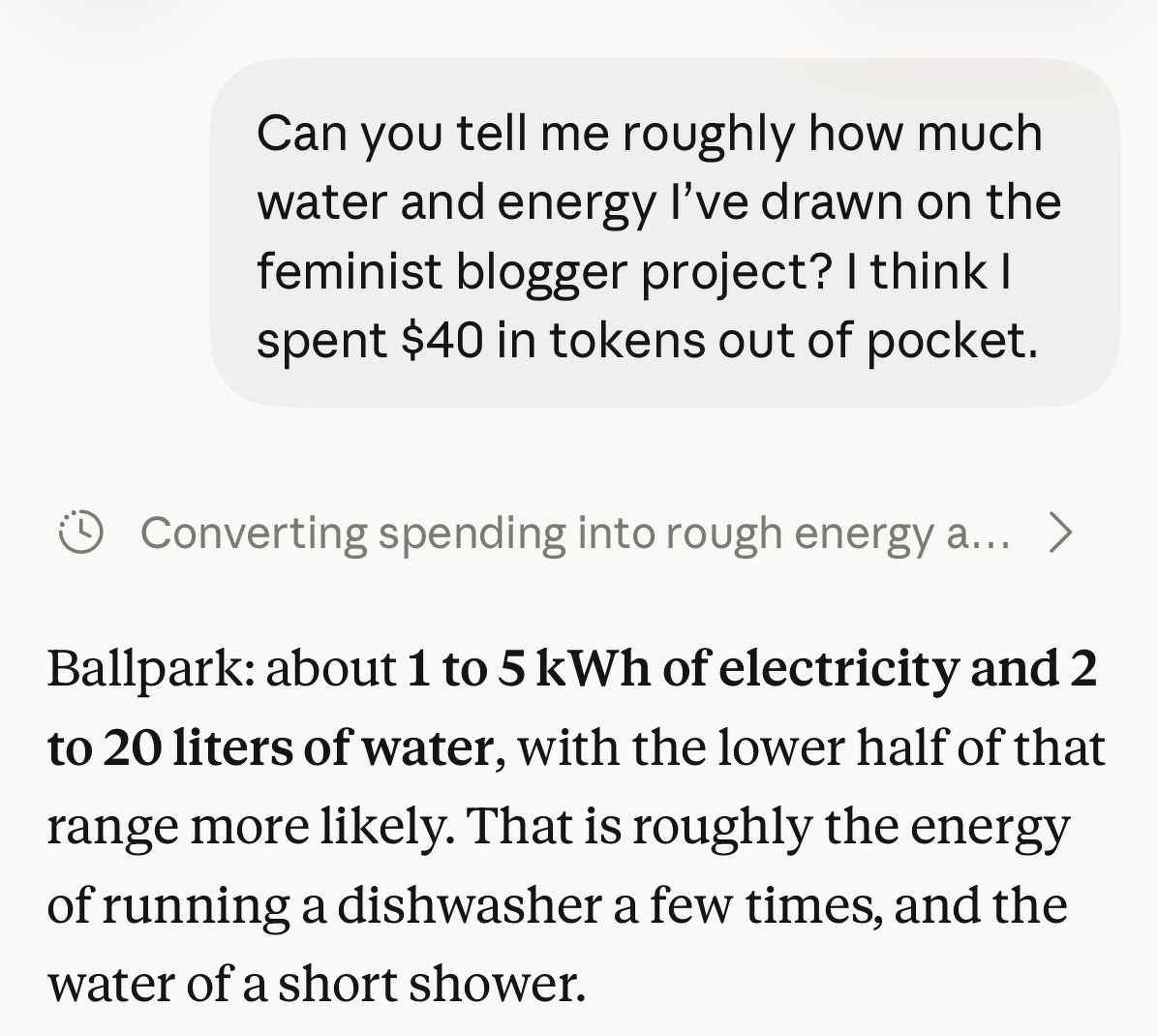 ---
# 2026-09-30
*2026-09-30* — https://flotisserie.micro.blog/2026/09/30/creation-in-the-age-of.html
[Creation in the age of AI](https://harper.masson.us/portfolio/creation-in-the-age-of-ai/).
---
# 2026-09-30
*2026-09-30* — https://flotisserie.micro.blog/2026/09/30/on-living-through-this-long.html
On [living through this long, slow boring](https://www.nytimes.com/2026/09/29/opinion/boring-politics-exhaustion.html?unlocked_article_code=1.FFE.gqHz.69FxRZCSqNF8&smid=nytcore-ios-share).
---
# 2026-09-30
*2026-09-30* — https://flotisserie.micro.blog/2026/09/30/before-enterprise-cmss-there-were.html
Before enterprise CMSs, there were blogs. Before blogs, [there were zines](https://youtu.be/k5Qa0SqAZRc?is=a2un0MZHFiWEQuxz).
---
# 2026-09-30
*2026-09-30* — https://flotisserie.micro.blog/2026/09/30/harvard-business-provides-a-roundup.html
Harvard Business provides a roundup of articles and research showing [practical uses (or not) of AI in the workplace today](https://hbr.org/2026/09/a-collection-of-hbrs-most-insightful-research-on-ai-at-work?tpcc=orgsocial_edit&utm_campaign=hbr&utm_medium=social&utm_source=linkedin).
---
# 2026-09-28
*2026-09-28* — https://flotisserie.micro.blog/2026/09/28/eve-ewing-on-the-slow.html
[Eve Ewing on the slow disaster encroaching on Chicago’s South Side](https://southsideweekly.com/a-slow-and-steady-disaster/), and a relevant companion to the NHJ piece circulating so widely this week. [Also related](https://flotisserie.micro.blog/2026/09/25/gary-indiana-reading-list.html).
---
# 2026-09-27
*2026-09-27* — https://flotisserie.micro.blog/2026/09/27/why-cool-is-hard-to.html
Why [cool is hard to imitate](https://docs.google.com/presentation/d/1_pwJyQVBNRBT9KLF-rvVk1ntjWk2X8xhQqIiQY5ItLI/edit?usp=drivesdk).
---
# 2026-09-27
*2026-09-27* — https://flotisserie.micro.blog/2026/09/27/garbage-day-asks-what-are.html
Garbage Day asks what all the new [embedded AI agents](https://www.garbageday.email/p/am-i-too-boring-to-need-an-ai-agent) are for.
---
# 2026-09-27
*2026-09-27* — https://flotisserie.micro.blog/2026/09/27/plain-language-guide-on-how.html
Plain language guide on how [LLMs are shifting the AI market right now](https://www.theaicowboys.com/blog/large-language-models-llms-ai-engineering-2026).
---
# 2026-09-27
*2026-09-27* — https://flotisserie.micro.blog/2026/09/27/trend-watch-defanging-consumer-surveillance.html
Trend watch: [Defanging consumer surveillance technology by emphasizing cuteness](https://www.theguardian.com/fashion/2026/sep/26/charming-and-disarming-how-metas-technology-packed-muse-harnesses-the-power-of-cuteness).
---
# 2026-09-27
*2026-09-27* — https://flotisserie.micro.blog/2026/09/27/how-highly-formalized-government-processes.html
How [highly formalized government processes are slowing down AI governance at the state level](https://www.nytimes.com/2026/09/27/technology/ai-government-regulation.html?smid=nytcore-ios-share).
---
# Feminist blog cohorts: a (semi-) authoritative remapping using AI
*2026-09-26* — https://flotisserie.micro.blog/2026/09/26/feminist-blog-cohorts-an-authoritative.html
🎵: [Let’s Dance - David Bowie](https://youtu.be/VbD_kBJc_gI?is=-cGHiU-WAMC6rne2)
I’ve spent the last few months annoyed with the incomplete retrospectives around writers and writing online and how we all got here. At work, I use a portfolio perspective to understand working groups, and used a couple of AI approaches to build out a highly contextual, and likely contested, [interactive map charting some of the major players and influences around the feminist blog years, the major platforms, their cultural impacts and major publications](https://claude.ai/artifact/BGQENXPUPdoJWZTbkZY67K). These are case studies and cohorts based on my personal angles mixed with authoritative resources, including a highly annotated bibliography.
Does this feel slimy? I concede it may. But it demonstrates the value of personal writing and thoughtful design in digital spaces despite its many gaps and flaws.
Enjoy and tinker. Feedback is welcome. I’ll have some notes on my approach and why many of these [findings remain heavily qualified](https://flotisserie.micro.blog/2026/02/27/ai-and-the-god-trick.html) in the coming weeks.
---
# 2026-09-25
*2026-09-25* — https://flotisserie.micro.blog/2026/09/25/konstantinos-komaitis-has-started-a.html
[Konstantinos Komaitis](https://www.techdirt.com/user/konstantinos-komaitis/) has started a ten-part series at Techdirt called [The Metric Is Not the Mission](https://www.techdirt.com/2026/09/21/the-metric-is-not-the-mission-history-rarely-announces-itself/). It traces how Big Tech went from building the open internet to reshaping it around its own metrics and incentives. Part I argues that the recurring fights over content moderation, privacy, recommendation algorithms, and AI are symptoms of one long shift.
Search, social networks and recommendation systems solved real problems of navigation and abundance. Eventually each solution becomes the environment itself, and [continues to be optimized for incentives that benefit the companies behind tech solutions](https://www.techdirt.com/2025/12/17/when-the-internet-grew-up-and-locked-out-its-kids/). His phrase for how we've been reading the news about tech is "paying attention to the weather while overlooking the climate."
The historical framing will only pay off if later installments name specific mechanisms and the people who made the decisions, and I'm reading the rest to see whether they do. New parts come out twice a week, with a full PDF at the end.
---
# 1000 Mountains: a Gary, Indiana, reading list
*2026-09-25* — https://flotisserie.micro.blog/2026/09/25/gary-indiana-reading-list.html
🎵: [A Thousand Mountains - Freddie Gibbs and The Alchemist](https://www.youtube.com/watch?v=k3OTpuNep_o)
Yesterday I cut through Gary to get around a traffic jam on the toll road and picked up the Dan Ryan and the Skyway. Since living in Madison, I've made some version of that drive more times than I can count. I grew up south of Gary, at the edge of what a colleague called “[the Chicago ombré](https://southsideweekly.com/a-slow-and-steady-disaster/),” and in my twenties my friends and I spent our weekends in The Region, thrifting our way across Lake County and hitting 18+ hip hop clubs in East Chicago. ([King Von measured the same gradient from the city side in "Took Her to the O.](https://en.wikipedia.org/wiki/Took_Her_to_the_O)”) To many, Gary is the city you drive through on the way to somewhere else.
The Skyway has a long political history: Chicago built it in 1958 with revenue bonds, then the bonds defaulted in 1963, and the city spent the next few decades catching up on deferred maintenance, according to [Louise Nelson Dyble's history of the road](https://trid.trb.org/view/1240128). In 2005, the Daley administration leased it for 99 years to Cintra and Macquarie for $1.83 billion, making it the first existing toll road in the country to be privatized. Eleven years later, the consortium [sold the lease](https://chicago.suntimes.com/2016/6/24/18448534/canadian-consortium-buys-chicago-skyway-lease-rights-for-2-8-billion) to three Canadian pension funds for $2.8 billion. The crossing now costs $8.10 in a car, and [CBS Chicago reports](https://www.cbsnews.com/chicago/news/chicago-skyway-tolls-increase-2026) that tolls have gone up more than 200 percent since the lease, about three and a half times the rate of inflation.
Indiana saw the incentives in this arrangement and followed along. In 2006, then-governor Mitch Daniels leased the Indiana Toll Road to the same Macquarie-Cintra group for 75 years and $3.8 billion, and he used the money to pay for [Major Moves](https://www.in.gov/indot/current-programs/major-moves/), his statewide highway program. [Stateline's 2012 retrospective](https://stateline.org/2012/06/19/indiana-highway-building-ramps-up-as-daniels-term-winds-down/) called the lease one of the most divisive things Daniels did as governor. The bill passed without a single House Democrat, and the Region hated it. At a [town hall in Crown Point](https://www.wthr.com/article/news/daniels-faces-tough-comments-from-toll-road-lease-opponents/531-795ee306-550a-4bd3-b791-d717a221bc65), one resident told Daniels the deal amounted to taxation without representation. The operator [went into Chapter 11 in 2014](https://en.wikipedia.org/wiki/Indiana_Toll_Road_Concession_Company), and an Australian fund bought the lease the next year for $5.7 billion. A big share of the original money built [I-69](https://www.in.gov/indot/projects/i69/) between Evansville and the Crane Naval Base, at the other end of the state. When Eric Holcomb later [approved a truck toll hike in exchange for another $1 billion](https://www.nwitimes.com/news/local/govt-and-politics/state-to-receive-billion-in-exchange-for-allowing-higher-truck/article_640a7253-34cb-5bfe-a7fd-5b653ba4ef86.html), he had to deny in public that the Region was once again paying for highways its drivers would never use.
The state keeps the paperwork on deals like these. The [Indiana State Archives](https://www.in.gov/iara/home/) [opened a new downtown building](https://indianacapitalchronicle.com/2026/09/24/inside-indianas-new-downtown-archives-where-state-history-gets-a-new-home/) in Indianapolis on Thursday after 25 years in a "temporary" warehouse on East 30th Street, a former RCA record-stamping plant whose roof leaked partly because people shot holes in it. An old combination safe in the new building holds the state's original constitutions, Jim Jones's church incorporation papers, and Donald Trump's application for a casino in Gary. Upstairs, a conservator expects to spend four to six weeks piecing together a Porter County survey map that had broken into fragments. The reading room is open to the public Tuesday through Saturday, and the staff asks you to make an appointment so they can pull the boxes before you arrive.
**[Gary has been on the wrong end of these deals](https://flotisserie.micro.blog/2026/02/20/as-a-true-blue-hoosier.html) since before it had a name.** Paige Williams's [New Yorker piece on Gary and U.S. Steel](https://www.newyorker.com/magazine/2025/02/17/gary-indiana-and-the-long-shadow-of-us-steel) asks whether a company town once called "the most miserable city in America" can remake itself. U.S. Steel founded Gary in 1906 to house the workers for its mills, and [in 1920 Carl Sandburg published a poem about how the people running the place saw those workers](https://allpoetry.com/The-Mayor-Of-Gary).
Freddie Gibbs grew up on Gary's east side, and Jeff Weiss has profiled him twice. The [2021 profile in The Ringer](https://www.theringer.com/features/2021/3/10/22319899/freddie-gibbs-grammy-nomination-profile-alfredo-alchemist) catches Gibbs around his Grammy nomination for *Alfredo* and opens on a 2009 visit to his Van Nuys apartment, where [Gibbs told Weiss that robbing freight trains](https://www.nytimes.com/2026/09/23/opinion/ai-politics-railroads-history.html?smid=nytcore-ios-share) was a popular hobby back home. Weiss's earlier piece, [The Miseducation of Freddie Gibbs](https://www.powmag.net/p/the-miseducation-of-freddie-gibbs-2), adds that one of Gibbs's teachers got fired for robbing them too.
(Weiss, bless him, professes not to understand the [rabbit metaphor](https://en.wikipedia.org/wiki/Rabbits_and_hares_in_art) present throughout Gibbs’ work, yet confidently persists.)
Gibbs's father, Warren Tipton, spent about twenty years on the Gary police force and later sang with [the Chi-Lites](https://vocalgroup.org/inductees/the-chi-lites/). He died in May, and [AllHipHop's obituary](https://allhiphop.com/features/freddie-gibbs-mourns-father-warren-tipton-singer-who-once-competed-against-michael-jackson/) places him in the same Gary music scene that produced the Jacksons. That detail stuck with me because my ex-father-in-law was a police officer and chief of police downstate during the same years, and also played drums in a local band. [Jamelle Bouie has historically described](https://www.nytimes.com/2023/02/03/opinion/police-violence-democracy.html) police departments as "jobs for the boys," a steady public paycheck handed to working-class men, and that fits both of their careers better than anything about their relationships to law and order. In towns where the mills were shedding jobs, a badge was one of the few paychecks that came with a pension, and a man who could sing still needed that safety net.
**Policing in the Region** has much uglier chapters than that. The Chicago Sun-Times has spent years [covering the federal case against the Sin City Deciples](https://chicago.suntimes.com/the-watchdogs/2025/06/20/biker-gang-sin-city-deciples-gary-indiana), a motorcycle club founded in Gary in 1967. One member admitted he worked as a Gary police chaplain while killing two men, one of them the son of a former Gary police chief. The Chicago Reader's [Tiger King of the Midwest](https://chicagoreader.com/arts-culture/tiger-king-of-the-midwest/) profiles Roy "Roy Boy" Cooper, who ran a tattoo shop called the Badlands with Bengal tigers in cages next to the chairs. Tattooing was illegal in Indiana then, and Cooper's lawyer reportedly steered him to Gary because the police had bigger problems than a tattoo shop — as long as it paid its taxes. Media Burn has [raw footage](https://mediaburn.org/?p=32835) of Cooper setting a leashed tiger on a pool table while his wife runs through the rest of their animals, which included a grizzly bear and a baboon. In the video, Lady Cooper recommends taking the animals out in public, to the grocery store, socializing them on the locals.
Anderson went through the same collapse with auto parts. General Motors moved in during the 1920s and eventually ran [two divisions there](https://andersonmchs.com/delco-remy-and-guide-lamp/), Delco-Remy for electrical systems and Guide Lamp for headlights. By the time Jon Alpert made [Dirty Driving: Thundercars of Indiana](https://www.hbomax.com/movie/733a25c4-93d9-4f2f-b2f2-c53a5366719d) for HBO in 2008, a town that once had 33,000 GM jobs had empty factories and shuttered stores, and what was left of it went to [the Anderson Speedway](https://andersonspeedway.com/) every Friday night. The Herald Bulletin [caught up with one of the film's drivers](https://www.heraldbulletin.com/community/hbo-film-documents-anderson-life-racing/article_ef3870ba-8939-5944-8745-183f0d4434a3.html), Sammy Hawkins, as he flew home from the New York premiere to a Firestone job in Noblesville that he expected to lose. His line in the film is that Anderson doesn't make cars anymore, but it can still race them and wreck them.
**Music in Gary** started in the mills. Joe Jackson ran a crane and played guitar in a band called the Falcons, which [never got a record deal](https://encyclopediaofarkansas.net/entries/joseph-walter-5988/), so he kept the mill job and trained his sons into the Jackson 5 instead. Their first contract came from [Steeltown Records](https://en.wikipedia.org/wiki/Steeltown_Records), a Gary label, in 1967, and "Big Boy" was a local hit before Motown signed them. Most people in a mill town who can sing still need the day job, and the ones who make it usually leave.
[Detroit turned its losses](https://www.nytimes.com/2026/09/25/opinion/ezra-klein-podcast-abdul-el-sayed.html?unlocked_article_code=1.EFE.w8YL.BO1GiRgg3_F0) into techno. Juan Atkins, Derrick May, and Kevin Saunderson learned Kraftwerk and Parliament from a late-night DJ called [the Electrifyin' Mojo](https://detroithistorical.org/learn/encyclopedia-of-detroit/electrifying-mojo), and by 1987 more than half of Detroit's manufacturing, retail, and wholesale base was gone, as [SPIN reported in 1998](https://www.spinmagazine.com/2019/11/juan-atkins-derrick-may-kevin-saunderson-carl-craig-detroit-techno-october-1998-feature-a-tale-of-two-cities/). Midstory's [Built to Boom](https://www.midstory.org/built-to-boom-how-cars-and-culture-drove-detroits-music-scene/) traces the line from the assembly plants through Motown to techno, and May describes sampling industrial noise, traffic, and construction into his tracks.
The techno ran straight into the rap Jorjiana grew up on. NPR's piece on [how Detroit and Flint became havens for rap dark horses](https://www.npr.org/2023/07/27/1189985872/how-detroit-and-flint-became-havens-for-rap-dark-horses) credits the producer Helluva with a "basement sound" of ominous pianos and synth stabs, which he built by crossing West Coast gangsta rap with Detroit techno, and it describes the Flint rappers as a crew of flippant, vulgar jokers. [Flintside's history of the Flint scene](https://www.flintside.com/features/flint-hip-hop-golden-age.aspx) shows how a co-sign from Detroit's Peezy lifted Rio Da Yung OG and everyone around him. Lil Yachty [spent years showing up on Michigan records](https://packs.substack.com/p/lil-yachty-is-finding-himself-in), and he later vouched for Jorjiana too.
**[Jorjiana is 21, and a single mom, and from Michigan City, just down the shore from Gary](https://www.simonandschuster.com/books/My-Mothers-Daughter/Tracy-Clark-Flory/9781668083321).** The Times of Northwest Indiana [profiled her recently](https://www.nwitimes.com/life-entertainment/local/music/article_bb62c49f-3b0c-5fcf-9d7c-808617725351.html) after "ILBB2" took off, and her [Complex interview](https://www.complex.com/music/a/j-rose/jorjiana-doesnt-even-know-what-an-industry-plant-is) covers a childhood spent moving between relatives while her parents struggled with addiction. By her account, her music career started with screwing around with her friends around town. She and her friends were bored during the pandemic, so they freestyled in her car, and she posted the results, doing actual numbers. She told [Justin Moran](https://justinmoran.substack.com/p/whos-that-jorjiana) that her friends talked her into cross-posting the TikTok clips to Instagram, which she barely used, and that's where the A&Rs found her. At the time she didn't know what an A&R was. In [a clip Complex posted](https://www.tiktok.com/@complexmusic/video/7488410757634329886), she admits she doesn't know who Freddie Gibbs is either, so what ties her to Gary is the shoreline more than any influence. She should get familiar with his catalog (and a metronome!).
Plenty of good bands started as friends goofing off: Devo began as a satirical art project at Kent State, and the Maels studied graphic design and film at UCLA before Sparks. Edgar Wright's [The Sparks Brothers](https://www.empireonline.com/movies/news/the-sparks-brothers-edgar-wright-documentary-first-trailer) spends a lot of time on how they built their act for [Top of the Pops closeups](https://www.kexp.org/read/2022/12/21/50-years-of-music-1974-sparks-this-town-aint-big-enough-for-both-of-us/). Both bands treated the dominant screen of their time as part of the instrument. Jorjiana's screen is the short-form feed, and I've been watching her work it for the last year or so: snippets of songs previewed, clips pushed to every platform, [a freestyle on On The Radar](https://www.youtube.com/watch?v=qlrn9GgBYt0) at the end of 2024 that brought more than a dozen labels calling, [a GloRilla remix](https://en.wikipedia.org/wiki/ILBB2), and co-signs from Lil Yachty and GloRilla.
**If you want to know** what Gary is doing now, read [Capital B Gary](https://gary.capitalbnews.org/), which covers the city more consistently than anyone else. Start with their [feature on Koney King](https://gary.capitalbnews.org/koney-king-restaurant-gary/), a Broadway diner that has been serving chili for more than a century, and then look through their [2024 year in photos](https://gary.capitalbnews.org/through-our-lens-the-stories-that-shaped-gary-in-2024/), which has residents cleaning up parks on the East Side and crowds on the beach for the eclipse.
---
# 2026-09-30
*2026-09-30* — https://flotisserie.micro.blog/2026/09/30/creation-in-the-age-of.html
[Creation in the age of AI](https://harper.masson.us/portfolio/creation-in-the-age-of-ai/).
---
# 2026-09-30
*2026-09-30* — https://flotisserie.micro.blog/2026/09/30/on-living-through-this-long.html
On [living through this long, slow boring](https://www.nytimes.com/2026/09/29/opinion/boring-politics-exhaustion.html?unlocked_article_code=1.FFE.gqHz.69FxRZCSqNF8&smid=nytcore-ios-share).
---
# 2026-09-30
*2026-09-30* — https://flotisserie.micro.blog/2026/09/30/before-enterprise-cmss-there-were.html
Before enterprise CMSs, there were blogs. Before blogs, [there were zines](https://youtu.be/k5Qa0SqAZRc?is=a2un0MZHFiWEQuxz).
---
# 2026-09-30
*2026-09-30* — https://flotisserie.micro.blog/2026/09/30/harvard-business-provides-a-roundup.html
Harvard Business provides a roundup of articles and research showing [practical uses (or not) of AI in the workplace today](https://hbr.org/2026/09/a-collection-of-hbrs-most-insightful-research-on-ai-at-work?tpcc=orgsocial_edit&utm_campaign=hbr&utm_medium=social&utm_source=linkedin).
---
# 2026-09-28
*2026-09-28* — https://flotisserie.micro.blog/2026/09/28/eve-ewing-on-the-slow.html
[Eve Ewing on the slow disaster encroaching on Chicago’s South Side](https://southsideweekly.com/a-slow-and-steady-disaster/), and a relevant companion to the NHJ piece circulating so widely this week. [Also related](https://flotisserie.micro.blog/2026/09/25/gary-indiana-reading-list.html).
---
# 2026-09-27
*2026-09-27* — https://flotisserie.micro.blog/2026/09/27/why-cool-is-hard-to.html
Why [cool is hard to imitate](https://docs.google.com/presentation/d/1_pwJyQVBNRBT9KLF-rvVk1ntjWk2X8xhQqIiQY5ItLI/edit?usp=drivesdk).
---
# 2026-09-27
*2026-09-27* — https://flotisserie.micro.blog/2026/09/27/garbage-day-asks-what-are.html
Garbage Day asks what all the new [embedded AI agents](https://www.garbageday.email/p/am-i-too-boring-to-need-an-ai-agent) are for.
---
# 2026-09-27
*2026-09-27* — https://flotisserie.micro.blog/2026/09/27/plain-language-guide-on-how.html
Plain language guide on how [LLMs are shifting the AI market right now](https://www.theaicowboys.com/blog/large-language-models-llms-ai-engineering-2026).
---
# 2026-09-27
*2026-09-27* — https://flotisserie.micro.blog/2026/09/27/trend-watch-defanging-consumer-surveillance.html
Trend watch: [Defanging consumer surveillance technology by emphasizing cuteness](https://www.theguardian.com/fashion/2026/sep/26/charming-and-disarming-how-metas-technology-packed-muse-harnesses-the-power-of-cuteness).
---
# 2026-09-27
*2026-09-27* — https://flotisserie.micro.blog/2026/09/27/how-highly-formalized-government-processes.html
How [highly formalized government processes are slowing down AI governance at the state level](https://www.nytimes.com/2026/09/27/technology/ai-government-regulation.html?smid=nytcore-ios-share).
---
# Feminist blog cohorts: a (semi-) authoritative remapping using AI
*2026-09-26* — https://flotisserie.micro.blog/2026/09/26/feminist-blog-cohorts-an-authoritative.html
🎵: [Let’s Dance - David Bowie](https://youtu.be/VbD_kBJc_gI?is=-cGHiU-WAMC6rne2)
I’ve spent the last few months annoyed with the incomplete retrospectives around writers and writing online and how we all got here. At work, I use a portfolio perspective to understand working groups, and used a couple of AI approaches to build out a highly contextual, and likely contested, [interactive map charting some of the major players and influences around the feminist blog years, the major platforms, their cultural impacts and major publications](https://claude.ai/artifact/BGQENXPUPdoJWZTbkZY67K). These are case studies and cohorts based on my personal angles mixed with authoritative resources, including a highly annotated bibliography.
Does this feel slimy? I concede it may. But it demonstrates the value of personal writing and thoughtful design in digital spaces despite its many gaps and flaws.
Enjoy and tinker. Feedback is welcome. I’ll have some notes on my approach and why many of these [findings remain heavily qualified](https://flotisserie.micro.blog/2026/02/27/ai-and-the-god-trick.html) in the coming weeks.
---
# 2026-09-25
*2026-09-25* — https://flotisserie.micro.blog/2026/09/25/konstantinos-komaitis-has-started-a.html
[Konstantinos Komaitis](https://www.techdirt.com/user/konstantinos-komaitis/) has started a ten-part series at Techdirt called [The Metric Is Not the Mission](https://www.techdirt.com/2026/09/21/the-metric-is-not-the-mission-history-rarely-announces-itself/). It traces how Big Tech went from building the open internet to reshaping it around its own metrics and incentives. Part I argues that the recurring fights over content moderation, privacy, recommendation algorithms, and AI are symptoms of one long shift.
Search, social networks and recommendation systems solved real problems of navigation and abundance. Eventually each solution becomes the environment itself, and [continues to be optimized for incentives that benefit the companies behind tech solutions](https://www.techdirt.com/2025/12/17/when-the-internet-grew-up-and-locked-out-its-kids/). His phrase for how we've been reading the news about tech is "paying attention to the weather while overlooking the climate."
The historical framing will only pay off if later installments name specific mechanisms and the people who made the decisions, and I'm reading the rest to see whether they do. New parts come out twice a week, with a full PDF at the end.
---
# 1000 Mountains: a Gary, Indiana, reading list
*2026-09-25* — https://flotisserie.micro.blog/2026/09/25/gary-indiana-reading-list.html
🎵: [A Thousand Mountains - Freddie Gibbs and The Alchemist](https://www.youtube.com/watch?v=k3OTpuNep_o)
Yesterday I cut through Gary to get around a traffic jam on the toll road and picked up the Dan Ryan and the Skyway. Since living in Madison, I've made some version of that drive more times than I can count. I grew up south of Gary, at the edge of what a colleague called “[the Chicago ombré](https://southsideweekly.com/a-slow-and-steady-disaster/),” and in my twenties my friends and I spent our weekends in The Region, thrifting our way across Lake County and hitting 18+ hip hop clubs in East Chicago. ([King Von measured the same gradient from the city side in "Took Her to the O.](https://en.wikipedia.org/wiki/Took_Her_to_the_O)”) To many, Gary is the city you drive through on the way to somewhere else.
The Skyway has a long political history: Chicago built it in 1958 with revenue bonds, then the bonds defaulted in 1963, and the city spent the next few decades catching up on deferred maintenance, according to [Louise Nelson Dyble's history of the road](https://trid.trb.org/view/1240128). In 2005, the Daley administration leased it for 99 years to Cintra and Macquarie for $1.83 billion, making it the first existing toll road in the country to be privatized. Eleven years later, the consortium [sold the lease](https://chicago.suntimes.com/2016/6/24/18448534/canadian-consortium-buys-chicago-skyway-lease-rights-for-2-8-billion) to three Canadian pension funds for $2.8 billion. The crossing now costs $8.10 in a car, and [CBS Chicago reports](https://www.cbsnews.com/chicago/news/chicago-skyway-tolls-increase-2026) that tolls have gone up more than 200 percent since the lease, about three and a half times the rate of inflation.
Indiana saw the incentives in this arrangement and followed along. In 2006, then-governor Mitch Daniels leased the Indiana Toll Road to the same Macquarie-Cintra group for 75 years and $3.8 billion, and he used the money to pay for [Major Moves](https://www.in.gov/indot/current-programs/major-moves/), his statewide highway program. [Stateline's 2012 retrospective](https://stateline.org/2012/06/19/indiana-highway-building-ramps-up-as-daniels-term-winds-down/) called the lease one of the most divisive things Daniels did as governor. The bill passed without a single House Democrat, and the Region hated it. At a [town hall in Crown Point](https://www.wthr.com/article/news/daniels-faces-tough-comments-from-toll-road-lease-opponents/531-795ee306-550a-4bd3-b791-d717a221bc65), one resident told Daniels the deal amounted to taxation without representation. The operator [went into Chapter 11 in 2014](https://en.wikipedia.org/wiki/Indiana_Toll_Road_Concession_Company), and an Australian fund bought the lease the next year for $5.7 billion. A big share of the original money built [I-69](https://www.in.gov/indot/projects/i69/) between Evansville and the Crane Naval Base, at the other end of the state. When Eric Holcomb later [approved a truck toll hike in exchange for another $1 billion](https://www.nwitimes.com/news/local/govt-and-politics/state-to-receive-billion-in-exchange-for-allowing-higher-truck/article_640a7253-34cb-5bfe-a7fd-5b653ba4ef86.html), he had to deny in public that the Region was once again paying for highways its drivers would never use.
The state keeps the paperwork on deals like these. The [Indiana State Archives](https://www.in.gov/iara/home/) [opened a new downtown building](https://indianacapitalchronicle.com/2026/09/24/inside-indianas-new-downtown-archives-where-state-history-gets-a-new-home/) in Indianapolis on Thursday after 25 years in a "temporary" warehouse on East 30th Street, a former RCA record-stamping plant whose roof leaked partly because people shot holes in it. An old combination safe in the new building holds the state's original constitutions, Jim Jones's church incorporation papers, and Donald Trump's application for a casino in Gary. Upstairs, a conservator expects to spend four to six weeks piecing together a Porter County survey map that had broken into fragments. The reading room is open to the public Tuesday through Saturday, and the staff asks you to make an appointment so they can pull the boxes before you arrive.
**[Gary has been on the wrong end of these deals](https://flotisserie.micro.blog/2026/02/20/as-a-true-blue-hoosier.html) since before it had a name.** Paige Williams's [New Yorker piece on Gary and U.S. Steel](https://www.newyorker.com/magazine/2025/02/17/gary-indiana-and-the-long-shadow-of-us-steel) asks whether a company town once called "the most miserable city in America" can remake itself. U.S. Steel founded Gary in 1906 to house the workers for its mills, and [in 1920 Carl Sandburg published a poem about how the people running the place saw those workers](https://allpoetry.com/The-Mayor-Of-Gary).
Freddie Gibbs grew up on Gary's east side, and Jeff Weiss has profiled him twice. The [2021 profile in The Ringer](https://www.theringer.com/features/2021/3/10/22319899/freddie-gibbs-grammy-nomination-profile-alfredo-alchemist) catches Gibbs around his Grammy nomination for *Alfredo* and opens on a 2009 visit to his Van Nuys apartment, where [Gibbs told Weiss that robbing freight trains](https://www.nytimes.com/2026/09/23/opinion/ai-politics-railroads-history.html?smid=nytcore-ios-share) was a popular hobby back home. Weiss's earlier piece, [The Miseducation of Freddie Gibbs](https://www.powmag.net/p/the-miseducation-of-freddie-gibbs-2), adds that one of Gibbs's teachers got fired for robbing them too.
(Weiss, bless him, professes not to understand the [rabbit metaphor](https://en.wikipedia.org/wiki/Rabbits_and_hares_in_art) present throughout Gibbs’ work, yet confidently persists.)
Gibbs's father, Warren Tipton, spent about twenty years on the Gary police force and later sang with [the Chi-Lites](https://vocalgroup.org/inductees/the-chi-lites/). He died in May, and [AllHipHop's obituary](https://allhiphop.com/features/freddie-gibbs-mourns-father-warren-tipton-singer-who-once-competed-against-michael-jackson/) places him in the same Gary music scene that produced the Jacksons. That detail stuck with me because my ex-father-in-law was a police officer and chief of police downstate during the same years, and also played drums in a local band. [Jamelle Bouie has historically described](https://www.nytimes.com/2023/02/03/opinion/police-violence-democracy.html) police departments as "jobs for the boys," a steady public paycheck handed to working-class men, and that fits both of their careers better than anything about their relationships to law and order. In towns where the mills were shedding jobs, a badge was one of the few paychecks that came with a pension, and a man who could sing still needed that safety net.
**Policing in the Region** has much uglier chapters than that. The Chicago Sun-Times has spent years [covering the federal case against the Sin City Deciples](https://chicago.suntimes.com/the-watchdogs/2025/06/20/biker-gang-sin-city-deciples-gary-indiana), a motorcycle club founded in Gary in 1967. One member admitted he worked as a Gary police chaplain while killing two men, one of them the son of a former Gary police chief. The Chicago Reader's [Tiger King of the Midwest](https://chicagoreader.com/arts-culture/tiger-king-of-the-midwest/) profiles Roy "Roy Boy" Cooper, who ran a tattoo shop called the Badlands with Bengal tigers in cages next to the chairs. Tattooing was illegal in Indiana then, and Cooper's lawyer reportedly steered him to Gary because the police had bigger problems than a tattoo shop — as long as it paid its taxes. Media Burn has [raw footage](https://mediaburn.org/?p=32835) of Cooper setting a leashed tiger on a pool table while his wife runs through the rest of their animals, which included a grizzly bear and a baboon. In the video, Lady Cooper recommends taking the animals out in public, to the grocery store, socializing them on the locals.
Anderson went through the same collapse with auto parts. General Motors moved in during the 1920s and eventually ran [two divisions there](https://andersonmchs.com/delco-remy-and-guide-lamp/), Delco-Remy for electrical systems and Guide Lamp for headlights. By the time Jon Alpert made [Dirty Driving: Thundercars of Indiana](https://www.hbomax.com/movie/733a25c4-93d9-4f2f-b2f2-c53a5366719d) for HBO in 2008, a town that once had 33,000 GM jobs had empty factories and shuttered stores, and what was left of it went to [the Anderson Speedway](https://andersonspeedway.com/) every Friday night. The Herald Bulletin [caught up with one of the film's drivers](https://www.heraldbulletin.com/community/hbo-film-documents-anderson-life-racing/article_ef3870ba-8939-5944-8745-183f0d4434a3.html), Sammy Hawkins, as he flew home from the New York premiere to a Firestone job in Noblesville that he expected to lose. His line in the film is that Anderson doesn't make cars anymore, but it can still race them and wreck them.
**Music in Gary** started in the mills. Joe Jackson ran a crane and played guitar in a band called the Falcons, which [never got a record deal](https://encyclopediaofarkansas.net/entries/joseph-walter-5988/), so he kept the mill job and trained his sons into the Jackson 5 instead. Their first contract came from [Steeltown Records](https://en.wikipedia.org/wiki/Steeltown_Records), a Gary label, in 1967, and "Big Boy" was a local hit before Motown signed them. Most people in a mill town who can sing still need the day job, and the ones who make it usually leave.
[Detroit turned its losses](https://www.nytimes.com/2026/09/25/opinion/ezra-klein-podcast-abdul-el-sayed.html?unlocked_article_code=1.EFE.w8YL.BO1GiRgg3_F0) into techno. Juan Atkins, Derrick May, and Kevin Saunderson learned Kraftwerk and Parliament from a late-night DJ called [the Electrifyin' Mojo](https://detroithistorical.org/learn/encyclopedia-of-detroit/electrifying-mojo), and by 1987 more than half of Detroit's manufacturing, retail, and wholesale base was gone, as [SPIN reported in 1998](https://www.spinmagazine.com/2019/11/juan-atkins-derrick-may-kevin-saunderson-carl-craig-detroit-techno-october-1998-feature-a-tale-of-two-cities/). Midstory's [Built to Boom](https://www.midstory.org/built-to-boom-how-cars-and-culture-drove-detroits-music-scene/) traces the line from the assembly plants through Motown to techno, and May describes sampling industrial noise, traffic, and construction into his tracks.
The techno ran straight into the rap Jorjiana grew up on. NPR's piece on [how Detroit and Flint became havens for rap dark horses](https://www.npr.org/2023/07/27/1189985872/how-detroit-and-flint-became-havens-for-rap-dark-horses) credits the producer Helluva with a "basement sound" of ominous pianos and synth stabs, which he built by crossing West Coast gangsta rap with Detroit techno, and it describes the Flint rappers as a crew of flippant, vulgar jokers. [Flintside's history of the Flint scene](https://www.flintside.com/features/flint-hip-hop-golden-age.aspx) shows how a co-sign from Detroit's Peezy lifted Rio Da Yung OG and everyone around him. Lil Yachty [spent years showing up on Michigan records](https://packs.substack.com/p/lil-yachty-is-finding-himself-in), and he later vouched for Jorjiana too.
**[Jorjiana is 21, and a single mom, and from Michigan City, just down the shore from Gary](https://www.simonandschuster.com/books/My-Mothers-Daughter/Tracy-Clark-Flory/9781668083321).** The Times of Northwest Indiana [profiled her recently](https://www.nwitimes.com/life-entertainment/local/music/article_bb62c49f-3b0c-5fcf-9d7c-808617725351.html) after "ILBB2" took off, and her [Complex interview](https://www.complex.com/music/a/j-rose/jorjiana-doesnt-even-know-what-an-industry-plant-is) covers a childhood spent moving between relatives while her parents struggled with addiction. By her account, her music career started with screwing around with her friends around town. She and her friends were bored during the pandemic, so they freestyled in her car, and she posted the results, doing actual numbers. She told [Justin Moran](https://justinmoran.substack.com/p/whos-that-jorjiana) that her friends talked her into cross-posting the TikTok clips to Instagram, which she barely used, and that's where the A&Rs found her. At the time she didn't know what an A&R was. In [a clip Complex posted](https://www.tiktok.com/@complexmusic/video/7488410757634329886), she admits she doesn't know who Freddie Gibbs is either, so what ties her to Gary is the shoreline more than any influence. She should get familiar with his catalog (and a metronome!).
Plenty of good bands started as friends goofing off: Devo began as a satirical art project at Kent State, and the Maels studied graphic design and film at UCLA before Sparks. Edgar Wright's [The Sparks Brothers](https://www.empireonline.com/movies/news/the-sparks-brothers-edgar-wright-documentary-first-trailer) spends a lot of time on how they built their act for [Top of the Pops closeups](https://www.kexp.org/read/2022/12/21/50-years-of-music-1974-sparks-this-town-aint-big-enough-for-both-of-us/). Both bands treated the dominant screen of their time as part of the instrument. Jorjiana's screen is the short-form feed, and I've been watching her work it for the last year or so: snippets of songs previewed, clips pushed to every platform, [a freestyle on On The Radar](https://www.youtube.com/watch?v=qlrn9GgBYt0) at the end of 2024 that brought more than a dozen labels calling, [a GloRilla remix](https://en.wikipedia.org/wiki/ILBB2), and co-signs from Lil Yachty and GloRilla.
**If you want to know** what Gary is doing now, read [Capital B Gary](https://gary.capitalbnews.org/), which covers the city more consistently than anyone else. Start with their [feature on Koney King](https://gary.capitalbnews.org/koney-king-restaurant-gary/), a Broadway diner that has been serving chili for more than a century, and then look through their [2024 year in photos](https://gary.capitalbnews.org/through-our-lens-the-stories-that-shaped-gary-in-2024/), which has residents cleaning up parks on the East Side and crowds on the beach for the eclipse.


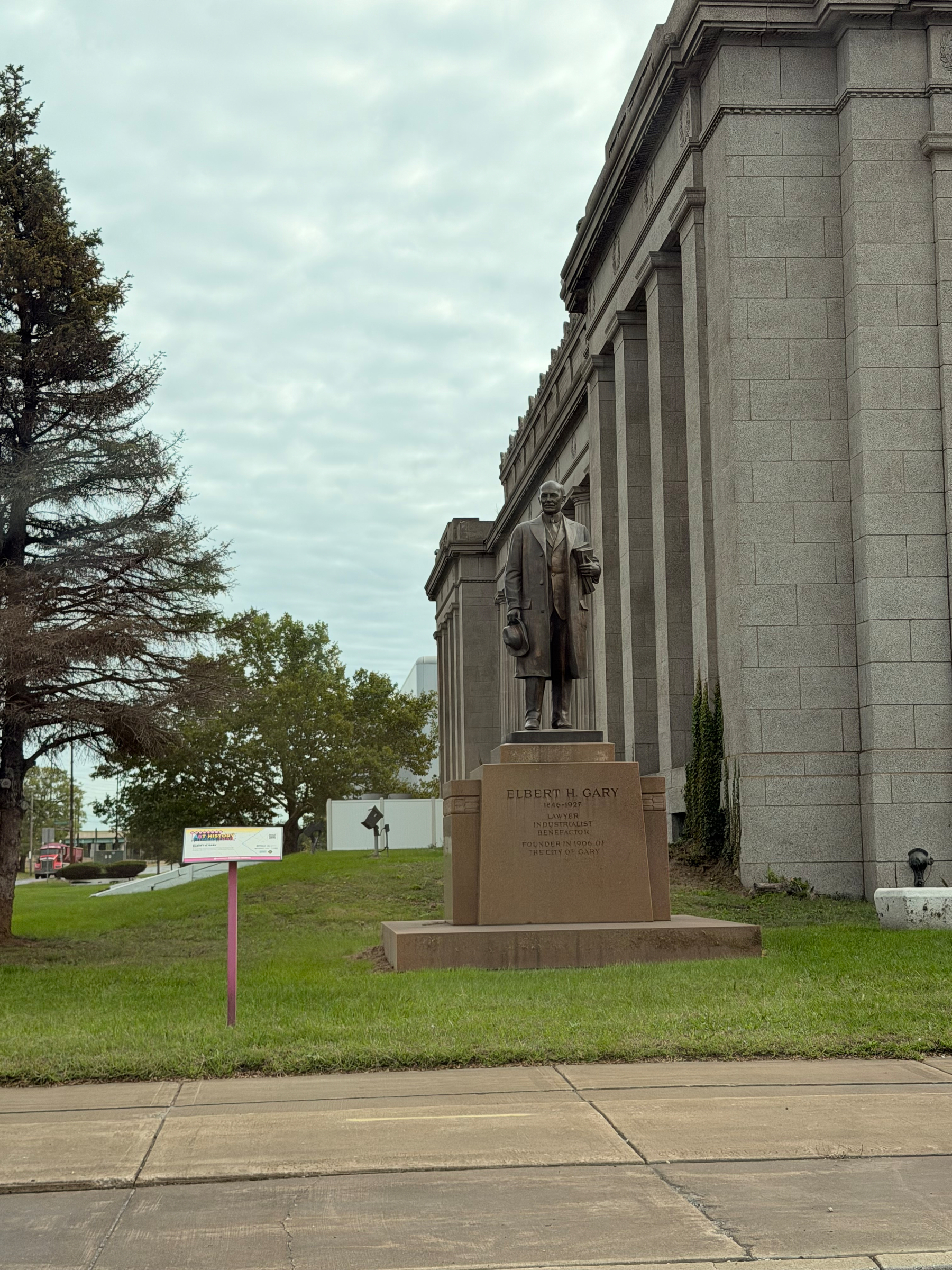
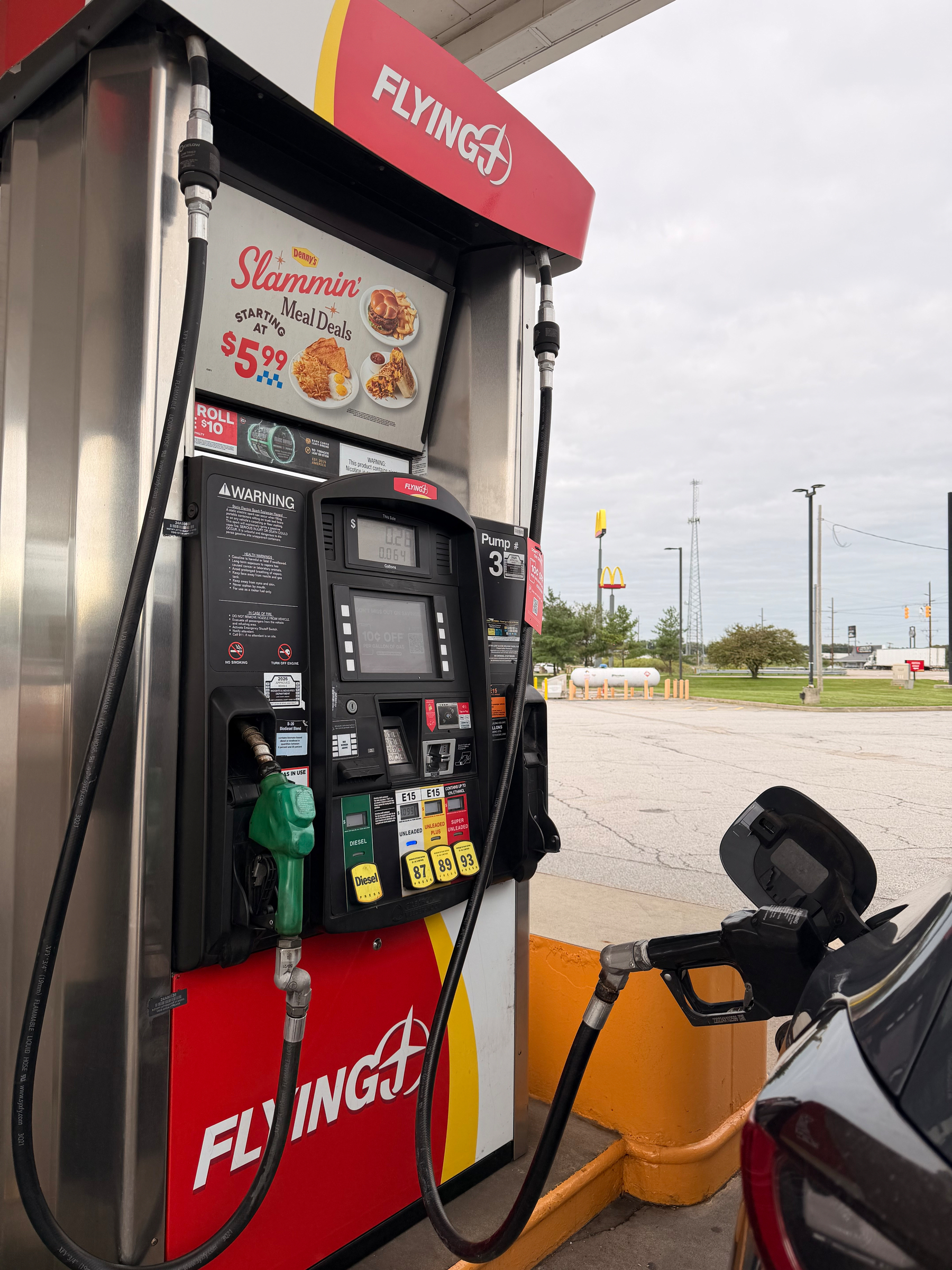 I, myself, [had a run-in with a white supremacist Indiana biker gang in my twenties in West Lafayette, also connected to a money-laundering tattoo shop](https://en.wikipedia.org/wiki/Hammerskins). Someday I’ll commit the story to paper.
**Other notes:** Akron went through its own version a decade later, with rubber instead of steel. Midstory's history of [how Akron became "the new Liverpool"](https://www.midstory.org/how-akron-became-the-new-liverpool-of-punk-music/) describes Devo, Tin Huey, the Bizarros, and the Rubber City Rebels as kids from factory families trying not to follow their fathers into the plants. The scene got its home during one of the longest rubber workers' strikes in the city's history, when the Rubber City Rebels took over a rubber workers' bar called the Crypt, as PBS Western Reserve tells it in [It's Everything, and Then It's Gone](https://www.pbswesternreserve.org/productions/its-everything-and-then-its-gone/). Chris Smith's [2024 Devo documentary](https://consequence.net/2025/07/devo-documentary-netflix-release-date) picks up the story from Kent State and follows the band into the early days of MTV.
A recent article on the [Indiana Quaker community's place in the Underground Railroad](https://fpinews.org/rural/2026/09/24/quaker-meeting-house-underground-railroad-pendleton-2/).
---
# Two steps forward, one step back
*2026-09-25* — https://flotisserie.micro.blog/2026/09/25/two-steps-forward-one-step.html
While I still go back to Haraway's ["Situated Knowledges"](https://www.jstor.org/stable/3178066) for the argument that every view comes from somewhere, these days, the writer I read most closely on technology is [Dr. Tressie McMillan Cottom](https://en.wikipedia.org/wiki/Tressie_McMillan_Cottom).
Haraway asks where a knowledge claim is standing, while Dr. Tressie asks who pays for it. [*Lower Ed*](https://en.wikipedia.org/wiki/Lower_Ed) traced how for-profit colleges sold credentials to audiences the rest of higher education had shut out. In a [TikTok mini-lecture on AI, politics, and inequality](https://www.tiktok.com/@black_was_genius/video/7426166861240323370), she carried that analysis forward using [Daniel Greene's "access doctrine,](https://logicmag.io/distribution/the-access-doctrine/)" which holds that the answer to economic inequality is more skills rather than more support, and which universities facing their own precarity have leaned into. [Audrey Watters](https://2ndbreakfast.audreywatters.com/when-knowledge-is-dangerous-but-information-is-power/) and [Ed & Class](https://ghost.edandclass.com/ai-politics-and-inequality-from-tressie-mcmillan-cottom/) both wrote it up.
Her [March 2025 *Times* column](https://www.nytimes.com/2025/03/29/opinion/ai-tech-innovation.html) argued that the fantasy appeals to risk-averse organizations because it promises control and oversight. [Neil Selwyn's notes on the column](https://criticaledtech.com/2025/05/13/acknowledging-the-mid-ness-of-educational-ai-notes-on-tressie-mcmillan-cottom-2025/) apply it directly to educational AI.
Her question fits my work life better right now while AI begins to show up in procurement, policy and training decks, and her ongoing attention to pedagogy keeps the conversation tied to what happens between a teacher and a student. [I read Haraway for the epistemology](https://flotisserie.micro.blog/2025/11/01/returning-to-haraway.html) and [Dr. Tressie for the current evidence](https://flotisserie.micro.blog/2026/03/06/reaching-back-to-to-put.html) of how it plays out in real classrooms.
---
# 2026-09-25
*2026-09-25* — https://flotisserie.micro.blog/2026/09/25/noted-because-im-using-gemini.html
Noted: Because I’m using Gemini to find and complete resources related to the earliest blog years, I’m citing a [Clancy](https://english.louisiana.edu/node/210) throughout my project, which the LLM keeps pulling back to center events and articles related to the [Clancy trial](https://www.cornellsun.com/article/2026/09/how-social-media-hijacked-the-lindsay-clancy-trial).
---
# How long before Claude or Gemini cite a new webpage?
*2026-09-25* — https://flotisserie.micro.blog/2026/09/25/how-long-before-claude-or.html
Neither company publishes a timeline, and most of the numbers floating around come from SEO consultants, so treat this as rough. The short answer is that Gemini usually gets there faster because it searches Google's index, while Claude appears to search Brave's, which fills in more slowly.
Gemini grounds its answers in Google Search, so its lag is roughly Google's indexing lag. That can mean a few days for a page on an established site and two to six weeks for everything else. If your robots.txt blocks [Google-Extended](https://developers.google.com/search/docs/crawling-indexing/google-common-crawlers), Gemini won't use your pages for grounding at all.
Anthropic hasn't officially named its search provider, but the evidence points to Brave: Brave is on [Anthropic's subprocessor list](https://trust.anthropic.com/subprocessors), and one analysis found about 79% of Claude's cited URLs in Brave's top 10. [Brave mostly discovers pages that already rank on Google or Bing, or that enough Brave browser users visit](https://merj.com/blog/how-brave-search-discovers-new-pages). For a low-traffic site, that can take weeks or months.
If you paste a URL directly into either chat, the model reads the page right away without waiting on any index. To check whether you're findable, search your domain on [search.brave.com](https://search.brave.com/) and in [Google Search Console](https://search.google.com/search-console/about). Blocking ClaudeBot, the training crawler, doesn't stop Claude from citing you; [Claude-SearchBot](https://support.claude.com/en/articles/8896518-does-anthropic-crawl-data-from-the-web-and-how-can-site-owners-block-the-crawler) is the one that governs search.
Fellow [SEO/GEO nerds](https://flotisserie.micro.blog/2026/02/13/ive-been-writing-about-how.html) are citing an average of six days to show up in Google’s systems, though it is sometimes taking as long as thirty days on smaller, less-visited sites.
---
# 2026-09-25
*2026-09-25* — https://flotisserie.micro.blog/2026/09/25/grief-resources-from-fellow-internet.html
[Grief resources](https://www.sayheylenee.com/grief-resources) from fellow internet long-hauler [Lenée](https://www.sayheylenee.com).
---
# 2026-09-24
*2026-09-24* — https://flotisserie.micro.blog/2026/09/24/watched-the-craft-with-the.html
🍿 Watched The Craft with the teenager tonight. Her observation: “Everyone looks so normal in the nineties. Look at their teeth!”
---
# 2026-09-22
*2026-09-22* — https://flotisserie.micro.blog/2026/09/22/machines-and-machine-learning-change.html
Machines and machine learning change the ways we think about humans and humanity. In cyberspace, we create "digital doubles," or data doubles, or digital human twins (DHTs), and now these [digital doubles move through assemblages of AI systems](https://link.springer.com/article/10.1007/s00146-025-02632-z?fromPaywallRec=false). New politics are emerging from this tangle.
---
# 2026-09-22
*2026-09-22* — https://flotisserie.micro.blog/2026/09/22/reading-about-personalized-llms-and.html
Reading about [personalized LLMs and the risks of the digital twin metaphor](https://link.springer.com/article/10.1007/s00146-026-02875-4).
---
# 2026-09-21
*2026-09-21* — https://flotisserie.micro.blog/2026/09/21/witch-doctor-erykah-badu-and.html
🎵: [Witch Doctor - Erykah Badu and The Alchemist](https://www.youtube.com/watch?v=zbJulCKneRM)
Over the weekend, I asked Gemini to examine the career trajectories of the authors in [this 2019 Jezebel article by Soraya Roberts, which covered the ins and outs of the major conflicts that erupted over the feminist blogs](https://www.jezebel.com/how-the-internet-killed-feminism-1839983896).
(I am [sad to hear that Soraya passed away last month](https://defector.com/soraya-roberts-was-a-great-critic-and-a-great-hang). During her research for this article, I enjoyed discussing the technical details that created these spaces and how our collective work facilitated everything that came afterward, or didn't. I know Soraya was hanging a lot of her career on this article and felt it was poorly handled at the time, speculating it was because the voices most implicated by the research now manage the levers of publishing.)
Knowing Google has the juice for search, including all the missing bits deprecated over time, I asked it what technical and social lessons were learned, assuming Gemini could treat that work like a portfolio and provide a business analysis with the full benefits of hindsight.
Per Gemini, links added by me:
I, myself, [had a run-in with a white supremacist Indiana biker gang in my twenties in West Lafayette, also connected to a money-laundering tattoo shop](https://en.wikipedia.org/wiki/Hammerskins). Someday I’ll commit the story to paper.
**Other notes:** Akron went through its own version a decade later, with rubber instead of steel. Midstory's history of [how Akron became "the new Liverpool"](https://www.midstory.org/how-akron-became-the-new-liverpool-of-punk-music/) describes Devo, Tin Huey, the Bizarros, and the Rubber City Rebels as kids from factory families trying not to follow their fathers into the plants. The scene got its home during one of the longest rubber workers' strikes in the city's history, when the Rubber City Rebels took over a rubber workers' bar called the Crypt, as PBS Western Reserve tells it in [It's Everything, and Then It's Gone](https://www.pbswesternreserve.org/productions/its-everything-and-then-its-gone/). Chris Smith's [2024 Devo documentary](https://consequence.net/2025/07/devo-documentary-netflix-release-date) picks up the story from Kent State and follows the band into the early days of MTV.
A recent article on the [Indiana Quaker community's place in the Underground Railroad](https://fpinews.org/rural/2026/09/24/quaker-meeting-house-underground-railroad-pendleton-2/).
---
# Two steps forward, one step back
*2026-09-25* — https://flotisserie.micro.blog/2026/09/25/two-steps-forward-one-step.html
While I still go back to Haraway's ["Situated Knowledges"](https://www.jstor.org/stable/3178066) for the argument that every view comes from somewhere, these days, the writer I read most closely on technology is [Dr. Tressie McMillan Cottom](https://en.wikipedia.org/wiki/Tressie_McMillan_Cottom).
Haraway asks where a knowledge claim is standing, while Dr. Tressie asks who pays for it. [*Lower Ed*](https://en.wikipedia.org/wiki/Lower_Ed) traced how for-profit colleges sold credentials to audiences the rest of higher education had shut out. In a [TikTok mini-lecture on AI, politics, and inequality](https://www.tiktok.com/@black_was_genius/video/7426166861240323370), she carried that analysis forward using [Daniel Greene's "access doctrine,](https://logicmag.io/distribution/the-access-doctrine/)" which holds that the answer to economic inequality is more skills rather than more support, and which universities facing their own precarity have leaned into. [Audrey Watters](https://2ndbreakfast.audreywatters.com/when-knowledge-is-dangerous-but-information-is-power/) and [Ed & Class](https://ghost.edandclass.com/ai-politics-and-inequality-from-tressie-mcmillan-cottom/) both wrote it up.
Her [March 2025 *Times* column](https://www.nytimes.com/2025/03/29/opinion/ai-tech-innovation.html) argued that the fantasy appeals to risk-averse organizations because it promises control and oversight. [Neil Selwyn's notes on the column](https://criticaledtech.com/2025/05/13/acknowledging-the-mid-ness-of-educational-ai-notes-on-tressie-mcmillan-cottom-2025/) apply it directly to educational AI.
Her question fits my work life better right now while AI begins to show up in procurement, policy and training decks, and her ongoing attention to pedagogy keeps the conversation tied to what happens between a teacher and a student. [I read Haraway for the epistemology](https://flotisserie.micro.blog/2025/11/01/returning-to-haraway.html) and [Dr. Tressie for the current evidence](https://flotisserie.micro.blog/2026/03/06/reaching-back-to-to-put.html) of how it plays out in real classrooms.
---
# 2026-09-25
*2026-09-25* — https://flotisserie.micro.blog/2026/09/25/noted-because-im-using-gemini.html
Noted: Because I’m using Gemini to find and complete resources related to the earliest blog years, I’m citing a [Clancy](https://english.louisiana.edu/node/210) throughout my project, which the LLM keeps pulling back to center events and articles related to the [Clancy trial](https://www.cornellsun.com/article/2026/09/how-social-media-hijacked-the-lindsay-clancy-trial).
---
# How long before Claude or Gemini cite a new webpage?
*2026-09-25* — https://flotisserie.micro.blog/2026/09/25/how-long-before-claude-or.html
Neither company publishes a timeline, and most of the numbers floating around come from SEO consultants, so treat this as rough. The short answer is that Gemini usually gets there faster because it searches Google's index, while Claude appears to search Brave's, which fills in more slowly.
Gemini grounds its answers in Google Search, so its lag is roughly Google's indexing lag. That can mean a few days for a page on an established site and two to six weeks for everything else. If your robots.txt blocks [Google-Extended](https://developers.google.com/search/docs/crawling-indexing/google-common-crawlers), Gemini won't use your pages for grounding at all.
Anthropic hasn't officially named its search provider, but the evidence points to Brave: Brave is on [Anthropic's subprocessor list](https://trust.anthropic.com/subprocessors), and one analysis found about 79% of Claude's cited URLs in Brave's top 10. [Brave mostly discovers pages that already rank on Google or Bing, or that enough Brave browser users visit](https://merj.com/blog/how-brave-search-discovers-new-pages). For a low-traffic site, that can take weeks or months.
If you paste a URL directly into either chat, the model reads the page right away without waiting on any index. To check whether you're findable, search your domain on [search.brave.com](https://search.brave.com/) and in [Google Search Console](https://search.google.com/search-console/about). Blocking ClaudeBot, the training crawler, doesn't stop Claude from citing you; [Claude-SearchBot](https://support.claude.com/en/articles/8896518-does-anthropic-crawl-data-from-the-web-and-how-can-site-owners-block-the-crawler) is the one that governs search.
Fellow [SEO/GEO nerds](https://flotisserie.micro.blog/2026/02/13/ive-been-writing-about-how.html) are citing an average of six days to show up in Google’s systems, though it is sometimes taking as long as thirty days on smaller, less-visited sites.
---
# 2026-09-25
*2026-09-25* — https://flotisserie.micro.blog/2026/09/25/grief-resources-from-fellow-internet.html
[Grief resources](https://www.sayheylenee.com/grief-resources) from fellow internet long-hauler [Lenée](https://www.sayheylenee.com).
---
# 2026-09-24
*2026-09-24* — https://flotisserie.micro.blog/2026/09/24/watched-the-craft-with-the.html
🍿 Watched The Craft with the teenager tonight. Her observation: “Everyone looks so normal in the nineties. Look at their teeth!”
---
# 2026-09-22
*2026-09-22* — https://flotisserie.micro.blog/2026/09/22/machines-and-machine-learning-change.html
Machines and machine learning change the ways we think about humans and humanity. In cyberspace, we create "digital doubles," or data doubles, or digital human twins (DHTs), and now these [digital doubles move through assemblages of AI systems](https://link.springer.com/article/10.1007/s00146-025-02632-z?fromPaywallRec=false). New politics are emerging from this tangle.
---
# 2026-09-22
*2026-09-22* — https://flotisserie.micro.blog/2026/09/22/reading-about-personalized-llms-and.html
Reading about [personalized LLMs and the risks of the digital twin metaphor](https://link.springer.com/article/10.1007/s00146-026-02875-4).
---
# 2026-09-21
*2026-09-21* — https://flotisserie.micro.blog/2026/09/21/witch-doctor-erykah-badu-and.html
🎵: [Witch Doctor - Erykah Badu and The Alchemist](https://www.youtube.com/watch?v=zbJulCKneRM)
Over the weekend, I asked Gemini to examine the career trajectories of the authors in [this 2019 Jezebel article by Soraya Roberts, which covered the ins and outs of the major conflicts that erupted over the feminist blogs](https://www.jezebel.com/how-the-internet-killed-feminism-1839983896).
(I am [sad to hear that Soraya passed away last month](https://defector.com/soraya-roberts-was-a-great-critic-and-a-great-hang). During her research for this article, I enjoyed discussing the technical details that created these spaces and how our collective work facilitated everything that came afterward, or didn't. I know Soraya was hanging a lot of her career on this article and felt it was poorly handled at the time, speculating it was because the voices most implicated by the research now manage the levers of publishing.)
Knowing Google has the juice for search, including all the missing bits deprecated over time, I asked it what technical and social lessons were learned, assuming Gemini could treat that work like a portfolio and provide a business analysis with the full benefits of hindsight.
Per Gemini, links added by me:
 Finished reading: [Multipliers](https://micro.blog/books/9780062663078) by Liz Wiseman 📚
---
# 2026-09-15
*2026-09-15* — https://flotisserie.micro.blog/2026/09/15/media-on-project-lily-the.html
404 Media on [Project Lily, the ChatGPT project where humans read users' prompts](https://www.404media.co/inside-project-lily-the-humans-reading-your-chatgpt-chats/) -- including sensitive and personal information -- to better train the product.
---
# 2026-09-09
*2026-09-09* — https://flotisserie.micro.blog/2026/09/09/thinking-about-how-the-democratization.html
Eli Lilly redux: Thinking about the democratization of information and the removal of gatekeepers alongside this story I [saw first at Boys' Club](https://boysclub.beehiiv.com/p/vibecoding-schizophrenia-drugs-malware). This Harvard PhD is [vibe-manufacturing schizophrenia drugs](https://x.com/DouglasYaoDY/status/2097377733466800489?utm_source=boysclub.beehiiv.com&utm_medium=newsletter&utm_campaign=vibecoding-schizophrenia-drugs&_bhlid=449d38af6f23b19c8746b94f72a0f127d8767f7f) in his garage. Are we vibe-coding medicine?
---
# Extra credit
*2026-09-09* — https://flotisserie.micro.blog/2026/09/09/extra-credit.html
The university is back in session, so [the city's lineup of food trucks are back](https://www.cityofmadison.com/dpced/economic-development/street-vending/vending-areas) in formation. Some tips:
- [El Wiscorican](https://www.elwiscorican.com/) is a perennial fav, offering a short but very customizable menu. Vegetarian and vegan options are regularly available for those among us who like to keep it light. They'll ask if you want it spicy -- but whatever your expectations are around spice levels, dial it back. The great north is suspicious of the [virtues of capsaicin](https://groveatlantic.com/book/the-core-of-the-sun/). (I recommend the fried plantains.)
- [Saigon Sandwich](https://saigonsandwichwi.square.site/) has one of the best banh mi sandwiches in town, which is pretty wild given that this sandwich is produced by a single person in a box trailer. But with fresh bread and ultra-fresh ingredients, it's a really good one. Nothing beats a fresh banh mi with good bread and snappy veggies.
- Madison boasts (at least) two great fresh juice trucks -- [Fresh Cool Drinks](https://freshcooldrinks.com/) and [Natural Juice](https://isthmus.com/locations/natural-juice/) -- and you're as likely to find them at the end of State Street as you are at the [Saturday farmers' markets](https://dcfm.org/). They both make excellent juice concoctions on the spot, and sell delicious, fresh vegetable spring rolls packed with fresh, local produce.
Several years ago, many people were [weighing the possibility that the Madison food truck economy would struggle to recover after the long shutdown](https://isthmus.com/food-drink/window-of-opportunity/), worried because this scene is one of the things that makes the urban food desert more livable during the workday and supports a great deal of local culture with it. This makes your participation in [the little treat economy](https://www.nytimes.com/2025/08/16/business/gen-z-treat-spending.html) practically a civic responsibility.
---
# 2026-09-09
*2026-09-09* — https://flotisserie.micro.blog/2026/09/09/this-essay-is-circulating-widely.html
This 2013 essay is circulating widely this week. In it, cartoonist Tim Kreider reflects on having anxiety, and in particular the [anxiety he feels while interacting with an increasingly watchful stack of digital tools](https://archive.nytimes.com/opinionator.blogs.nytimes.com/2013/06/15/i-know-what-you-think-of-me/) and on how they provide him with social feedback he's not prepared for.
---
# 2026-09-08
*2026-09-08* — https://flotisserie.micro.blog/2026/09/08/techcrunch-reports-on-the-problems.html
TechCrunch reports on the [problems inherent to AI-generated restaurant advertising](https://techcrunch.com/2026/09/03/the-sameness-problem-behind-those-unappetizing-ai-generated-menus/) - it looks wrong.
---
# 2026-09-07
*2026-09-07* — https://flotisserie.micro.blog/2026/09/07/return-to-markdown.html
Return to [markdown](http://scripting.com/2026/09/07.html#a164356)?
---
# 2026-09-07
*2026-09-07* — https://flotisserie.micro.blog/2026/09/07/finished-reading-suffer-a-witch.html
Finished reading: [Multipliers](https://micro.blog/books/9780062663078) by Liz Wiseman 📚
---
# 2026-09-15
*2026-09-15* — https://flotisserie.micro.blog/2026/09/15/media-on-project-lily-the.html
404 Media on [Project Lily, the ChatGPT project where humans read users' prompts](https://www.404media.co/inside-project-lily-the-humans-reading-your-chatgpt-chats/) -- including sensitive and personal information -- to better train the product.
---
# 2026-09-09
*2026-09-09* — https://flotisserie.micro.blog/2026/09/09/thinking-about-how-the-democratization.html
Eli Lilly redux: Thinking about the democratization of information and the removal of gatekeepers alongside this story I [saw first at Boys' Club](https://boysclub.beehiiv.com/p/vibecoding-schizophrenia-drugs-malware). This Harvard PhD is [vibe-manufacturing schizophrenia drugs](https://x.com/DouglasYaoDY/status/2097377733466800489?utm_source=boysclub.beehiiv.com&utm_medium=newsletter&utm_campaign=vibecoding-schizophrenia-drugs&_bhlid=449d38af6f23b19c8746b94f72a0f127d8767f7f) in his garage. Are we vibe-coding medicine?
---
# Extra credit
*2026-09-09* — https://flotisserie.micro.blog/2026/09/09/extra-credit.html
The university is back in session, so [the city's lineup of food trucks are back](https://www.cityofmadison.com/dpced/economic-development/street-vending/vending-areas) in formation. Some tips:
- [El Wiscorican](https://www.elwiscorican.com/) is a perennial fav, offering a short but very customizable menu. Vegetarian and vegan options are regularly available for those among us who like to keep it light. They'll ask if you want it spicy -- but whatever your expectations are around spice levels, dial it back. The great north is suspicious of the [virtues of capsaicin](https://groveatlantic.com/book/the-core-of-the-sun/). (I recommend the fried plantains.)
- [Saigon Sandwich](https://saigonsandwichwi.square.site/) has one of the best banh mi sandwiches in town, which is pretty wild given that this sandwich is produced by a single person in a box trailer. But with fresh bread and ultra-fresh ingredients, it's a really good one. Nothing beats a fresh banh mi with good bread and snappy veggies.
- Madison boasts (at least) two great fresh juice trucks -- [Fresh Cool Drinks](https://freshcooldrinks.com/) and [Natural Juice](https://isthmus.com/locations/natural-juice/) -- and you're as likely to find them at the end of State Street as you are at the [Saturday farmers' markets](https://dcfm.org/). They both make excellent juice concoctions on the spot, and sell delicious, fresh vegetable spring rolls packed with fresh, local produce.
Several years ago, many people were [weighing the possibility that the Madison food truck economy would struggle to recover after the long shutdown](https://isthmus.com/food-drink/window-of-opportunity/), worried because this scene is one of the things that makes the urban food desert more livable during the workday and supports a great deal of local culture with it. This makes your participation in [the little treat economy](https://www.nytimes.com/2025/08/16/business/gen-z-treat-spending.html) practically a civic responsibility.
---
# 2026-09-09
*2026-09-09* — https://flotisserie.micro.blog/2026/09/09/this-essay-is-circulating-widely.html
This 2013 essay is circulating widely this week. In it, cartoonist Tim Kreider reflects on having anxiety, and in particular the [anxiety he feels while interacting with an increasingly watchful stack of digital tools](https://archive.nytimes.com/opinionator.blogs.nytimes.com/2013/06/15/i-know-what-you-think-of-me/) and on how they provide him with social feedback he's not prepared for.
---
# 2026-09-08
*2026-09-08* — https://flotisserie.micro.blog/2026/09/08/techcrunch-reports-on-the-problems.html
TechCrunch reports on the [problems inherent to AI-generated restaurant advertising](https://techcrunch.com/2026/09/03/the-sameness-problem-behind-those-unappetizing-ai-generated-menus/) - it looks wrong.
---
# 2026-09-07
*2026-09-07* — https://flotisserie.micro.blog/2026/09/07/return-to-markdown.html
Return to [markdown](http://scripting.com/2026/09/07.html#a164356)?
---
# 2026-09-07
*2026-09-07* — https://flotisserie.micro.blog/2026/09/07/finished-reading-suffer-a-witch.html
 Finished reading: [Suffer a Witch A Memoir](https://micro.blog/books/9780593855904) by Joy McCullough 📚
---
# 2026-09-06
*2026-09-06* — https://flotisserie.micro.blog/2026/09/06/cap-times-on-electric-heart.html
Cap Times on [Electric Heart, the new EP by Madison songwriter Whitney Mann](https://captimes.com/entertainment/music/whitney-mann-is-back-with-a-new-album-and-it-s-electric/article_70f19f3b-80e9-4f40-ac16-e3f773a37a89.html).
---
# 2026-09-05
*2026-09-05* — https://flotisserie.micro.blog/2026/09/05/in-plain-language-this-suggests.html
In plain language, this suggests that [the way search is reoriented around AI revalued long tail search strings](https://flotisserie.micro.blog/2026/09/03/traditional-search-favored-common-keywords.html), so there are big incentives to link deeply and widely across the corpus, especially if you have access to an authoritative platform.
---
# 2026-09-04
*2026-09-04* — https://flotisserie.micro.blog/2026/09/04/manton-on-agi-as-we.html
Manton on AGI: "As we reach AGI... I’d like to set some ground rules for myself — [beliefs that won’t change as technology changes](https://www.manton.org/2026/09/04/reaching-agi.html). AI will be smarter than us, but consciousness and 'a soul' can’t be created from computation."
---
# 2026-09-04
*2026-09-04* — https://flotisserie.micro.blog/2026/09/04/where-weve-been-todays-young.html
Where we've been: "Today’s young American women were born into a world of unfinished feminism. We have [freedoms our great-grandmothers couldn’t have imagined, but also fewer rights than we did just a handful of years ago](https://www.nytimes.com/2026/09/03/opinion/gloria-steinem-feminism-abortion.html?unlocked_article_code=1.-lA.LgUs.lFxiblcaeyLa&smid=url-share)." Plus, some examination of [how ad tech and algorithmic sorting set the table](https://www.nytimes.com/2026/09/04/opinion/gloria-steinem-feminism.html).
---
# 2026-09-03
*2026-09-03* — https://flotisserie.micro.blog/2026/09/03/traditional-search-favored-common-keywords.html
Traditional search favored common keywords, while [LLMs favor (extremely) long tail search terms because of the idiosyncratic and conversational way people write to chatbots](https://www.bavaria-ai.com/long-tail-keywords-geo-strategy/). Suggesting that a small group of writers on the open web could move the corpus on any coordinated subject in no time at all.
---
# 2026-09-03
*2026-09-03* — https://flotisserie.micro.blog/2026/09/03/in-honor-of-gloria-steinems.html
In honor of Gloria Steinem's passing (rest in power), an article on [the business and activist tensions present in, and the long-tail value of, feminist publishing efforts](https://www.tandfonline.com/doi/full/10.1080/09574042.2021.1973698#abstract). And a 2019 dissertation on [organized literacy education as a civil rights effort](https://ir.library.louisville.edu/cgi/viewcontent.cgi?article=4469&context=etd). A [trip to the bookstore](https://roomofonesown.com/) is in order.
---
# 2026-09-03
*2026-09-03* — https://flotisserie.micro.blog/2026/09/03/this-firstperson-essay-from-the.html
This [first-person essay from The Baffler](https://thebaffler.com/salvos/paid-phones-kolitz) is circulating in writerly crowds this week. It's a ripper and a must-read, enough to convert me to a print subscriber.
---
# 2026-09-02
*2026-09-02* — https://flotisserie.micro.blog/2026/09/02/for-reasons-i-was-reminded.html
For reasons, I was reminded of the [list of Geek Social Fallacies that first circulated on Plausibly Deniable](https://plausiblydeniable.com/five-geek-social-fallacies/), then [took root as an entire body of advice at Captain Awkward](https://captainawkward.com/tag/geek-social-fallacies/).
---
# 2026-09-01
*2026-09-01* — https://flotisserie.micro.blog/2026/09/01/a-composition-teacher-friend-shared.html
A composition teacher friend shared this paper on social media: [Lester Faigley's "Literacy after the Revolution"](https://repositories.lib.utexas.edu/server/api/core/bitstreams/67eacca6-b113-4241-b057-5e830ab29348/content), the essay version of his 1996 [CCCC](https://cccc.ncte.org/) Chair's address. In it, the author argues that the economic impacts of the digital revolution had begun to undo an older commitment, formed in the Civil Rights era, to teaching literacy as a path toward equality. He further argues that writing instruction was being reorganized around tools owned by a few firms (then: Netscape, Microsoft) at a moment when wealth was concentrating upward. Faigley left us with the question of whether educators can hold onto literacy-for-equality while the tides run against it.
Thirty years later, the worry has a new face: AI will do young people's writing for them and their thinking with it. Ultimately, Faigley believed the need for [the skills that composition teaches](https://flotisserie.micro.blog/2026/02/08/my-undergrad-experience-in-college.html) will keep growing, not despite, but because of our need to convey information in and around that technology and the humanity it serves in a complex society. Does that suspicion hold water today?
---
# 2026-09-01
*2026-09-01* — https://flotisserie.micro.blog/2026/09/01/in-honor-of-dolly-rest.html
In honor of Dolly (rest in power), some links:
- [Dolly Parton's America](https://www.wnycstudios.org/podcasts/dolly-partons-america): This nine-episode podcast offers a deep dive into the Dollyverse, covering Dolly's biography and lore and her role as an icon within a broader story about American ideals. This series swept the best-of lists of 2019.
- [Professor and NYT contributor Tressie McMillan Cottom](https://flotisserie.micro.blog/2026/03/06/reaching-back-to-to-put.html) has [long been](https://tressie.substack.com/p/the-dolly-moment) [the public's expert on Dolly Parton](https://tressie.substack.com/p/the-daughters-of-dolly-and-the-limits), and [her memorial tribute to Dolly does not disappoint](https://www.nytimes.com/2026/08/27/opinion/dolly-parton-appalachia-legacy.html?unlocked_article_code=1.8lA.-_f2.GCNixkwaRzlM). She reads Dolly as an auteur who held up the juxtapositions of American culture in a way that made them safely legible to the rest of us. Bonus read: Dr. McMillan Cottom on [the enduring culture of blonde](https://www.nytimes.com/2023/01/19/opinion/the-enduring-invisible-power-of-blond.html?unlocked_article_code=1.91A.LIfF.l8W7-o8kcjwU).
- [A cool embroidery of Dolly Parton by Jenny Hart](https://www.jennyhartstudio.com/).
---
# 2026-09-01
*2026-09-01* — https://flotisserie.micro.blog/2026/09/01/lux-magazine-on-the-return.html
[Lux Magazine on the return of The Rumpus](https://lux-magazine.com/lux-for-life/the-rumpus-interview/).
---
# 2026-08-31
*2026-08-31* — https://flotisserie.micro.blog/2026/08/31/i-found-out-about-a.html
I found out about a hyperlocal newsletter in my neighborhood and had to share. The [Monroe Street Tattler offers print delivery and email distribution](https://monroestreettattler.com/), and reports only on the hard local news, such as dog walk water bowl locations and the best fries in the neighborhood, among other ephemera.
---
# 2026-08-28
*2026-08-28* — https://flotisserie.micro.blog/2026/08/28/students-who-spoke-to-espn.html
"Students who spoke to ESPN said that betting is an accepted part of day-to-day life and that they learned about their school's gambling culture immediately after arriving on campus. A 2023 NCAA survey of 18- to 22-year-olds found that [51% of the women and two-thirds of the men have bet on sports](https://www.espn.com/sports-betting/story/_/id/49547066/sports-betting-gambling-poker-addiction-college-campus-youth)."
---
# 2026-08-28
*2026-08-28* — https://flotisserie.micro.blog/2026/08/28/guerrilla-marketing-when-someone-built.html
Guerrilla marketing: When someone built a fake deodorant company with a lightweight marketing plan to capture long-tail search results, she found her way into AI recommendation results, [showing how brands can gain visibility in emerging discovery systems](https://www.inc.com/jelinda-montes/a-marketer-built-a-fake-deodorant-brand-weeks-later-it-was-being-recommended-over-real-products/91385991).
---
# 2026-08-27
*2026-08-27* — https://flotisserie.micro.blog/2026/08/27/grose-covers-how-scandinavians-approach.html
Grose covers how Scandinavians approach AI and ed tech by [emphasizing peer review and removing the profit motive](https://www.nytimes.com/2026/08/26/opinion/ai-norway-schools.html?unlocked_article_code=1.8lA.QIsd.IZvMBOUHIQTR&smid=url-share).
---
# 2026-08-27
*2026-08-27* — https://flotisserie.micro.blog/2026/08/27/reading-about-yesterdays-meta-settlement.html
Reading about [yesterday's Meta settlement](https://flotisserie.micro.blog/2026/08/26/reading-over-the-b-meta.html), the [global movement to get kids off tech](https://www.nytimes.com/2026/08/26/world/americas/children-social-media-restrictions-global-movement-meta.html?unlocked_article_code=1.8lA.iHhq.ZP2aiVxxl4Eu), "[chopped uncs](https://flotisserie.micro.blog/2026/08/26/we-all-know-that-you.html)," and thinking about the dance between students and our local school system’s IT department during the COVID-19 shutdown, when my then-elementary schooler was [unwittingly participating in a digital cold war](https://flotisserie.micro.blog/2026/05/08/why-im-broadly-skeptical-of.html):
In our community, the kids were in remote learning for a full year and a half, and the IT department chased them around their approved digital tools like a game of whack a mole, shutting down access to chat and collaboration. In the meantime, almost no socialization happened between students that wasn’t directly observed by teachers. By 2021, the kids were engaged in secret, digital note-passing, chatting within Google docs and PPT slide decks and Pinterest DMs to avoid teacher surveillance on their approved tools. Where there is a will to socialize, there is a way.
Business Insider provides an update on [how teen social media bans are going in Australia](https://www.businessinsider.com/australias-social-media-ban-teens-failure-2026-8), and it's not great! After a few months, kids steadily got back online, nearing or matching pre-ban levels.
---
# 2026-08-26
*2026-08-26* — https://flotisserie.micro.blog/2026/08/26/we-all-know-that-you.html
“We all know that you can get lied to online at any point. If you don’t get that this is an obvious lie, [then you’re washed and you’re unc and you’re chopped](https://www.cnn.com/2026/08/20/entertainment/tiktok-switched-questions-meme-disinformation-cec).”
---
# 2026-08-26
*2026-08-26* — https://flotisserie.micro.blog/2026/08/26/reading-over-the-b-meta.html
Reading over the [$18b Meta settlement over social media harms to children](https://techcrunch.com/2026/08/26/meta-settles-for-18-billion-in-lawsuit-brought-by-29-states-over-social-media-harms-to-children/), and while it's not perfect, it's something. I'm a fan of default time limits, night and school-time blocks, and other limits baked into the software. It's not fair to ask every parent to become an IT governance expert.
---
# 2026-08-25
*2026-08-25* — https://flotisserie.micro.blog/2026/08/25/finished-reading-famesick-by-lena.html
Finished reading: [Suffer a Witch A Memoir](https://micro.blog/books/9780593855904) by Joy McCullough 📚
---
# 2026-09-06
*2026-09-06* — https://flotisserie.micro.blog/2026/09/06/cap-times-on-electric-heart.html
Cap Times on [Electric Heart, the new EP by Madison songwriter Whitney Mann](https://captimes.com/entertainment/music/whitney-mann-is-back-with-a-new-album-and-it-s-electric/article_70f19f3b-80e9-4f40-ac16-e3f773a37a89.html).
---
# 2026-09-05
*2026-09-05* — https://flotisserie.micro.blog/2026/09/05/in-plain-language-this-suggests.html
In plain language, this suggests that [the way search is reoriented around AI revalued long tail search strings](https://flotisserie.micro.blog/2026/09/03/traditional-search-favored-common-keywords.html), so there are big incentives to link deeply and widely across the corpus, especially if you have access to an authoritative platform.
---
# 2026-09-04
*2026-09-04* — https://flotisserie.micro.blog/2026/09/04/manton-on-agi-as-we.html
Manton on AGI: "As we reach AGI... I’d like to set some ground rules for myself — [beliefs that won’t change as technology changes](https://www.manton.org/2026/09/04/reaching-agi.html). AI will be smarter than us, but consciousness and 'a soul' can’t be created from computation."
---
# 2026-09-04
*2026-09-04* — https://flotisserie.micro.blog/2026/09/04/where-weve-been-todays-young.html
Where we've been: "Today’s young American women were born into a world of unfinished feminism. We have [freedoms our great-grandmothers couldn’t have imagined, but also fewer rights than we did just a handful of years ago](https://www.nytimes.com/2026/09/03/opinion/gloria-steinem-feminism-abortion.html?unlocked_article_code=1.-lA.LgUs.lFxiblcaeyLa&smid=url-share)." Plus, some examination of [how ad tech and algorithmic sorting set the table](https://www.nytimes.com/2026/09/04/opinion/gloria-steinem-feminism.html).
---
# 2026-09-03
*2026-09-03* — https://flotisserie.micro.blog/2026/09/03/traditional-search-favored-common-keywords.html
Traditional search favored common keywords, while [LLMs favor (extremely) long tail search terms because of the idiosyncratic and conversational way people write to chatbots](https://www.bavaria-ai.com/long-tail-keywords-geo-strategy/). Suggesting that a small group of writers on the open web could move the corpus on any coordinated subject in no time at all.
---
# 2026-09-03
*2026-09-03* — https://flotisserie.micro.blog/2026/09/03/in-honor-of-gloria-steinems.html
In honor of Gloria Steinem's passing (rest in power), an article on [the business and activist tensions present in, and the long-tail value of, feminist publishing efforts](https://www.tandfonline.com/doi/full/10.1080/09574042.2021.1973698#abstract). And a 2019 dissertation on [organized literacy education as a civil rights effort](https://ir.library.louisville.edu/cgi/viewcontent.cgi?article=4469&context=etd). A [trip to the bookstore](https://roomofonesown.com/) is in order.
---
# 2026-09-03
*2026-09-03* — https://flotisserie.micro.blog/2026/09/03/this-firstperson-essay-from-the.html
This [first-person essay from The Baffler](https://thebaffler.com/salvos/paid-phones-kolitz) is circulating in writerly crowds this week. It's a ripper and a must-read, enough to convert me to a print subscriber.
---
# 2026-09-02
*2026-09-02* — https://flotisserie.micro.blog/2026/09/02/for-reasons-i-was-reminded.html
For reasons, I was reminded of the [list of Geek Social Fallacies that first circulated on Plausibly Deniable](https://plausiblydeniable.com/five-geek-social-fallacies/), then [took root as an entire body of advice at Captain Awkward](https://captainawkward.com/tag/geek-social-fallacies/).
---
# 2026-09-01
*2026-09-01* — https://flotisserie.micro.blog/2026/09/01/a-composition-teacher-friend-shared.html
A composition teacher friend shared this paper on social media: [Lester Faigley's "Literacy after the Revolution"](https://repositories.lib.utexas.edu/server/api/core/bitstreams/67eacca6-b113-4241-b057-5e830ab29348/content), the essay version of his 1996 [CCCC](https://cccc.ncte.org/) Chair's address. In it, the author argues that the economic impacts of the digital revolution had begun to undo an older commitment, formed in the Civil Rights era, to teaching literacy as a path toward equality. He further argues that writing instruction was being reorganized around tools owned by a few firms (then: Netscape, Microsoft) at a moment when wealth was concentrating upward. Faigley left us with the question of whether educators can hold onto literacy-for-equality while the tides run against it.
Thirty years later, the worry has a new face: AI will do young people's writing for them and their thinking with it. Ultimately, Faigley believed the need for [the skills that composition teaches](https://flotisserie.micro.blog/2026/02/08/my-undergrad-experience-in-college.html) will keep growing, not despite, but because of our need to convey information in and around that technology and the humanity it serves in a complex society. Does that suspicion hold water today?
---
# 2026-09-01
*2026-09-01* — https://flotisserie.micro.blog/2026/09/01/in-honor-of-dolly-rest.html
In honor of Dolly (rest in power), some links:
- [Dolly Parton's America](https://www.wnycstudios.org/podcasts/dolly-partons-america): This nine-episode podcast offers a deep dive into the Dollyverse, covering Dolly's biography and lore and her role as an icon within a broader story about American ideals. This series swept the best-of lists of 2019.
- [Professor and NYT contributor Tressie McMillan Cottom](https://flotisserie.micro.blog/2026/03/06/reaching-back-to-to-put.html) has [long been](https://tressie.substack.com/p/the-dolly-moment) [the public's expert on Dolly Parton](https://tressie.substack.com/p/the-daughters-of-dolly-and-the-limits), and [her memorial tribute to Dolly does not disappoint](https://www.nytimes.com/2026/08/27/opinion/dolly-parton-appalachia-legacy.html?unlocked_article_code=1.8lA.-_f2.GCNixkwaRzlM). She reads Dolly as an auteur who held up the juxtapositions of American culture in a way that made them safely legible to the rest of us. Bonus read: Dr. McMillan Cottom on [the enduring culture of blonde](https://www.nytimes.com/2023/01/19/opinion/the-enduring-invisible-power-of-blond.html?unlocked_article_code=1.91A.LIfF.l8W7-o8kcjwU).
- [A cool embroidery of Dolly Parton by Jenny Hart](https://www.jennyhartstudio.com/).
---
# 2026-09-01
*2026-09-01* — https://flotisserie.micro.blog/2026/09/01/lux-magazine-on-the-return.html
[Lux Magazine on the return of The Rumpus](https://lux-magazine.com/lux-for-life/the-rumpus-interview/).
---
# 2026-08-31
*2026-08-31* — https://flotisserie.micro.blog/2026/08/31/i-found-out-about-a.html
I found out about a hyperlocal newsletter in my neighborhood and had to share. The [Monroe Street Tattler offers print delivery and email distribution](https://monroestreettattler.com/), and reports only on the hard local news, such as dog walk water bowl locations and the best fries in the neighborhood, among other ephemera.
---
# 2026-08-28
*2026-08-28* — https://flotisserie.micro.blog/2026/08/28/students-who-spoke-to-espn.html
"Students who spoke to ESPN said that betting is an accepted part of day-to-day life and that they learned about their school's gambling culture immediately after arriving on campus. A 2023 NCAA survey of 18- to 22-year-olds found that [51% of the women and two-thirds of the men have bet on sports](https://www.espn.com/sports-betting/story/_/id/49547066/sports-betting-gambling-poker-addiction-college-campus-youth)."
---
# 2026-08-28
*2026-08-28* — https://flotisserie.micro.blog/2026/08/28/guerrilla-marketing-when-someone-built.html
Guerrilla marketing: When someone built a fake deodorant company with a lightweight marketing plan to capture long-tail search results, she found her way into AI recommendation results, [showing how brands can gain visibility in emerging discovery systems](https://www.inc.com/jelinda-montes/a-marketer-built-a-fake-deodorant-brand-weeks-later-it-was-being-recommended-over-real-products/91385991).
---
# 2026-08-27
*2026-08-27* — https://flotisserie.micro.blog/2026/08/27/grose-covers-how-scandinavians-approach.html
Grose covers how Scandinavians approach AI and ed tech by [emphasizing peer review and removing the profit motive](https://www.nytimes.com/2026/08/26/opinion/ai-norway-schools.html?unlocked_article_code=1.8lA.QIsd.IZvMBOUHIQTR&smid=url-share).
---
# 2026-08-27
*2026-08-27* — https://flotisserie.micro.blog/2026/08/27/reading-about-yesterdays-meta-settlement.html
Reading about [yesterday's Meta settlement](https://flotisserie.micro.blog/2026/08/26/reading-over-the-b-meta.html), the [global movement to get kids off tech](https://www.nytimes.com/2026/08/26/world/americas/children-social-media-restrictions-global-movement-meta.html?unlocked_article_code=1.8lA.iHhq.ZP2aiVxxl4Eu), "[chopped uncs](https://flotisserie.micro.blog/2026/08/26/we-all-know-that-you.html)," and thinking about the dance between students and our local school system’s IT department during the COVID-19 shutdown, when my then-elementary schooler was [unwittingly participating in a digital cold war](https://flotisserie.micro.blog/2026/05/08/why-im-broadly-skeptical-of.html):
In our community, the kids were in remote learning for a full year and a half, and the IT department chased them around their approved digital tools like a game of whack a mole, shutting down access to chat and collaboration. In the meantime, almost no socialization happened between students that wasn’t directly observed by teachers. By 2021, the kids were engaged in secret, digital note-passing, chatting within Google docs and PPT slide decks and Pinterest DMs to avoid teacher surveillance on their approved tools. Where there is a will to socialize, there is a way.
Business Insider provides an update on [how teen social media bans are going in Australia](https://www.businessinsider.com/australias-social-media-ban-teens-failure-2026-8), and it's not great! After a few months, kids steadily got back online, nearing or matching pre-ban levels.
---
# 2026-08-26
*2026-08-26* — https://flotisserie.micro.blog/2026/08/26/we-all-know-that-you.html
“We all know that you can get lied to online at any point. If you don’t get that this is an obvious lie, [then you’re washed and you’re unc and you’re chopped](https://www.cnn.com/2026/08/20/entertainment/tiktok-switched-questions-meme-disinformation-cec).”
---
# 2026-08-26
*2026-08-26* — https://flotisserie.micro.blog/2026/08/26/reading-over-the-b-meta.html
Reading over the [$18b Meta settlement over social media harms to children](https://techcrunch.com/2026/08/26/meta-settles-for-18-billion-in-lawsuit-brought-by-29-states-over-social-media-harms-to-children/), and while it's not perfect, it's something. I'm a fan of default time limits, night and school-time blocks, and other limits baked into the software. It's not fair to ask every parent to become an IT governance expert.
---
# 2026-08-25
*2026-08-25* — https://flotisserie.micro.blog/2026/08/25/finished-reading-famesick-by-lena.html
 Finished reading: [Famesick](https://micro.blog/books/9780008384234) by Lena Dunham 📚
---
# 2026-08-25
*2026-08-25* — https://flotisserie.micro.blog/2026/08/25/to-read-this-report-from.html
To read: this report from Common Sense Media, "[Talk, Trust and Trade-Offs: How and Why Teens Use AI Companions](https://www.commonsensemedia.org/sites/default/files/research/report/talk-trust-and-trade-offs_2025_web.pdf)." About a third of teens have turned to an AI for serious conversations about their own mental health and relationships, showing these tools are already embedded in teen social life.
---
# Computer Love
*2026-08-25* — https://flotisserie.micro.blog/2026/08/25/computer-love.html
I listened to two great podcasts this week exploring the tangle of human/AI relationships. In "[Computer Love](https://open.spotify.com/episode/1hkG0cEqJrBCGw7VclLI4b)," the guests explore whether these relationships are good for us, and in "[Your AI Companion Doesn't Love You](https://open.spotify.com/episode/6aW7lEC4qgHeKaCZ1T99dn)," they explore the technical and business implications of these relationships. Both of these feature podcaster and writer Bridget Todd, who is promoting her new book "[Love at First Prompt](https://www.simonandschuster.com/books/Love-at-First-Prompt/Bridget-Todd/9781668179826)." As of today, [about 1 in 5 young people in the U.S. have asked a chatbot for mental health advice](https://www.rand.org/news/press/2026/06/nearly-1-in-5-us-adolescents-and-young-adults-use-ai.html), and [1 in 5 high schoolers have had a romantic AI relationship](https://www.commonsensemedia.org/sites/default/files/research/report/talk-trust-and-trade-offs_2025_web.pdf).
Note: [Todd's (excellent) podcast](https://podcasts.apple.com/us/podcast/there-are-no-girls-on-the-internet/id1520715907) title is a reference to [Rule 30 of the internet](https://www.dictionary.com/culture/slang/rules-of-the-internet).
---
# 2026-08-24
*2026-08-24* — https://flotisserie.micro.blog/2026/08/24/microbloggers-im-interested-in-turning.html
Micro.bloggers: I'm [interested in turning the link log into a micro.blog plug-in](https://help.micro.blog/t/link-log-proposal/4436), but I don't have the skill or the will to make it happen. Where should I begin?
---
# 2026-08-24
*2026-08-24* — https://flotisserie.micro.blog/2026/08/24/when-accidental-engagement-counts-the.html
When [accidental engagement counts the same](https://www.businessinsider.com/tiktok-accidental-sending-dm-issue-2026-8) as intentional engagement.
---
# 2026-08-20
*2026-08-20* — https://flotisserie.micro.blog/2026/08/20/deep-dive-what-are-platforms.html
Deep dive: [What are platforms](https://www.uu.nl/en/background/what-are-platforms-definition-examples-and-why-they-are-so-powerful), and why do they have so much power?
---
# 2026-08-19
*2026-08-19* — https://flotisserie.micro.blog/2026/08/19/question-for-parents-how-are.html
Question for parents: How are you teaching your teens to stay safe and think about safety and security while they surf, shop, chat and learn on their digital apps and devices? Are you sharing books, articles and videos with one another? If so, which ones? I'm [asking for a friend; the friend is me](https://flotisserie.micro.blog/say-hello/).
---
# 2026-08-19
*2026-08-19* — https://flotisserie.micro.blog/2026/08/19/question-for-microbloggers-can-you.html
Question for micro.bloggers: Can you separate keywords by comma in this category filter field, or is it one word per filter?
Finished reading: [Famesick](https://micro.blog/books/9780008384234) by Lena Dunham 📚
---
# 2026-08-25
*2026-08-25* — https://flotisserie.micro.blog/2026/08/25/to-read-this-report-from.html
To read: this report from Common Sense Media, "[Talk, Trust and Trade-Offs: How and Why Teens Use AI Companions](https://www.commonsensemedia.org/sites/default/files/research/report/talk-trust-and-trade-offs_2025_web.pdf)." About a third of teens have turned to an AI for serious conversations about their own mental health and relationships, showing these tools are already embedded in teen social life.
---
# Computer Love
*2026-08-25* — https://flotisserie.micro.blog/2026/08/25/computer-love.html
I listened to two great podcasts this week exploring the tangle of human/AI relationships. In "[Computer Love](https://open.spotify.com/episode/1hkG0cEqJrBCGw7VclLI4b)," the guests explore whether these relationships are good for us, and in "[Your AI Companion Doesn't Love You](https://open.spotify.com/episode/6aW7lEC4qgHeKaCZ1T99dn)," they explore the technical and business implications of these relationships. Both of these feature podcaster and writer Bridget Todd, who is promoting her new book "[Love at First Prompt](https://www.simonandschuster.com/books/Love-at-First-Prompt/Bridget-Todd/9781668179826)." As of today, [about 1 in 5 young people in the U.S. have asked a chatbot for mental health advice](https://www.rand.org/news/press/2026/06/nearly-1-in-5-us-adolescents-and-young-adults-use-ai.html), and [1 in 5 high schoolers have had a romantic AI relationship](https://www.commonsensemedia.org/sites/default/files/research/report/talk-trust-and-trade-offs_2025_web.pdf).
Note: [Todd's (excellent) podcast](https://podcasts.apple.com/us/podcast/there-are-no-girls-on-the-internet/id1520715907) title is a reference to [Rule 30 of the internet](https://www.dictionary.com/culture/slang/rules-of-the-internet).
---
# 2026-08-24
*2026-08-24* — https://flotisserie.micro.blog/2026/08/24/microbloggers-im-interested-in-turning.html
Micro.bloggers: I'm [interested in turning the link log into a micro.blog plug-in](https://help.micro.blog/t/link-log-proposal/4436), but I don't have the skill or the will to make it happen. Where should I begin?
---
# 2026-08-24
*2026-08-24* — https://flotisserie.micro.blog/2026/08/24/when-accidental-engagement-counts-the.html
When [accidental engagement counts the same](https://www.businessinsider.com/tiktok-accidental-sending-dm-issue-2026-8) as intentional engagement.
---
# 2026-08-20
*2026-08-20* — https://flotisserie.micro.blog/2026/08/20/deep-dive-what-are-platforms.html
Deep dive: [What are platforms](https://www.uu.nl/en/background/what-are-platforms-definition-examples-and-why-they-are-so-powerful), and why do they have so much power?
---
# 2026-08-19
*2026-08-19* — https://flotisserie.micro.blog/2026/08/19/question-for-parents-how-are.html
Question for parents: How are you teaching your teens to stay safe and think about safety and security while they surf, shop, chat and learn on their digital apps and devices? Are you sharing books, articles and videos with one another? If so, which ones? I'm [asking for a friend; the friend is me](https://flotisserie.micro.blog/say-hello/).
---
# 2026-08-19
*2026-08-19* — https://flotisserie.micro.blog/2026/08/19/question-for-microbloggers-can-you.html
Question for micro.bloggers: Can you separate keywords by comma in this category filter field, or is it one word per filter?  ---
# Some thoughts on linklogs and link libraries
*2026-08-18* — https://flotisserie.micro.blog/2026/08/18/some-thoughts-on-linklogs-and.html
A linklog is a dated list of outbound links, maybe a tag, and a note about why it's worthwhile. But that little note does two things at once, and together they make for a better web.
First, it's a way of organizing the web. The web doesn't sort itself, so finding good information depends on someone curating and tracking interesting content, preferably on the open, free internet. It acts as a customizable bookmark library: newest at the top, tags to group items, and a line explaining why the link was worthwhile. This is similar to [what del.icio.us did](https://en.wikipedia.org/wiki/Delicious_(website)), where people grouped and tagged links, creating a rough filing system.
Second, it's a social act. An outbound link points to someone else's work, so a linklog is essentially a renewable engine for sending traffic to other people and places. It stays renewable because the content is easy to sort and remix: a URL's relevance no longer depends on where an algorithm or activity feed happens to place it, so older links can keep resurfacing instead of scrolling out of reach. That's the precise opposite of what big platforms design for audiences; platforms such as Twitter, Instagram and Facebook quietly bury posts with outbound links to keep your attention (and dollars) on their site and with their advertising customers, losing relevance after one interaction. A linklog explores the opposing dynamic: it willingly hands your audience and attention away while crediting your forebears, comrades, mentors and co-conspirators. It turns the rough digital filing system into a "[folksonomy](https://en.wikipedia.org/wiki/Folksonomy)," if you will.
Compare these dynamics to an algorithmic feed on a platform. An algo also sorts the flood of content, but computer magic does the sorting, and someone else monetizes your attention and relationships and hoards your data. "Engagement" for these companies is primarily a measure of how long you stay on their platform with their content. The goal is to keep you scrolling and the ad revenue rolling. But over here on the [indie internet](https://indieweb.org/), our goal is to build human communities online and connect people to quality information, tools, ideas and processes.
Back in the day, we had [blogrolls](https://indieweb.org/blogroll), and [blogrolls came with a lot of politics around representation and belonging](https://dl.acm.org/doi/10.1145/1134271.1134277), and [some of those choices had real-world impacts](https://www.tandfonline.com/doi/full/10.1080/13614568.2022.2075942). [Who you listed in your sidebar was a public statement about your community and your allegiances](https://flotisserie.micro.blog/2026/09/21/old-playbook-new-eyes.html); however, though smaller blogs linked to bigger ones, the big blogs rarely returned the attention. That contentious dynamic faded as social platforms became the main sites for online interaction, and the follow list, or the Twitter list, took over the blogroll's old job of [reinforcing networked hierarchies of writers and audiences](https://www.alevin.com/?p=1855). Because a blogroll is a static list of people, it hardens into a status game and is kind of stale the moment someone stops babysitting it; meanwhile, a linklog points at individual pieces of writing one at a time, so it stays current and rewards the work rather than the social and professional standing of the writer.
In this sense, a linklog is an easy way to be an opinionated curator and a decent neighbor at once, by hosting and sharing with thoughtfulness and deliberation. Out here, my data is also likely being scraped, but I have far more control over what data is findable, shared, and shareable, and over what is investigable and degradable over time.
---
# 2026-08-18
*2026-08-18* — https://flotisserie.micro.blog/2026/08/18/posting-a-lot-while-i.html
Posting a lot while I get through the inbox today. Among other stories, WordPress is offering free hosting to students, [marketing WP as a way to change how people relate to their own writing](https://wordpress.com/education/). Does a self-hosted public blog make students think differently about audience than a school LMS post does?
---
# 2026-08-18
*2026-08-18* — https://flotisserie.micro.blog/2026/08/18/chester-argues-that-universities-should.html
[Chester argues that universities should govern AI by classifying data by sensitivity rather than approving specific tools](https://dispatches.timothychester.com/p/ai-governance-is-a-human-judgment). Public data goes anywhere --> regulated data requires an institutional contract --> sensitive data requires a local system. He also makes a renewed case for MS Copilot.
---
# 2026-08-18
*2026-08-18* — https://flotisserie.micro.blog/2026/08/18/community-notes-was-meant-to.html
[Community Notes was meant to democratize moderation power](https://arxiv.org/pdf/2602.08970) (and spare platforms the burden of thinking through moderation). Instead, a new paper shows that 20% of users cast 80% of ratings, and removing just ten active note writers from the pool changes what happens to nearly 5,000 community notes.
---
# 2026-08-18
*2026-08-18* — https://flotisserie.micro.blog/2026/08/18/gruber-argues-that-ai-text.html
[Gruber argues that AI text watermarking likely degrades prose quality](https://daringfireball.net/2026/08/follow-up_thoughts_on_watermarking) and, even if it doesn't, remains objectionable because it operates as an embargoed, unverifiable tag or signal controlled by providers like Anthropic and Google.
---
# 2026-08-18
*2026-08-18* — https://flotisserie.micro.blog/2026/08/18/a-person-was-found-to.html
A person was found to be [hiding an AI prompt injection in a legal filing that tells any AI that reads it to side with his perspective](https://www.404media.co/person-hides-prompt-injection-in-legal-filing-telling-ai-to-side-with-them/). The judge in this case likened it to “an automated agent communicat[ing] covertly with a juror during trial.”
---
# 2026-08-15
*2026-08-15* — https://flotisserie.micro.blog/2026/08/15/saw-the-odyssey-with-the.html
Saw “The Odyssey” with the fam. 🍿
---
# Computah: Make it a link
*2026-08-13* — https://flotisserie.micro.blog/2026/08/13/computah-make-it-a-link.html
I spent a little time with the blog last night and pulled together two new site features using [Claude Cowork](https://claude.com/product/cowork). The last time I experimented significantly with Claude like this was to use Claude chat to [build the link log from scratch](https://flotisserie.micro.blog/link-archive/), walking it through my thinking in plain language, then copying and pasting its suggestions into the backend of the site and hitting publish. This time I used Cowork, the tool that runs in the browser, and it clicked through the screens itself, fully taking on the execution of tasks. I have some coding skills, but not the kind these changes required. If I were taking this on, I would need YouTube, [Hugo](https://gohugo.io/) for Dummies, and my own personal IT guy, and still probably couldn’t pull it together.
Last night I asked a few things of Claude:
I asked Claude Cowork to get into the backend of the micro.blog site and change my theme to link each line in the linklog back to my original post. The date field in the right column now links back to the original post for each link logged. No problem, easy request with easy execution. I made the request, confirmed the plan, and went about my business while Claude made the edits.
I also asked it to analyze my post content and suggest category tags for groups of content, then to label that content correctly in the backend. Claude reviewed about 500 posts and suggested I add a few new categories to my blog: [AI in Practice](https://flotisserie.micro.blog/categories/ai-in-practice/), [Books & Reading](https://flotisserie.micro.blog/categories/books-reading/) and [Writing & Language](https://flotisserie.micro.blog/categories/writing-language/). Then I set up some auto-filters to run at publish time to automatically categorize posts based on keywords moving forward.
Finally, [I manually added the archive page](https://flotisserie.micro.blog/archive/), which lets you sort posts by category or year. This means I now have a functional archive here. Enjoy my anodyne thoughts, dear reader.
Adjacent to my day job, I’ve been toying with Claude Pro now for about a year; in my experience, it has improved significantly within the last six months. It’s not perfect: my requested edits were completed, but [it also changed the CSS on the linklog so some of the text is too light to read](https://flotisserie.micro.blog/link-archive/), which I didn’t ask for and don’t want. But it has arguably extended my ability to execute on work that requires [skills I don’t otherwise have](https://flotisserie.micro.blog/2025/12/07/a-meta-lesson-about-ai.html) (such as design and coding). What I do bring to the table is an expansive practical background in publishing and production, and all the language to describe it.
---
# 2026-08-13
*2026-08-13* — https://flotisserie.micro.blog/2026/08/13/when-you-gaze-long-enough.html
"[When you gaze long enough into Instagram](https://www.bloomberg.com/news/articles/2026-08-13/from-veneers-to-ai-pursuit-of-perfection-runs-its-course-on-tiktok-instagram?accessToken=eyJhbGciOiJIUzI1NiIsInR5cCI6IkpXVCJ9.eyJzb3VyY2UiOiJTdWJzY3JpYmVyR2lmdGVkQXJ0aWNsZSIsImlhdCI6MTc4NjYzMzMyNCwiZXhwIjoxNzg3MjM4MTI0LCJhcnRpY2xlSWQiOiJUSlBENEtLR0lGUEowMCIsImJjb25uZWN0SWQiOiI3MDQyN0U3REVGMkM0MDEzODNCNDUzRjAyNUE2NDc3NyJ9.iWr_BbwW2gdP_L5efN2dpghePU8BcSMD0dhPzsGmetc&leadSource=article-gifting), Instagram gazes back into you."
---
# 2026-08-12
*2026-08-12* — https://flotisserie.micro.blog/2026/08/12/a-friend-of-the-blog.html
A friend of the blog shared [the Embroidered Computer, a programmable 8-bit computer](https://ireneposch.net/the-embroidered-computer/) created by using a combination of magnetic and glass beads, gold wire, and traditional gold embroidery techniques to fix material elements to cotton cloth. When complete, it has the processing capacity of a 1950s mainframe computer without the modern silicon microchip. Something about this [reminds me of Ellen Ullman's observation](https://flotisserie.micro.blog/2026/02/21/my-life-is-work-right.html) that computers are made of boxes and wires, written on chips and tape. ([via](https://www.isaacgreene.com/))
---
# 2026-08-12
*2026-08-12* — https://flotisserie.micro.blog/2026/08/12/claude-is-launching-an-ai.html
[Claude is launching an AI watermark](https://techcrunch.com/2026/08/11/anthropic-says-it-will-watermark-text-generated-by-its-ai-models), one that users can’t opt out of (but can easily outsmart). As internet god Notopoulos wrote, “Claude’s watermarking poses the question: [Are you willing to proudly own that you write with AI?](https://www.businessinsider.com/claude-watermarking-ai-writing-unmasking-2026-8)” More: [What is an AI watermark and how do they work?](https://huggingface.co/blog/watermarking)
---
# 2026-08-12
*2026-08-12* — https://flotisserie.micro.blog/2026/08/12/i-cant-believe-its-midaugust.html
I can’t believe it’s mid-August. I’m terribly behind on my reading list. Still, I did want to draw attention to this entertaining and extremely shareable article on [the glory of Record Head, a legendary record store in Milwaukee](https://milwaukeerecord.com/music/lawyers-guns-and-records-the-long-playing-story-of-record-head/). Make sure to watch their public access TV commercials at the link.
---
# 2026-08-06
*2026-08-06* — https://flotisserie.micro.blog/2026/08/06/the-knitting-community-is-one.html
The knitting community is [one of the great deliberative communities of the internet](https://flotisserie.micro.blog/2026/02/08/my-undergrad-experience-in-college.html), and as they’ll happily tell you, knitting and fiber arts are [closely tied to industrial and computing history](https://www.computerhistory.org/storageengine/punched-cards-control-jacquard-loom/). It’s really hard to pull one over on knitters online, because they have a deep and different relationship to the technical side of their hobby and all of the political and tech history behind it, and [especially how it relates to computer engineering](https://illumin.usc.edu/common-threads-between-knitting-and-engineering/). I was thinking about that dynamic while [reading about the latest fracas around YouTuber Hank Green](https://www.garbageday.email/p/hank-green-s-anti-ai-ai-psychosis), who is taking time away from public life after being called out by his audience, when his AI use was perceived as being in contradiction with his public persona. If you want to go down the rabbit hole on this, [here’s a good video summary](https://www.youtube.com/watch?v=0EA3QwdC2OQ).
Ultimately [viewers are reacting negatively to Green’s admission of using AI to quickly aggregate research to drive his content creation](https://fortune.com/2026/08/04/did-hank-green-use-ai-chatgpt-youtube-social-media/), suggesting that he lost his own creative discretion amid a growing demand for online content. But in the meantime, his technical inaccuracies were paired with completely avoidable gender bias alongside the AI use, which drew additional scrutiny from technical experts. It [wasn't his first go-round](https://knitting.craftgossip.com/why-do-knitters-have-beef-with-hank-green/2025/09/12/) with the knitting community, it turns out. Was the bias Green's or facilitated by his use of the tools? Debate ensues.
---
# 2026-08-04
*2026-08-04* — https://flotisserie.micro.blog/2026/08/04/winer-on-the-purpose-of.html
Winer on [the purpose of web standards](http://scripting.com/2026/08/04/124651.html): "I find that most standards that come out of the standards bodies aren't developed by implementors or with them in mind. They avoid trying to solve any specific problem, rather focusing on the elegance and flexibility of the format. This makes interop much less likely. I saw the differences several times as the web standards were growing up."
---
# 2026-08-04
*2026-08-04* — https://flotisserie.micro.blog/2026/08/04/i-found-this-american-affairs.html
I found [this American Affairs article on the insidiousness of ad tech quite relevant](https://americanaffairsjournal.org/2026/06/exploitable-by-design-social-media-and-the-adtech-threat/). It focuses on foreign propagandists' exploitation of social media, but it's just as instructive for thinking about ad tech as tech, channel and product, and its entwinement with social media as infrastructure.
---
# 2026-07-24
*2026-07-24* — https://flotisserie.micro.blog/2026/07/24/garbage-day-uses-jimothy-to.html
Garbage Day [uses Jimothy to trace how virality works](https://www.garbageday.email/p/how-to-go-viral-in-2026-as-told-by-jimothy) on the internet of 2026. Related: this story on how [the algorithm has prevented us from producing a single "song of the summer."](https://archive.ph/foqIW)
---
# 2026-07-22
*2026-07-22* — https://flotisserie.micro.blog/2026/07/22/uwmadison-communication-professor-catalina-toma.html
UW–Madison communication professor Catalina Toma argues that [technology-mediated communication more often supports human connection and well-being than harms it](https://onwisconsin.uwalumni.com/the-upside-of-online-relationships/), provided people use it intentionally.
---
# 2026-07-21
*2026-07-21* — https://flotisserie.micro.blog/2026/07/21/i-watched-obsession-with-my.html
I watched “[Obsession](https://variety.com/2026/film/news/obsession-review-1236747795/)” with my teenager last night, and dare I say, I liked it as a little genre story, a morality play about romance, relationships and consent. I also enjoyed the practical horror effects.🍿
---
# 2026-07-21
*2026-07-21* — https://flotisserie.micro.blog/2026/07/21/a-colleague-hosted-a-nice.html
A colleague hosted a nice discussion of the work of David Dylan Thomas, who advocates for [using human-centered design concepts to bring humanity back to tech](https://www.youtube.com/watch?v=CTmSqxu3kWg). New and novel approaches abound, especially on whether and how to let engagement metrics drive decisions on design teams.
---
# 2026-07-20
*2026-07-20* — https://flotisserie.micro.blog/2026/07/20/this-is-a-pretty-good.html
This is a pretty good [Tiktok breaking down the historical, cultural and religious meanings invoked in the “computah” memes](https://www.tiktok.com/t/ZTARBuxuU/). An important rule of the internet: [the best memes are intertextual](https://ceid1002019.home.blog/2019/12/14/memes-and-intertextuality/).
---
# 2026-07-20
*2026-07-20* — https://flotisserie.micro.blog/2026/07/20/scheduled-send-as-alibi-nice.html
[Scheduled send as alibi](https://www.nytimes.com/2026/07/19/business/delayed-email-glitch.html?unlocked_article_code=1.zFA.J1sb.Zwlk_x16AZeX&smid=url-share)? Nice try, Costanza.
---
# 2026-07-20
*2026-07-20* — https://flotisserie.micro.blog/2026/07/20/parents-wanting-stakes-lower-than.html
Parents wanting stakes lower than a smartphone: [consider a kid-friendly Wi-Fi landline, which looks and works like an old corded phone but runs over your internet connection](https://www.nytimes.com/wirecutter/reviews/wirecutter-show-podcast-20260626-bluetooth-landline/), giving kids the independence to get connected safely. Alternatively, get a VOIP phone through your ISP for ~$10/mo.
---
# 2026-07-17
*2026-07-17* — https://flotisserie.micro.blog/2026/07/17/finished-reading-well-prescribe-you.html
---
# Some thoughts on linklogs and link libraries
*2026-08-18* — https://flotisserie.micro.blog/2026/08/18/some-thoughts-on-linklogs-and.html
A linklog is a dated list of outbound links, maybe a tag, and a note about why it's worthwhile. But that little note does two things at once, and together they make for a better web.
First, it's a way of organizing the web. The web doesn't sort itself, so finding good information depends on someone curating and tracking interesting content, preferably on the open, free internet. It acts as a customizable bookmark library: newest at the top, tags to group items, and a line explaining why the link was worthwhile. This is similar to [what del.icio.us did](https://en.wikipedia.org/wiki/Delicious_(website)), where people grouped and tagged links, creating a rough filing system.
Second, it's a social act. An outbound link points to someone else's work, so a linklog is essentially a renewable engine for sending traffic to other people and places. It stays renewable because the content is easy to sort and remix: a URL's relevance no longer depends on where an algorithm or activity feed happens to place it, so older links can keep resurfacing instead of scrolling out of reach. That's the precise opposite of what big platforms design for audiences; platforms such as Twitter, Instagram and Facebook quietly bury posts with outbound links to keep your attention (and dollars) on their site and with their advertising customers, losing relevance after one interaction. A linklog explores the opposing dynamic: it willingly hands your audience and attention away while crediting your forebears, comrades, mentors and co-conspirators. It turns the rough digital filing system into a "[folksonomy](https://en.wikipedia.org/wiki/Folksonomy)," if you will.
Compare these dynamics to an algorithmic feed on a platform. An algo also sorts the flood of content, but computer magic does the sorting, and someone else monetizes your attention and relationships and hoards your data. "Engagement" for these companies is primarily a measure of how long you stay on their platform with their content. The goal is to keep you scrolling and the ad revenue rolling. But over here on the [indie internet](https://indieweb.org/), our goal is to build human communities online and connect people to quality information, tools, ideas and processes.
Back in the day, we had [blogrolls](https://indieweb.org/blogroll), and [blogrolls came with a lot of politics around representation and belonging](https://dl.acm.org/doi/10.1145/1134271.1134277), and [some of those choices had real-world impacts](https://www.tandfonline.com/doi/full/10.1080/13614568.2022.2075942). [Who you listed in your sidebar was a public statement about your community and your allegiances](https://flotisserie.micro.blog/2026/09/21/old-playbook-new-eyes.html); however, though smaller blogs linked to bigger ones, the big blogs rarely returned the attention. That contentious dynamic faded as social platforms became the main sites for online interaction, and the follow list, or the Twitter list, took over the blogroll's old job of [reinforcing networked hierarchies of writers and audiences](https://www.alevin.com/?p=1855). Because a blogroll is a static list of people, it hardens into a status game and is kind of stale the moment someone stops babysitting it; meanwhile, a linklog points at individual pieces of writing one at a time, so it stays current and rewards the work rather than the social and professional standing of the writer.
In this sense, a linklog is an easy way to be an opinionated curator and a decent neighbor at once, by hosting and sharing with thoughtfulness and deliberation. Out here, my data is also likely being scraped, but I have far more control over what data is findable, shared, and shareable, and over what is investigable and degradable over time.
---
# 2026-08-18
*2026-08-18* — https://flotisserie.micro.blog/2026/08/18/posting-a-lot-while-i.html
Posting a lot while I get through the inbox today. Among other stories, WordPress is offering free hosting to students, [marketing WP as a way to change how people relate to their own writing](https://wordpress.com/education/). Does a self-hosted public blog make students think differently about audience than a school LMS post does?
---
# 2026-08-18
*2026-08-18* — https://flotisserie.micro.blog/2026/08/18/chester-argues-that-universities-should.html
[Chester argues that universities should govern AI by classifying data by sensitivity rather than approving specific tools](https://dispatches.timothychester.com/p/ai-governance-is-a-human-judgment). Public data goes anywhere --> regulated data requires an institutional contract --> sensitive data requires a local system. He also makes a renewed case for MS Copilot.
---
# 2026-08-18
*2026-08-18* — https://flotisserie.micro.blog/2026/08/18/community-notes-was-meant-to.html
[Community Notes was meant to democratize moderation power](https://arxiv.org/pdf/2602.08970) (and spare platforms the burden of thinking through moderation). Instead, a new paper shows that 20% of users cast 80% of ratings, and removing just ten active note writers from the pool changes what happens to nearly 5,000 community notes.
---
# 2026-08-18
*2026-08-18* — https://flotisserie.micro.blog/2026/08/18/gruber-argues-that-ai-text.html
[Gruber argues that AI text watermarking likely degrades prose quality](https://daringfireball.net/2026/08/follow-up_thoughts_on_watermarking) and, even if it doesn't, remains objectionable because it operates as an embargoed, unverifiable tag or signal controlled by providers like Anthropic and Google.
---
# 2026-08-18
*2026-08-18* — https://flotisserie.micro.blog/2026/08/18/a-person-was-found-to.html
A person was found to be [hiding an AI prompt injection in a legal filing that tells any AI that reads it to side with his perspective](https://www.404media.co/person-hides-prompt-injection-in-legal-filing-telling-ai-to-side-with-them/). The judge in this case likened it to “an automated agent communicat[ing] covertly with a juror during trial.”
---
# 2026-08-15
*2026-08-15* — https://flotisserie.micro.blog/2026/08/15/saw-the-odyssey-with-the.html
Saw “The Odyssey” with the fam. 🍿
---
# Computah: Make it a link
*2026-08-13* — https://flotisserie.micro.blog/2026/08/13/computah-make-it-a-link.html
I spent a little time with the blog last night and pulled together two new site features using [Claude Cowork](https://claude.com/product/cowork). The last time I experimented significantly with Claude like this was to use Claude chat to [build the link log from scratch](https://flotisserie.micro.blog/link-archive/), walking it through my thinking in plain language, then copying and pasting its suggestions into the backend of the site and hitting publish. This time I used Cowork, the tool that runs in the browser, and it clicked through the screens itself, fully taking on the execution of tasks. I have some coding skills, but not the kind these changes required. If I were taking this on, I would need YouTube, [Hugo](https://gohugo.io/) for Dummies, and my own personal IT guy, and still probably couldn’t pull it together.
Last night I asked a few things of Claude:
I asked Claude Cowork to get into the backend of the micro.blog site and change my theme to link each line in the linklog back to my original post. The date field in the right column now links back to the original post for each link logged. No problem, easy request with easy execution. I made the request, confirmed the plan, and went about my business while Claude made the edits.
I also asked it to analyze my post content and suggest category tags for groups of content, then to label that content correctly in the backend. Claude reviewed about 500 posts and suggested I add a few new categories to my blog: [AI in Practice](https://flotisserie.micro.blog/categories/ai-in-practice/), [Books & Reading](https://flotisserie.micro.blog/categories/books-reading/) and [Writing & Language](https://flotisserie.micro.blog/categories/writing-language/). Then I set up some auto-filters to run at publish time to automatically categorize posts based on keywords moving forward.
Finally, [I manually added the archive page](https://flotisserie.micro.blog/archive/), which lets you sort posts by category or year. This means I now have a functional archive here. Enjoy my anodyne thoughts, dear reader.
Adjacent to my day job, I’ve been toying with Claude Pro now for about a year; in my experience, it has improved significantly within the last six months. It’s not perfect: my requested edits were completed, but [it also changed the CSS on the linklog so some of the text is too light to read](https://flotisserie.micro.blog/link-archive/), which I didn’t ask for and don’t want. But it has arguably extended my ability to execute on work that requires [skills I don’t otherwise have](https://flotisserie.micro.blog/2025/12/07/a-meta-lesson-about-ai.html) (such as design and coding). What I do bring to the table is an expansive practical background in publishing and production, and all the language to describe it.
---
# 2026-08-13
*2026-08-13* — https://flotisserie.micro.blog/2026/08/13/when-you-gaze-long-enough.html
"[When you gaze long enough into Instagram](https://www.bloomberg.com/news/articles/2026-08-13/from-veneers-to-ai-pursuit-of-perfection-runs-its-course-on-tiktok-instagram?accessToken=eyJhbGciOiJIUzI1NiIsInR5cCI6IkpXVCJ9.eyJzb3VyY2UiOiJTdWJzY3JpYmVyR2lmdGVkQXJ0aWNsZSIsImlhdCI6MTc4NjYzMzMyNCwiZXhwIjoxNzg3MjM4MTI0LCJhcnRpY2xlSWQiOiJUSlBENEtLR0lGUEowMCIsImJjb25uZWN0SWQiOiI3MDQyN0U3REVGMkM0MDEzODNCNDUzRjAyNUE2NDc3NyJ9.iWr_BbwW2gdP_L5efN2dpghePU8BcSMD0dhPzsGmetc&leadSource=article-gifting), Instagram gazes back into you."
---
# 2026-08-12
*2026-08-12* — https://flotisserie.micro.blog/2026/08/12/a-friend-of-the-blog.html
A friend of the blog shared [the Embroidered Computer, a programmable 8-bit computer](https://ireneposch.net/the-embroidered-computer/) created by using a combination of magnetic and glass beads, gold wire, and traditional gold embroidery techniques to fix material elements to cotton cloth. When complete, it has the processing capacity of a 1950s mainframe computer without the modern silicon microchip. Something about this [reminds me of Ellen Ullman's observation](https://flotisserie.micro.blog/2026/02/21/my-life-is-work-right.html) that computers are made of boxes and wires, written on chips and tape. ([via](https://www.isaacgreene.com/))
---
# 2026-08-12
*2026-08-12* — https://flotisserie.micro.blog/2026/08/12/claude-is-launching-an-ai.html
[Claude is launching an AI watermark](https://techcrunch.com/2026/08/11/anthropic-says-it-will-watermark-text-generated-by-its-ai-models), one that users can’t opt out of (but can easily outsmart). As internet god Notopoulos wrote, “Claude’s watermarking poses the question: [Are you willing to proudly own that you write with AI?](https://www.businessinsider.com/claude-watermarking-ai-writing-unmasking-2026-8)” More: [What is an AI watermark and how do they work?](https://huggingface.co/blog/watermarking)
---
# 2026-08-12
*2026-08-12* — https://flotisserie.micro.blog/2026/08/12/i-cant-believe-its-midaugust.html
I can’t believe it’s mid-August. I’m terribly behind on my reading list. Still, I did want to draw attention to this entertaining and extremely shareable article on [the glory of Record Head, a legendary record store in Milwaukee](https://milwaukeerecord.com/music/lawyers-guns-and-records-the-long-playing-story-of-record-head/). Make sure to watch their public access TV commercials at the link.
---
# 2026-08-06
*2026-08-06* — https://flotisserie.micro.blog/2026/08/06/the-knitting-community-is-one.html
The knitting community is [one of the great deliberative communities of the internet](https://flotisserie.micro.blog/2026/02/08/my-undergrad-experience-in-college.html), and as they’ll happily tell you, knitting and fiber arts are [closely tied to industrial and computing history](https://www.computerhistory.org/storageengine/punched-cards-control-jacquard-loom/). It’s really hard to pull one over on knitters online, because they have a deep and different relationship to the technical side of their hobby and all of the political and tech history behind it, and [especially how it relates to computer engineering](https://illumin.usc.edu/common-threads-between-knitting-and-engineering/). I was thinking about that dynamic while [reading about the latest fracas around YouTuber Hank Green](https://www.garbageday.email/p/hank-green-s-anti-ai-ai-psychosis), who is taking time away from public life after being called out by his audience, when his AI use was perceived as being in contradiction with his public persona. If you want to go down the rabbit hole on this, [here’s a good video summary](https://www.youtube.com/watch?v=0EA3QwdC2OQ).
Ultimately [viewers are reacting negatively to Green’s admission of using AI to quickly aggregate research to drive his content creation](https://fortune.com/2026/08/04/did-hank-green-use-ai-chatgpt-youtube-social-media/), suggesting that he lost his own creative discretion amid a growing demand for online content. But in the meantime, his technical inaccuracies were paired with completely avoidable gender bias alongside the AI use, which drew additional scrutiny from technical experts. It [wasn't his first go-round](https://knitting.craftgossip.com/why-do-knitters-have-beef-with-hank-green/2025/09/12/) with the knitting community, it turns out. Was the bias Green's or facilitated by his use of the tools? Debate ensues.
---
# 2026-08-04
*2026-08-04* — https://flotisserie.micro.blog/2026/08/04/winer-on-the-purpose-of.html
Winer on [the purpose of web standards](http://scripting.com/2026/08/04/124651.html): "I find that most standards that come out of the standards bodies aren't developed by implementors or with them in mind. They avoid trying to solve any specific problem, rather focusing on the elegance and flexibility of the format. This makes interop much less likely. I saw the differences several times as the web standards were growing up."
---
# 2026-08-04
*2026-08-04* — https://flotisserie.micro.blog/2026/08/04/i-found-this-american-affairs.html
I found [this American Affairs article on the insidiousness of ad tech quite relevant](https://americanaffairsjournal.org/2026/06/exploitable-by-design-social-media-and-the-adtech-threat/). It focuses on foreign propagandists' exploitation of social media, but it's just as instructive for thinking about ad tech as tech, channel and product, and its entwinement with social media as infrastructure.
---
# 2026-07-24
*2026-07-24* — https://flotisserie.micro.blog/2026/07/24/garbage-day-uses-jimothy-to.html
Garbage Day [uses Jimothy to trace how virality works](https://www.garbageday.email/p/how-to-go-viral-in-2026-as-told-by-jimothy) on the internet of 2026. Related: this story on how [the algorithm has prevented us from producing a single "song of the summer."](https://archive.ph/foqIW)
---
# 2026-07-22
*2026-07-22* — https://flotisserie.micro.blog/2026/07/22/uwmadison-communication-professor-catalina-toma.html
UW–Madison communication professor Catalina Toma argues that [technology-mediated communication more often supports human connection and well-being than harms it](https://onwisconsin.uwalumni.com/the-upside-of-online-relationships/), provided people use it intentionally.
---
# 2026-07-21
*2026-07-21* — https://flotisserie.micro.blog/2026/07/21/i-watched-obsession-with-my.html
I watched “[Obsession](https://variety.com/2026/film/news/obsession-review-1236747795/)” with my teenager last night, and dare I say, I liked it as a little genre story, a morality play about romance, relationships and consent. I also enjoyed the practical horror effects.🍿
---
# 2026-07-21
*2026-07-21* — https://flotisserie.micro.blog/2026/07/21/a-colleague-hosted-a-nice.html
A colleague hosted a nice discussion of the work of David Dylan Thomas, who advocates for [using human-centered design concepts to bring humanity back to tech](https://www.youtube.com/watch?v=CTmSqxu3kWg). New and novel approaches abound, especially on whether and how to let engagement metrics drive decisions on design teams.
---
# 2026-07-20
*2026-07-20* — https://flotisserie.micro.blog/2026/07/20/this-is-a-pretty-good.html
This is a pretty good [Tiktok breaking down the historical, cultural and religious meanings invoked in the “computah” memes](https://www.tiktok.com/t/ZTARBuxuU/). An important rule of the internet: [the best memes are intertextual](https://ceid1002019.home.blog/2019/12/14/memes-and-intertextuality/).
---
# 2026-07-20
*2026-07-20* — https://flotisserie.micro.blog/2026/07/20/scheduled-send-as-alibi-nice.html
[Scheduled send as alibi](https://www.nytimes.com/2026/07/19/business/delayed-email-glitch.html?unlocked_article_code=1.zFA.J1sb.Zwlk_x16AZeX&smid=url-share)? Nice try, Costanza.
---
# 2026-07-20
*2026-07-20* — https://flotisserie.micro.blog/2026/07/20/parents-wanting-stakes-lower-than.html
Parents wanting stakes lower than a smartphone: [consider a kid-friendly Wi-Fi landline, which looks and works like an old corded phone but runs over your internet connection](https://www.nytimes.com/wirecutter/reviews/wirecutter-show-podcast-20260626-bluetooth-landline/), giving kids the independence to get connected safely. Alternatively, get a VOIP phone through your ISP for ~$10/mo.
---
# 2026-07-17
*2026-07-17* — https://flotisserie.micro.blog/2026/07/17/finished-reading-well-prescribe-you.html
 Finished reading: [We'll Prescribe You a Cat](https://micro.blog/books/9780593818749) by Syou Ishida 📚
---
# 2026-07-13
*2026-07-13* — https://flotisserie.micro.blog/2026/07/13/the-atlantic-takes-on-the.html
The Atlantic takes on the [prevalence of the “it’s not X, it’s Y” construction in AI-generated writing](https://www.theatlantic.com/technology/2026/07/ai-chatbot-writing-tic-negative-parallelism/687892/?gift=A_VYuI0Bs4X1cJsYonaJVKZI8BKMs-1E0bmyL5bl368&utm_source=www.garbageday.email&utm_medium=newsletter&utm_campaign=every-new-beginning-comes-from-some-other-beginning-s-end&_bhlid=9da7212be82c4732d921c03f77cd18b119e799b9), highlighting the semantic roles in sentence construction that differentiate ideas for clarity. Chatbots seem to like this construction, despite how clunky it sounds to the human ear.
---
# 2026-07-13
*2026-07-13* — https://flotisserie.micro.blog/2026/07/13/henry-rollins-and-ian-mackaye.html
Henry Rollins and Ian Mackaye have taken on a critical calling: [preserving the legacy of The Cramps for posterity](https://www.motherjones.com/politics/2026/07/cramps-new-abum-vengeance-records-poison-ivy-lux-interior-henry-rollins-ian-mackaye-punk-psychobilly-revival/).
---
# 2026-07-11
*2026-07-11* — https://flotisserie.micro.blog/2026/07/11/finished-reading-yesteryear-a-novel.html
Finished reading: [We'll Prescribe You a Cat](https://micro.blog/books/9780593818749) by Syou Ishida 📚
---
# 2026-07-13
*2026-07-13* — https://flotisserie.micro.blog/2026/07/13/the-atlantic-takes-on-the.html
The Atlantic takes on the [prevalence of the “it’s not X, it’s Y” construction in AI-generated writing](https://www.theatlantic.com/technology/2026/07/ai-chatbot-writing-tic-negative-parallelism/687892/?gift=A_VYuI0Bs4X1cJsYonaJVKZI8BKMs-1E0bmyL5bl368&utm_source=www.garbageday.email&utm_medium=newsletter&utm_campaign=every-new-beginning-comes-from-some-other-beginning-s-end&_bhlid=9da7212be82c4732d921c03f77cd18b119e799b9), highlighting the semantic roles in sentence construction that differentiate ideas for clarity. Chatbots seem to like this construction, despite how clunky it sounds to the human ear.
---
# 2026-07-13
*2026-07-13* — https://flotisserie.micro.blog/2026/07/13/henry-rollins-and-ian-mackaye.html
Henry Rollins and Ian Mackaye have taken on a critical calling: [preserving the legacy of The Cramps for posterity](https://www.motherjones.com/politics/2026/07/cramps-new-abum-vengeance-records-poison-ivy-lux-interior-henry-rollins-ian-mackaye-punk-psychobilly-revival/).
---
# 2026-07-11
*2026-07-11* — https://flotisserie.micro.blog/2026/07/11/finished-reading-yesteryear-a-novel.html
 Finished reading: [Yesteryear A Novel](https://micro.blog/books/9780593804216) by Caro Claire Burke 📚
---
# 2026-07-10
*2026-07-10* — https://flotisserie.micro.blog/2026/07/10/rsschat-is-a-new-free.html
[rss.chat is a new, free social network service](http://scripting.com/2026/07/10/161133.html) that uses RSS to create a federated social feed that looks and feels a lot like OG Twitter. See also: the launch of [HyperTexting](https://hypertexting.com/), another RSS-based app that [centralizes the open web in a way that feels a little like Google Reader](https://techcrunch.com/2026/07/10/a-new-app-hypertexting-turns-the-open-web-into-a-scrollable-social-media-like-feed/) (complimentary).
---
# 2026-07-10
*2026-07-10* — https://flotisserie.micro.blog/2026/07/10/clothing-technology-tracing-a-history.html
Clothing technology: tracing [a history of pockets from ancient coin purses to tie-on pouches to today](https://www.christopherroosen.com/blog/2021/8/22/unobtrusive-power-but-uneven-influence-of-pockets).
---
# 2026-07-09
*2026-07-09* — https://flotisserie.micro.blog/2026/07/09/a-cool-article-from-cap.html
A cool article from Cap Times on how [language translation serves as a trust-builder for local government](https://captimes.com/news/government/the-madison-city-workers-helping-spanish-chinese-hmong-speakers/article_f25cf78c-123c-464c-b852-d6ac6824b6c8.html) in an era of mistrust.
---
# 2026-07-01
*2026-07-01* — https://flotisserie.micro.blog/2026/07/01/with-global-temps-at-peak.html
With global temps at peak in several areas of the world, the [BBC covers how critical tech infrastructure is impacted by high heat](https://www.bbc.com/news/articles/cj0gez6d50ro).
---
# 2026-06-26
*2026-06-26* — https://flotisserie.micro.blog/2026/06/26/if-youre-looking-to-be.html
If you're looking to be depressed, see this [early research from Business Insider on the social implications of GLP-1 usage and how it may impact relationships in the home and workplace](https://www.businessinsider.com/ozempic-glp-1-weight-loss-women-jobs-marriage-harvard-study-2026-6).
---
# 2026-06-26
*2026-06-26* — https://flotisserie.micro.blog/2026/06/26/dan-hon-made-me-laugh.html
Dan Hon made me laugh with "[carbon-based chauvinism](https://newsletter.danhon.com/archive/s21e07-anything-llms-can-do-i-can-do-better/)."
---
# 2026-06-25
*2026-06-25* — https://flotisserie.micro.blog/2026/06/25/i-found-this-piece-from.html
I found this piece from an anthology celebrating 50 years of women's studies, which explores [the intersection of scholarship and publishing practices over time](https://uw.pressbooks.pub/happy50thws/chapter/from-theory-to-content-feminist-publishing-makes-womens-studies-powerful/).
---
# 2026-06-25
*2026-06-25* — https://flotisserie.micro.blog/2026/06/25/i-too-am-dismayed-at.html
I too am dismayed at the [sudden lack of cottage cheese in the local supermarket](https://www.nytimes.com/2026/06/20/business/cottage-cheese-shortage.html?unlocked_article_code=1.s1A.h037.jbL7sffshd6z&smid=url-share) (I take mine as a snack, dusted with EBTB). The shortage hits hardest in the lactose-free section, where six of us appear to be competing for five tubs, and I have started to recognize their faces.
---
# 2026-06-25
*2026-06-25* — https://flotisserie.micro.blog/2026/06/25/among-other-disappointing-scotus-announcements.html
Among other disappointing SCOTUS announcements today: [Supreme Court Rejects Lawsuit Alleging Roundup Weedkiller Caused Cancer](https://www.nytimes.com/2026/06/25/us/politics/supreme-court-weedkiller-roundup-bayer.html?unlocked_article_code=1.s1A.jEVb.qgoshQC5WmrZ). In a previous life, I worked in the same college as [a cancer researcher who developed twenty years of conclusive research that Roundup causes cancer in dogs](https://vet.purdue.edu/wcorc/news/screening-scottish-terriers.php) by studying Scottish terriers. Scotties, it turns out, tend to be susceptible to bladder cancer, and thus make good candidates for related research when cancer is present. For several years, I got to witness a veritable army of Scottie dogs dressed in bowties and plaid jovially trotting in and out of our veterinary research hospital to seed her research during their cancer treatments in West Lafayette.
What I learned during that time is that a great deal of veterinary research is about looking for health patterns across species. While not all carcinogens act identically across species, most known cancer-causing agents affect both dogs and people in similar ways. Because dogs share our homes and have similar biological responses to toxins, scientists [track canine cancers](https://ccr.cancer.gov/comparative-oncology-program) as an early-warning system for human health risks and to research viable interventions to treat them.
In any case, while I don't know the ins and outs of the specific laws in play here, this is a disappointing outcome when it comes to the science.
---
# 2026-06-22
*2026-06-22* — https://flotisserie.micro.blog/2026/06/22/ive-been-on-vacation-which.html
I've been on vacation, which means I've been reading my fool face off. I've also caught several great live shows lately, including an incredible set by [Australian no-wave noise band Party Dozen](https://www.youtube.com/watch?v=cCQGMnY504g). It's a two-person band and the saxophonist sings directly into the bell of her horn -- energetic work.
Finished reading: [Yesteryear A Novel](https://micro.blog/books/9780593804216) by Caro Claire Burke 📚
---
# 2026-07-10
*2026-07-10* — https://flotisserie.micro.blog/2026/07/10/rsschat-is-a-new-free.html
[rss.chat is a new, free social network service](http://scripting.com/2026/07/10/161133.html) that uses RSS to create a federated social feed that looks and feels a lot like OG Twitter. See also: the launch of [HyperTexting](https://hypertexting.com/), another RSS-based app that [centralizes the open web in a way that feels a little like Google Reader](https://techcrunch.com/2026/07/10/a-new-app-hypertexting-turns-the-open-web-into-a-scrollable-social-media-like-feed/) (complimentary).
---
# 2026-07-10
*2026-07-10* — https://flotisserie.micro.blog/2026/07/10/clothing-technology-tracing-a-history.html
Clothing technology: tracing [a history of pockets from ancient coin purses to tie-on pouches to today](https://www.christopherroosen.com/blog/2021/8/22/unobtrusive-power-but-uneven-influence-of-pockets).
---
# 2026-07-09
*2026-07-09* — https://flotisserie.micro.blog/2026/07/09/a-cool-article-from-cap.html
A cool article from Cap Times on how [language translation serves as a trust-builder for local government](https://captimes.com/news/government/the-madison-city-workers-helping-spanish-chinese-hmong-speakers/article_f25cf78c-123c-464c-b852-d6ac6824b6c8.html) in an era of mistrust.
---
# 2026-07-01
*2026-07-01* — https://flotisserie.micro.blog/2026/07/01/with-global-temps-at-peak.html
With global temps at peak in several areas of the world, the [BBC covers how critical tech infrastructure is impacted by high heat](https://www.bbc.com/news/articles/cj0gez6d50ro).
---
# 2026-06-26
*2026-06-26* — https://flotisserie.micro.blog/2026/06/26/if-youre-looking-to-be.html
If you're looking to be depressed, see this [early research from Business Insider on the social implications of GLP-1 usage and how it may impact relationships in the home and workplace](https://www.businessinsider.com/ozempic-glp-1-weight-loss-women-jobs-marriage-harvard-study-2026-6).
---
# 2026-06-26
*2026-06-26* — https://flotisserie.micro.blog/2026/06/26/dan-hon-made-me-laugh.html
Dan Hon made me laugh with "[carbon-based chauvinism](https://newsletter.danhon.com/archive/s21e07-anything-llms-can-do-i-can-do-better/)."
---
# 2026-06-25
*2026-06-25* — https://flotisserie.micro.blog/2026/06/25/i-found-this-piece-from.html
I found this piece from an anthology celebrating 50 years of women's studies, which explores [the intersection of scholarship and publishing practices over time](https://uw.pressbooks.pub/happy50thws/chapter/from-theory-to-content-feminist-publishing-makes-womens-studies-powerful/).
---
# 2026-06-25
*2026-06-25* — https://flotisserie.micro.blog/2026/06/25/i-too-am-dismayed-at.html
I too am dismayed at the [sudden lack of cottage cheese in the local supermarket](https://www.nytimes.com/2026/06/20/business/cottage-cheese-shortage.html?unlocked_article_code=1.s1A.h037.jbL7sffshd6z&smid=url-share) (I take mine as a snack, dusted with EBTB). The shortage hits hardest in the lactose-free section, where six of us appear to be competing for five tubs, and I have started to recognize their faces.
---
# 2026-06-25
*2026-06-25* — https://flotisserie.micro.blog/2026/06/25/among-other-disappointing-scotus-announcements.html
Among other disappointing SCOTUS announcements today: [Supreme Court Rejects Lawsuit Alleging Roundup Weedkiller Caused Cancer](https://www.nytimes.com/2026/06/25/us/politics/supreme-court-weedkiller-roundup-bayer.html?unlocked_article_code=1.s1A.jEVb.qgoshQC5WmrZ). In a previous life, I worked in the same college as [a cancer researcher who developed twenty years of conclusive research that Roundup causes cancer in dogs](https://vet.purdue.edu/wcorc/news/screening-scottish-terriers.php) by studying Scottish terriers. Scotties, it turns out, tend to be susceptible to bladder cancer, and thus make good candidates for related research when cancer is present. For several years, I got to witness a veritable army of Scottie dogs dressed in bowties and plaid jovially trotting in and out of our veterinary research hospital to seed her research during their cancer treatments in West Lafayette.
What I learned during that time is that a great deal of veterinary research is about looking for health patterns across species. While not all carcinogens act identically across species, most known cancer-causing agents affect both dogs and people in similar ways. Because dogs share our homes and have similar biological responses to toxins, scientists [track canine cancers](https://ccr.cancer.gov/comparative-oncology-program) as an early-warning system for human health risks and to research viable interventions to treat them.
In any case, while I don't know the ins and outs of the specific laws in play here, this is a disappointing outcome when it comes to the science.
---
# 2026-06-22
*2026-06-22* — https://flotisserie.micro.blog/2026/06/22/ive-been-on-vacation-which.html
I've been on vacation, which means I've been reading my fool face off. I've also caught several great live shows lately, including an incredible set by [Australian no-wave noise band Party Dozen](https://www.youtube.com/watch?v=cCQGMnY504g). It's a two-person band and the saxophonist sings directly into the bell of her horn -- energetic work.